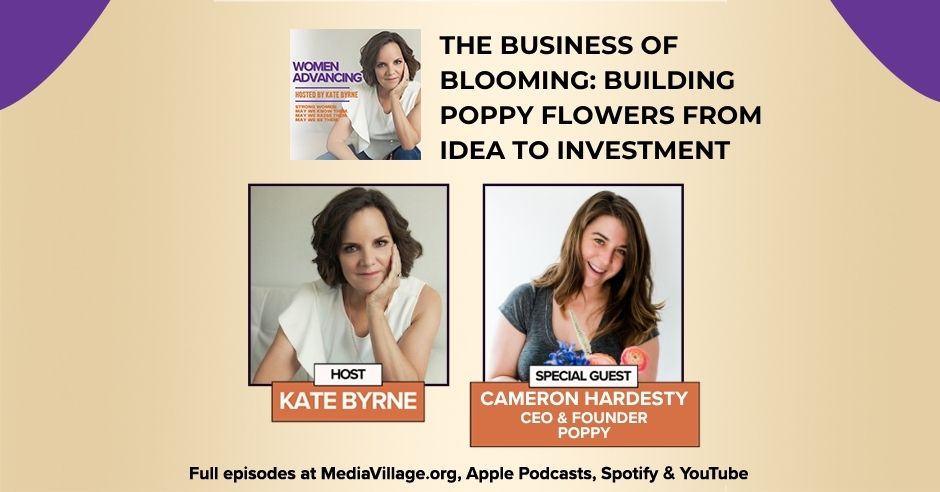
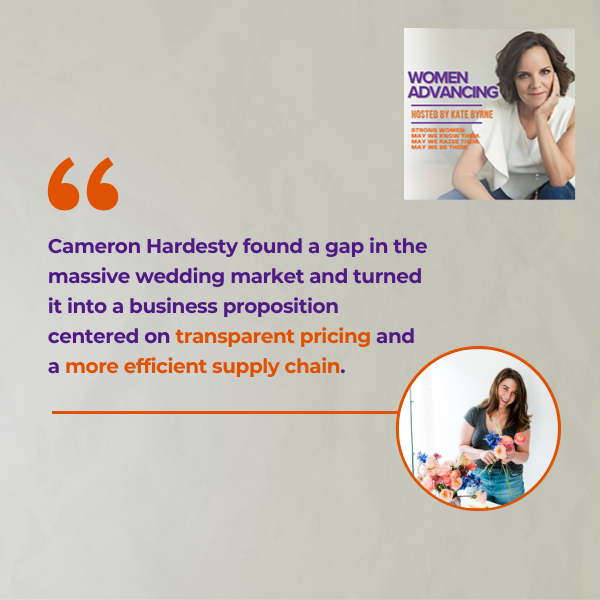
Floral design is the last big-ticket purchase you are making when planning your wedding. Although it may seem beautiful on the outset, it is downright ugly behind the scenes. When Cameron Hardesty was planning her own wedding flowers, she encountered unclear pricing, rigid minimums, sourcing issues, and manual workflows. After going through such a nightmare, she decided to turn it into a business idea. She joins Kate Byrne to discuss how she became the CEO and Founder of Poppy, a company that’s rethinking floral sourcing, pricing, and logistics using technology, transparency, and deep customer empathy. Cameron explains how she found her sweet spot to thrive in the vast wedding market, what it takes to modernize a legacy business, and how to navigate motherhood and a venture-backed company at the same time.
—
Watch the episode here
Listen to the podcast here
The Business Of Blooming: Cameron Hardesty On Building Poppy Flowers From Idea To Investment
Our guest took a personal pain point and made it her business literally to fix it. My guest is CEO and Founder of Poppy Flowers, Cameron Hardesty, who was busy planning her own wedding flowers. We know what a nightmare that can be. When she realized something didn’t add up. There was unclear pricing, rigid minimums, manual workflows.
Honestly, an experience that for everybody involved, be it the couples, the designers, the growers, wasn’t working for anybody. Let’s face it. The wedding industry is built on beauty on the outset, but behind the scenes, it’s seriously anything but. It’s downright ugly. Instead of accepting it, she took the situation and built a company out of the market gap she knew all too personally.
Poppy is a company that’s rethinking floral sourcing, pricing, and logistics. The whole thing was designed through using technology, transparency, and deep customer empathy. As a result, customers get ease of mind, wallet, and beauty on one of what is one of the most important days of their lives. We’re going to talk about what it took to modernize a legacy business, redesign supply chains, blending tech and craft, and building teams with culture.
Frankly, dealing with leading a venture-backed company while navigating motherhood and a few other life’s big transitions. It’s not easy, but Cam makes it so. This is a conversation about building businesses that sure change markets, but doing it on your own terms. Indeed, a thing of beauty. Stay to the end for KB Takeaways. Let’s dive in.
Welcome to yet another fabulous conversation with such a bad-ass, smart, soon-to-be mama of three, CEO and Founder Cameron Hardesty of Poppy Flowers. Cameron, thank you so much for making the time. Especially you’re weeks away.
I’m 38 weeks pregnant. Thanks for having me, Kate.
My pleasure. Everyone, the reason why I’m focusing on that might seem a little over the line. The reason why is to see how strong we are, seriously. Cameron has just been amazing to watch. Find a gap, find this market, and just create this massive market. I’ll let her talk a little bit about this notion of the gap that became a business.
It’s so appropriate that you brought up the pregnancy because more than half of our team are working moms. The moms are making it happen at Poppy.
Turning A Gap Into A Business Idea
There’s a lot of interesting and exciting new efforts to support moms. We, at Women Advancing, are going to be sponsoring a screening of a movie of a Whole Mom Movement. That’s a separate thing altogether. I’ll tell you offline. Let’s look at this whole notion of the gap. It became this business.
You’ve often said that what inspired Poppy was planning your own wedding flowers and realizing, “This is both expensive and so opaque.” I went through this with my daughter. We ended up doing our own thing. What was the exact moment when you connected those dots? Between personal frustration like, “I can make this a seriously scalable business.”
It goes back even further than that. There were breadcrumbs along the way. Before I got engaged and we got married, I started working at UrbanStems. Wirecutter just named them the top flower delivery service. If you’re looking for Valentine’s, Mother’s Day flowers, check out UrbanStems. I was one of the first executives there.
I remember coming in and seeing our seed round deck and realizing we were pitching this entire industry as our opportunity. We were not even addressing a big chunk of it, the wedding and events category. Even before I started, I came in hot with, “We got to start doing weddings.” This is a big opportunity because all my friends were getting engaged and planning weddings. This was 2015-2016.
Florals were always a pain point for them. I’ve been in the industry for ten years. I understand why. Florals are the last big ticket purchase you’re making when you’re planning your wedding. You’ve already spent 75% of your budget on other big ticket vendors. You get to florals. You think, “How much could it be, $1,000 or $2,000?” No.
If you’re planning a wedding of a certain budget level, you’re going to get sized up. You’re going to get sent proposals that are $10,000, $15,000, $20,000, or $25,000. There’s a lot of sticker shock associated with that. My friends were going through that at the time. I remember there was a friend of a friend who paid me to just consult with her on what our flowers should cost.
I’m like, “People are looking for them in the dark.” They are. It’s the first time that you’ve ever spent this much money on flowers. It’s probably the first time you planned a wedding. I could see that there was an opportunity. I could see that on the customer side of this transaction, there was a lot of opacity, price confusion, and sticker shock. It would be helpful to have someone to navigate this.
Before I got married and I was at UrbanStems, I was one of the only flower people at the company. I would go to floral design workshops to help improve my skills and stay on top of trends. Every time I went to a floral design workshop, there was at least half a day dedicated to not how to be a designer and artist, but how to run a business.
Pricing and profit generation were the two biggest issues that floral designers had. Also, educating their customers about why they should be willing to spend as much as they’re being asked to spend. I kept hearing the same issues over and over again with floral designers and realized, “Customers are saying this is so expensive. Why?” Floral designers are saying, “We’re struggling to turn a profit. We don’t know how to price our products and services.”
Pricing and profit generation were the two biggest issues that floral designers had. Share on XIt sparked the idea that there’s something broken here in between the two sides of this transaction. When my husband and I got engaged, like every other bride, I was trying to stick to a budget. The wedding was being considered for Martha Stewart Weddings, like real weddings. Every little design decision that I made felt important because I wanted it to be good enough for Martha Stewart Weddings.
I figured the highest leverage decor opportunity that I had was flowers because I did all the buying for UrbanStems. I knew how to buy from farms, which saves 50% to 100% on cogs. I don’t know if it was 75%. I started reaching out to these farms. I put together my plan, walked through the venue a couple of times. Put together the plan of what I wanted to create, built out what we call in the biz recipes.
Whenever you have a centerpiece or a bouquet, you write a floral recipe. X many roses, X many ranunculus. All of that builds up to a purchase order. I was doing that work. I’m getting to the moment where it all clicked. I was going to DIY it because I was like, “I’ll just do it. Fine. I know how to do flowers.” Me and one other gal.
I realized closer to the day that I had ordered basically two truck pallets worth of flowers. It would have taken me and the other gal a whole week just to cut them and put them. Not enough throughput between the two of us. I reached out to the Martha Stewart Weddings editor in a crisis like, “Please put me in touch with any floral designers you know in Austin, Texas.” Which is where we’re getting married.
She connected me with a few. When I brought those gals into the warehouse, where we were putting everything together, the flowers that I had bought from the farms. They were executing on these designs I had written out in Excel. I started running the numbers as I was walking around supervising everything. I realized based on industry standard pricing, what we’re doing here would cost me about $25,000 if I had gone with a florist.
My actual costs, including flowers and labor for five designers, was about $7,000. I thought, “You could still make a healthy gross margin and save people $10,000.” That’s where I realized, “This might be the basis of what a business model could be to start to bridge the gap between people who want a luxury floral experience. They’re not willing or able to spend $25,000 plus on their wedding flowers.” It was in a warehouse in Austin way back when.
Rethinking Sourcing From Farms And Building A Logistics Model
I know that’s one of the things. You’re a big value prop. It’s transparent pricing in a way more efficient supply chain. How did you approach rethinking sourcing from farms and building a logistics model? Which is all that unsexy stuff, but I swear to you. What I have learned in past life, that’s always where the magic is. If you do that, it’s sticking with it until you figure that out. Especially in an industry where you’ve got a bunch of very manual workflows. It’s old school. It’s working with an abacus, I’m kidding. How did you do that?
That part felt like a cheat code because I had been doing that work for UrbanStems. When I came to work at UrbanStems, we had one supplier. There was a wholesaler in Silver Spring, Maryland. We were getting some discounts because of the volume that we were buying at. We still had to pay a wholesaler markup.
I just started learning about the industry. The first book I read was Flower Confidential, which outlines the whole floral supply chain. I realized every time someone touches a flower, every time it stops at a warehouse, you’re adding cost. If you can reduce the number of touches in between when the flower is cut and when it’s delivered to the customer, then you’re going to reduce your costs.
Every time someone touches a flower, or it stops at a warehouse, you are adding cost. Share on XThe more time that people spend in the United States handling the flowers versus in the countries where most of the flowers that we buy here are grown, the cost difference is astronomical. Very early on, I realized you want to buy as much as you can from Colombia and Ecuador. Which is where 85% of the flowers are, like bananas or coffee. There aren’t any farms here.
Most flowers are grown in climates where they can be grown year-round. You want to buy as much as you can from there and bypass wholesalers where possible. You can’t always bypass wholesalers because there’s a value to what they’re doing. They’re consolidating from lots of different countries and states and all over the place. For the most part, most of what you need, you can buy from farms in Columbia and Ecuador.
I did that. I set that up. We started with a wholesaler at UrbanStems. By the time I left, we were buying from fifteen vendors all over the world. I built those relationships. I traveled to Ecuador. I had the best job. I got to travel to Ecuador, Colombia, California, the Netherlands. It was so fun. When I left UrbanStems, I was burnt out. I wasn’t even sure I would start another flower company. I’m off and realized this is my passion. It’s my network. It’s an industry I know well. That part was easy, knowing where to buy the flowers and how to buy them. I applied the same principles that I had learned and applied before.
How Poppy Combines Tech-Driven Efficiency And Creative Hands-On Product
Which is awesome to make it yours. Think about it, everybody. That’s your penultimate. How many times have we been in jobs that we absolutely love, but deal with some of these other people? You have the smarts and the wherewithal to be able to do it on your own. One of the things that I like about Poppy is your use of digital tools. You’re in the mood boards. I’m a sucker for an Insta board with floral design and logistics. What was the most surprising tension, or even breakthrough when you’re marrying this tech-driven efficiency with this deep creative hands-on product like flowers? One’s opposite ends. It’s tech and old, cold and warm and luscious floral.
I was the floral designer for some of my friends’ wedding flowers. I understood the process of how to do it with very little or just off-the-shelf tech products like Pinterest and whatever. Poppy’s process is not that different. The difference is that we have a catalog of products that are pre-priced, pre-recipied, and pre-sourced.
We know when we’re selling the product how much it costs us to fulfill it. That’s the unlock because most florists are selling something they don’t want to put a lot of work into recipeing out the design until they know that it’s been sold. By the time that they’re making a proposal to a customer, it’s a price range that they’re on.
As a customer, you’re having to agree to that knowing that it may go up if you make changes. As a florist, you’re taking on risk, too. You’re locking in price on costs you’re not going to know for months. The cost of flowers can fluctuate based on supply and demand and what’s going on with the weather. Florists address that build in a buffer and their pricing, which inflates the price. Not because they’re greedy, but because they’re trying to protect the downside that’s just baked into their business model.
We buy from these farms and our volume is high. We can predict what our inventory is. We can forecast what we’re going to buy in the future. We can lock in better pricing and know what our costs are going to be. That’s the unlock for us. We have a team of floral consultants that are all ex-floral designers that work for Poppy full-time. They’re the lead designer for our couples.
They’re working inside of our platform. The couple who works with Poppy has a floral consultant that is their person who’s their floral designer and making sure their vision comes to life. They’re working within a more defined universe of things that can possibly be sold. The costs are known at the time they’re quoting the prices which lets us be way more accurate on pricing and offer better pricing.
Which is fantastic. It’s also just a huge trust. You just feel so much more comfortable. Honestly, not that you’re doing this. Someone’s going to say, “I know you like this flower but this could add just a little bit of elegance for an extra dollar per stem.” Upselling could be perhaps even a greater opportunity. Not that that’s what one would do. If you did, I’d be more likely to go, “I could do that.”
Our most successful floral consultants take the opposite approach. “What’s your budget? Let me work with you.” Almost every other florist you encounter is trying to upsell you. The other functional difference between our business and most of our competitors, who are small businesses. We have the capacity to deliver thousands of weddings every year.
Most florists are trying to maximize the dollar value of every single wedding they get because they’re going to max out at 50 weddings. Most people don’t become floral designers to be flower factories. They want to be artisans. They’re trying to reduce the number of weddings rather than increase. The mechanism of this industry is when you enter the industry, you start low. Everyone’s trying to just move up market as quickly as they can.
That leaves a lot of churn for our customer who wants to spend $4,000 or $5,000. Before, $5,000 just barely gets you in the door with most florists in the Top 20 NFL cities, let’s say. That’s our sweet spot. It’s refreshing as a differentiator for couples to work with any wedding vendor that is genuinely trying to stick to their budget.
Building An Effective Culture In A High-Touch Service Business
On that end, culture and trust are huge in being successful, both obviously externally, but internally. We all know the external reflects what’s going on inside behind. What’s your philosophy on leadership when you’re building these teams? It is so distributed. It’s such a high touch service business. To your point, you don’t want to have a lot of churn.
We see it in our NPS when we have floral consultants’ turnover. We want to invest in the good people that we have and keep them with the company for a long time. I’m sure you’ve done strength finders. I have to, both my parents are psychologists. I’ve been in these frameworks for a long time. One of my top strengths and one that I like to look for especially in sales is competition. Drive, competition, intensity, and obsessiveness is important. It’s easy to measure a salesperson’s performance. It’s the easiest thing to measure.
Talk about transparency. It is obvious.
You can tell when you’ve got a goner on the team. The industry that we’re drawing from, for most of the jobs that exist in Poppy is the floral and wedding industry. In my experience, by and large, people who get into that industry and stay in it for as long as it would take to be qualified to work at Poppy are hardworking.
You have to be to run your own business in this industry. Genuinely good people who want to make things look beautiful and work for couples. We’re lucky because it’s a baseline in our industry. I’ll tell you, I can’t say for sure I would start a remote company again. It was an outcome of having started in January 2020 and scaling the team during COVID.
You have to be able to run your own business in the floral industry. You need genuinely good people who want to make things look beautiful and work for couples. Share on XThat is why I started hiring people in other places because everyone was working from home. There wasn’t a vaccine yet. No one knew what was going on. I still had to build this company. Knowing what I know now about how hard it is to build culture remotely and the administrative costs that come along with hiring in multiple states. I honestly can’t say I would do it again.
I will say, a thing that has made a huge difference is getting the entire team together in person. It’s expensive. We do it once a year, the whole team, but we did it. We had our second Annual All Team Meeting in December 2025. In 48 hours together, the amount of bonding, emotion, feeling, and connection that came out of that time was so impactful. If we could do it more than once a year, it’d be awesome. That’s been a real game-changer for us. We’re meeting in pods regionally as much as we can.
Finding The Drive To Move Forward Since 2020
I was going to say, in one way as great as it would be, the fact that you only do it once makes it so much more special. Once people experience that, they completely show up. I have to ask. Starting in January of 2020, what kept you going? That is a rough time. Was it just that, “I’ve put my foot in the ground, we’re doing this. I’ve put a stick in the ground. I’ve got all these people and their families counting on me.” That had to have been exhausting.
The second part I didn’t have yet. I had one employee. It was me, another gal, and one contract engineer. I remember. This might’ve been March or April 2020. I had raised a small amount of angel in friends and family money, probably $200,000 or $250,000 going into it. We had a little bit of money in the bank.
We didn’t have any expenses. We didn’t have rent, didn’t have payroll. I wasn’t paying myself. I was paying someone part-time. It would have been easy to just give the money back and said, “This is crazy.” I remember calling, he is a Stanford GSB professor, Steve Ciesinski. I called him. I remember I broke down crying. I was just so overwhelmed and didn’t know what to do. He was like, “Cam, you don’t have to do this. It’s okay. Everyone would understand.” I remember thinking, “That didn’t even cross my mind. I’m going to do this. I’m not going to quit.” I had spent, at that point, five years working toward this.
You’re so committed. You’re in now.
I went to work at UrbanStems and I could have done something else. I knew that going into it, I wanted to start my own business on the other side. I had just gone through my very first fundraiser. It was so hard. It was so draining. We finally had an opportunity to build this thing that was in my mind. I’m very driven. I have my little picture back here. I played D1 soccer, that was me.
Fabulous. Look at you go.
This is my grandfather and then his brother. They played at SMU in West Point. Having that experience of being an athlete for so long, I’m very driven. I don’t know how to give up. I was like, “I’m not going to give up now.” I didn’t have kids yet. It’s like, “What else am I going to do?” It was hard. It also caused me to make decisions about how to grow the business that I might not have made otherwise. That’s what happened. It was COVID. It was the block sum of it.
There’s also something where then that might force you to pivot. Has there been a pivot that you’ve got to make? Share a little bit. Was it hard to decide? Was it like “Feet to the fire. I’m totally doing it?”
It was easy.
It was a no-brainer.
We hadn’t made a big investment in building the business yet. We hadn’t made a big tech investment. Small ones, but I remember March 2020, as everything was going down. PPP became a thing. I was in Founder groups. Everyone was trying to figure this out. We were spending a couple of days trying to figure out PPP, whatever.
I thought, “This is a waste of time. Let’s make our money. Let’s just make money differently than we thought we were going to.” I spent years selling flowers online. You got to know how to do that. We pivoted in April 2020 to selling at-home flower arranging kits that we called Poppy at Home. We did that until May 2022. In 2021, it was neck-and-neck with our wedding business.
Eventually, I knew that we would wind it down and refocus. What COVID did was it dumb tested my resilience. It got me to be creative, but it also feels like we lost a couple years in building the thing that I had set out to build. Weddings just didn’t happen for a year and a half. In some ways, it was good that we pivoted because we kept everything warm and moving, but I felt like we lost some time in building the thing that I had set out to build.
Gathering Serious Investors For A Hardcore Tech Business
That’s the thing that happens sometimes. I’m not saying this is you. Sometimes, people either have such a vision of an idea and/or they are just fricking stubborn. It’s like, “I swear it’s going to work this way.” Until literally you realize, “It’s not going to work this way. I got to do otherwise.” You mentioned investment. Talk to me about that. Has it been hard? It’s hard for women anyway. If you’re doing a hardcore tech business.
I would imagine for this, did people take you seriously? On the one hand, I could see them going, “I’m not being dismissive of the business. It’s obviously amazing.” I can imagine how some with smaller minds and narrow minds would say, “It’s a nice little flower business. I’m not going to put any money in that. There’s no money in flowers.” On the other hand, someone who’s had personal experience realizes that is such an untapped market. Huge money in that. What has the experience been?
I came into this with a good understanding of the venture ecosystem. Pretty good because I had been at a venture-backed startup. My best friend worked at the National Venture Capital Association. I understood how it all worked. In terms of Founder Market fit, you couldn’t ask for a better founder market fit than me in this business because of my experience in the floral industry. I had those two things going for me.
That said, the math of the potential exit for Poppy and the timeline just doesn’t pencil out for a fund that needs to deploy a billion dollars or whatever. I spent a lot of time talking to funds that were too big or had seen or invested in UrbanStems. The Brooke’s Bloom, which was one of the early ones, H. Bloom. They were a crop of well-funded, venture-backed startups that focus on floral gifting that hadn’t been a hit yet. If you were a fund that saw one of those deals, and you passed. You just look at this business and you’re like, “Whatever. I don’t do flowers.”
It hasn’t panned out yet.
I knew that the business model was different, but it has taken time for a venture.
Venture’s a venture.
They go in groups. They follow each other.
Cohorts in class. They follow wherever the other one does. I don’t mean to sound derogatory. Sometimes, it reminds me of a young group of kids playing soccer. There’s one that goes there. Everybody goes to that, and then the other kid goes. That’s what I imagine. It’s like, “I don’t want to miss.”
If I had been a mercenary for fundraising or I just want this to be something that VCs can understand and invest in. I would not have picked flowers at the end of a ten-year venture cycle that was exploring this category and deemed to be unworthy. I wouldn’t have picked weddings because weddings are notoriously difficult for VCs to invest in.
The fact that I’ve raised as much as I have is a bit of a miracle. This business needs to exist. I have such high conviction and the opportunity because I’ve lived it for so long. When I hear floral designers, whether they’re excited we’re doing this or they’re begrudging. Many of them are like, “This is right. This is needed.” The people who understand the industry get it. It’s a big enough industry that the right size fund can underwrite a rational outcome.
The funds that have made sense for Poppy are Idea Fund Partners who is based in Durham, North Carolina. They have invested in a couple of funds, but they’re not raising $500 million and billion dollar funds. They can underwrite an exit that is rational for this business that could return their fund. Michigan Capital Network Series A, similarly sized. Again, they’re underwriting an exit that is possible for Poppy that works for their fund economics. I have found that high conviction, independent thinking, and more regionally-focused venture funds have been a good fit for this business.
High conviction, independent thinking, and more regionally-focused venture funds are a good fit for the floral business. Share on XIt’s so interesting because since I started fundraising in 2019, the venture industry has done a complete turnover and Q1 2022 deals dried up. The whole industry had a reckoning. We have enough time since then where I’m seeing funds that are looking for businesses like ours. I’m getting inbound from funds that are $225 million more.
That is looking for niche tech-enabled services businesses like ours. The venture industry has also, to some extent, had an opportunity to self-reflect and tweak the types of businesses. AI is its own thing. They, since 2020, have been a bit of a reckoning. New models are emerging that still rely on LP as an institutional capital, looking for not unicorns, but for purposes.
That is going to be much more potentially reliable. Which is great because it’s more sustainable in the long run for everybody. It’s just healthier.
It’s less like gambling and more like investing.
Cameron’s Advice To Her Younger Self
In closing, my friend, knowing what you know now, what advice would you give your younger self?
How much younger?
However you want. Let’s do your Division I soccer gal. Let’s also do you in 2014, the year before you said, “I’m jumping into the pool. I’m doing this.”
When I was 20, 21, I was in college. I didn’t know what my options were in entrepreneurship. I graduated in 2007. Davidson, where I went to school, has an entrepreneurship hub. No one was talking about startups or entrepreneurship when I was graduating college. I would tell myself, “You have more options than becoming a lawyer.”
Thank God.
I thought my options were lawyer, journalist, or poet. Those were the three things I was thinking I would do. I would have just encouraged myself to explore and probably talk to more people, a broader range of people. I think I did a pretty good job of exploring in my early twenties and learning. I’m proud of myself for that.
In 2014, there were moments where I just thought it’s so funny. I interviewed for a job with the woman who went on to be the chief-of-staff or chief communications officer for Harry and Megan. She was working for Melinda Gates for her new venture firm. I was interviewing for that job. I was a final three candidate, went to New York, and met with her.
I remember thinking, “I just want to work at UrbanStem. This is what I felt called to, even though this feels like a more prestigious or sure thing.” I remember telling her in the interview, “I’m here because it’s Melinda Gates, but I have this other thing I’m probably going to do.” Which I probably shouldn’t have done.
It’s funny. Before I started Poppy, I had a very similar experience where it was a communications role for a venture firm. It would have paid me so much money. It would have been great. I just remember thinking I just feel so called to do this other thing. The advice I would have given myself in 2014 is to trust your instinct.
You may think that money is the primary motivator, but being totally utilized, fulfilled in your work. Fulfilled and consumed. That’s the thing you care about the most. You will be fine. The universe will provide for you. You’ll be okay. People say, “Follow your passion and the money will come. That’s not always true. I would have told myself, “You’re going to be happy if you choose this path, so just do it.”
The truth sometimes that happens is if you don’t do it, how are you going to feel? Twenty years later, this weird gnawing thing and you’re just, “Still, it’s bad.” You’re either going to do it early and go to town, Charlie Brown, like you have. You’re going to do it 40 years later as your son’s heading. It will come back. I swear to you, it does. It happens like that. It just does. If it’s something that I think you are intended to do.
I thought about that. It’s so easy and can feel comforting at the time to hide your light and just follow this path that seems like the right one. People will question you when you’re making different decisions. You’ll question yourself because you’re not hitting the same milestones as your friends on the same timeline. Making those comparisons has felt hard sometimes, but we caught up. I’m not having a midlife crisis because I’m fulfilled and consumed. I can’t imagine the regret that I would have if I hadn’t done it. You can’t go back and change that.
The truth is that when you’re feeling that way, the mothership literally is that fulfilled. 1) You’re in flow. 2) What a great, fabulous role model for your little ones. When you are happy, I swear to God, everyone who’s reading, you know this is true. Everything else around you is. The family crew, you’re good. You’re the hub and the glue. Everything feels just better.
It’s hard. I want it clear. The amount of stress, uncertainty, and risk that you have to get comfortable with this. Most people will never understand it.
Until you’re in it.
I still think it’s worth it. To feel long-term, you’re in an aligned life path.
It is true because when you’re not, you know it. I can tell you that feels grosser. To your point, about listening to you and doing it, more often than not when you are and you’re just motoring along. Singing your song, doing what you’re meant to do. There will be so many people who may have comments, say you’re crazy. Maybe for them, great.
For me, this is what works. I found often it’s because they wish they’d done the same. They want to do the same. They don’t know how to do it. Mark my words. A year, two years, three years, seven, they will come to you and say, “How did you do that? I think I want to do this. Does this make sense? Is this an idea?” Stay your path. Your path is just that. It’s your path.
The older I’ve gotten, the more I’ve come to accept if you just keep putting one foot in front of the other, doing the right thing, acting with integrity, and staying aligned. The world shapes itself around what you’re doing.
This will be just my last thought on this. When you do that, that’s the culture that you have. Your entire ecosystem, be it your employees, the vendors, your business partners, your investors, your customers, and your family, all of that is so much happier and healthier. That’s good. If we could have companies that were able to acknowledge and take the responsibility of having that impact, that’d be great across all industries.
It ripples out to your employees, how they feel, how their families feel, and how they show up in the world at all matters. It starts from just being aligned and making it an outer world match.
Your business culture ripples out to your employees, how they feel, how their families feel, and how they show up in the world. Share on XIn this day and age, all the multiple generations across geographies. That thing is also what helps shift generational experience moving forward for that broad base. Not everyone has the same opportunities, all of a sudden, they do. Look what they do with them. Cam, thank you so much.
This was so fun.
I’m so excited. Everyone, go check out amazing, beautiful offerings. I’m just so glad you said yes and that you keep saying yes. You keep taking that one step in front of the other. I can’t wait to see what happens with Poppy next.
Thank you for your support.
Big love. Until our paths cross again.
Thanks, Kate.
You’re welcome.
—
KB Takeaways
I just love Cameron’s story. It’s been fun to watch her just grow and literally, blossom like a flower. Some key KB takeaways to me. One, she figured it out and found her sweet spot. That can be from a market standpoint. It can be from what your unique selling proposition is. Once you figure that out and focus on that, don’t stray from it. You’ll go incredibly far and have great growth.
Second, dig into some of that nitty gritty operational stuff. That, I swear to you, is efficient, a time saver, a huge money saver. It improves the customer and employee experience immensely. I would say, figure out from funding. Everybody thinks they want to go and work with certain size funds. You’re not ready for it yet, or it’s just not a match. Take a step back, do your homework, figure out what’s going to be a more likely yes. That’s going to result in a greater win moving forward. It makes it, frankly, less like gambling and more like serious investing. Go for smart capital, not just money. That’s for sure.
Remember, you’ve got more options than you know. If something doesn’t feel right, don’t be desperate. Hold off because I guarantee you. By not jumping at that option, there’s an amazing one right around the corner from it. It just is the way the universe works. Sorry, not to be juju. I got them for Generation California. What can I say? With that, thank you so much for joining Cameron and me in this conversation. I look forward to the next one. Until then, take care. Stay warm.
Important Links
- Cameron Hardesty on LinkedIn
- Poppy Flowers
- UrbanStems
- Flower Confidential
- Steve Ciesinski on LinkedIn
- Idea Fund Partners
- Michigan Capital Network
About Cameron Hardesty
 Cameron Hardesty is the CEO and Founder of Poppy. Her path to entrepreneurship began in the basement of The White House, where she discovered a passion for floral design while volunteering under Chief Floral Designer Laura Dowling.
Leaving her government job to pursue creativity full-time, she joined a leading floral startup, UrbanStems, and helped scale it into one of the nation’s largest e-commerce flower companies.
When planning her own wedding, Cameron saw firsthand how outdated, costly, and confusing the wedding flower supply chain was – so she sourced blooms directly from farms and worked with independent designers to bring her vision to life.
Inspired by that experience, she put her background in tech and supply chain to use, founding Poppy to modernize and simplify event florals.
Today, Poppy is the largest full-service wedding florist in the U.S., with a proprietary e-commerce platform tailor made for the wedding industry, more than 6,000 happy couples nationwide, and a growing network of 1,100 vetted local designers.