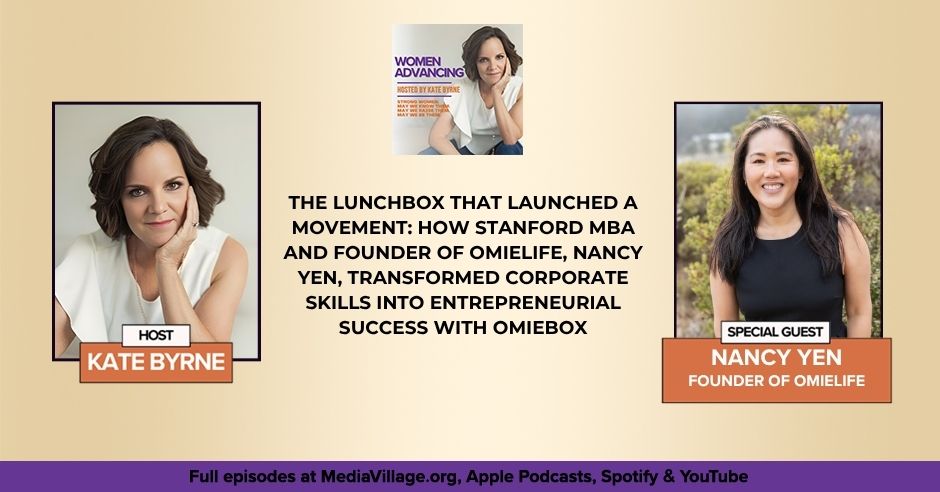
What does it take to turn a personal frustration into a journey of entrepreneurial success? In this episode, host Kate Byrne sits down with Nancy Yen, the Founder of OmieLife, to share a great founder story about her transition from a corporate career to founding her own company based on answering a problem she personally faced. Nancy breaks down her unconventional path from corporate roles at the Gap and LexisNexis to launching the wildly popular OmieBox, an insulated bento box designed to solve a daily struggle for parents everywhere. You’ll hear how she navigated manufacturing hurdles, ignored early rejections, and stayed true to her vision. Her commitment to solving one real problem well eventually led to a massive milestone: Target called her, asking her to be the lunchbox special for their back-to-school efforts across the country. Join us for this masterclass in persistence and turning corporate skills into a retail movement.
—
Watch the episode here
Listen to the podcast here
The Lunchbox That Launched A Movement: How Stanford MBA And Founder Of OmieLife, Nancy Yen, Transformed Corporate Skills Into Entrepreneurial Success With OmieBox
The Inspiration Behind OmieLife: Solving The Lunchbox Problem
“It’s Target calling,” those were the words. You can imagine how they must have landed a founder entrepreneur. My guest is Nancy Yen, founder of OmieLife. The company behind the wildly popular OmieBox, which is the first insulated bento box designed to keep hot and cold food together in one container for lunch boxes. It has changed and altered the lives across the country. The thing I love about this is, many years ago before that call, Nancy had gone to Target and they said, “Sorry. We’re not interested.” Years later, it’s Target calling. That’s extraordinary.
This is the story about a founder who has an extraordinary collection of career chapters that culminated in giving her everything she needed to make this business succeed. We’re going to talk about gnarly things like manufacturing and what to do, because it wasn’t an overnight success. The importance of persistence and willingness to stay with the problem. It’s about entrepreneurship, grounded and true observation and the guts and the grit to stick with it. Next thing you know, maybe Target will be calling you. With that, let’s listen to Nancy. It’s an amazing conversation. Plus, some great KB takeaways, if I do say so myself.
Women Advancing readers, you are in for such a treat. I’m so excited and it’s so fun when you meet someone that, on paper, you already respect and when you’re in conversation with them, you realize, “We have so much in common.” This is the case with our guest Nancy Yen, who’s the CEO and Founder of OmieLife. We’re going to talk about how she recognized a market need and filled the gap. It sounds like a textbook but it’s hard. It takes a lot of discipline and the power of solving one real problem extremely well. Wait until you hear how well she’s done it. Nancy, welcome.
Thank you, Kate. I’m so happy to be on the show.
It’s such a great time. I’m going to go right on in because I feel like I’ve done enough of a teaser and I don’t want to keep people dangling. It’s such a tremendous founder story. OmieLife, all started as a personal frustration as a mom. At what point, how did you decide, “If not me, then who?” This wasn’t just your problem. A lot of people when you were talking to them were having this. Maybe there’s this huge market gap and you could be the one to fill it.
That’s right. It all started when I was packing lunches for my then preschooler. He was not quite three. He’s always been on the smaller side. We’re always very worried about him not having enough nutrition. Sure enough, he went to school and he was eating any of his lunch. I would go to school just to help him but at the same time, observe how he ate, how the children ate, and how they interacted with food at lunch time.
I realized there was this huge unmet need in the market that there hadn’t been a lot of innovation in the space since we were little kids. It was for something different. That was what gave me the impetus to start thinking about what a new design could be and partnering with different people and doing a ton of market research to see how we could bring this to life.
Which is fabulous. I want readers to know is, I love Nancy’s background because if you were to see it on paper you’d go, “There’s a little here and there.” It’s not necessarily linear but it’s created the perfect ingredients for this company that has gone on to become this powerhouse showstopper. Talk a little bit about that. As we were talking, you’ve got the discipline from Goldman Sachs and understanding of financial situations. You’ve got Lexus Nexus research and all of that. You’ve got Gap, Old Navy, which alone in the retail world is such a blue chip brand in and of itself. You’ve got the whole retail aspect. How did you build and make these ships? Tell that story.
Career Stacking: How Corporate Experience Fueled Entrepreneurial Success
I wish it was so thought out. It wasn’t. It was very accidental, but it worked out at the end. Right after college, I went to work for a consulting company in Boston for four years. That was such a wild ride. We learned so much and it was very intense. I worked on projects for like AT&T for the lottery system. I worked in Brazil and Korea. It was just Business School 101. I learned everything I needed to learn for a business school from those four very important years.
That gave me a lot of basic knowledge about doing market sizing, doing consumer research, and finances. It was a good primer, then I went to business school. After that, I thought I’d have a short stint at Goldman. I was curious about that world, but it wasn’t for me. I wanted to work with products and so, while all of my other classmates went and did pretty important things. I went to the Gap and I was a merchandiser. I did a couple of functions there. I started as a merch planner then I did merchandising.
That’s usually a job for people who are like 2 or 3 years out of college, but I wanted to learn the ropes. I was in charge of the accessories department. Later, girls wovens where I did all the denim and also the Easter dresses. I learned so much through that process. Anything from, as you’re saying about Steve Jobs and the calligraphy classroom. It taught me that aesthetics was important, what is beautiful and how to make beautiful things about running at the P&L like managing unit inventory buys and making sure you didn’t have access to inventory. It was things that I had never learned before from all the years of consulting or from business school. It was so great.
You can only learn that hands-on. You will be so less inclined to do so or one would be. Good on you for finding yourself there and diving in.
That was great. I did that for a few years and then I had a call from a headhunter to go to a company called Lexus Nexus, which is so random. It’s legal research, online legal research.
I know Lexus Nexus because of the advertising world. I smiled when I saw that. I’m like, “You’re kidding,” anyway.
How many people do you see coming out of Lexus? I ended up spending five years there. I learned a lot about the law. I’m not a lawyer, but in order to make products to sell to lawyers, you have to know a little bit. In my spare time, I would pull up some legal case laws or analytical content. I would read it so I knew what I was talking about. When I was there, I got deep into medical malpractice and ended up inventing a platform for medical malpractice research. I won the Cody Award. Which is so random because I’m not a lawyer and know relatively little, but I knew how to make a product.
That’s where from the Gap experience. You can quickly spot a market need and you learned how to get a lot of consumer insights in order to make something that people want. I was reading one of the episodes earlier about human centered design and that’s exactly what it is. It’s hearing out what people have to say. Observing pain points that they don’t even know that they have, and creating something that meets their needs.
It's hearing out what people have to say, observing pain points that they don't even know that they have, and creating something that meets their needs. Share on XIt wasn’t all that different creating the medical malpractice tool or designing accessories at Gap to creating an Omie box. It was the same muscles that I’ve been doing for the last ten years since graduating business school. It’s identifying the need and doing a ton of research in order to understand what people need. A lot of it is unspoken. In the early days of designing the Omie box, I would go to people’s houses in the morning as they’re packing lunch to watch them.
A lot of what their pain points are they can’t even articulate to you. It takes watching them take things out of the fridge and pack it into boxes. Sometimes I go to people’s homes after school to see how they would clean up and to understand their pain points there, too. That was all how I started. It’s shocking that everything that I had learned all this time through these random jobs all became so useful at the end as an entrepreneur.
Which is the thing that’s so fabulous. I’ve also got to say your timing is good too because I would think there’s a bit of a sustainability message, too.
That’s something we try to lean into. Over time, we explored different materials and always had an eye on sustainability. We launched some toddler plates and we’re using a material called PLA that’s made out of corn. It’s compostable at the end of its life. We’re always trying to learn more about how we can be more responsible and how we can push for sustainability in our products.
Which is so terrific. It’s just great for the planet. Thank you for caring. The other thing too, is it’s so terrific because there’s so many consumers. Your customers who do too and they’re more inclined. I swear everyone reading, the more we build things like this from that point, with the triple Ps, people, profit, but planet, the whole world would be so much better off. It just will. You’ll have many more customers coming your way because you’ve got that purpose aspect deep within its very core.
We do. It’s a very deep part of our DNA. It informs everything that we do as a company.
One of the things that has been most impressive to me is that it’s easy. The natural inclination is, sometimes you get started, you get this company and you’re like, “I want to do this.” You focused on this one very specific, every day pain point. What did you understand about your customer consumer behavior about parents that others just missed?
Parents pack lunches 180 days a year. When you have multiple kids, that’s a lot of lunches that you’re packing. It’s just like brushing your teeth. It’s one of those things that you do day in and day out. This sucks up quite a lot of time because you have to think about what you’re going to put in those lunches. You have to worry about allergies and whether they’re getting enough protein. You don’t want too much sugar and GMO.
There’s a lot of thought that goes through mom and dad’s minds as they’re thinking about this. Yet the container that they put their lunches in has evolved very little over time. I wanted to make something that would be easy for parents to pack. A lot of times, when you’re trying to think about packing cold lunches, there’s only so much you can do. When hot is introduced, then you can do last night’s leftovers. There’s just a lot more options when you have hot as an option.
That was something I knew I wanted. Another thing I wanted was that I noticed in my consumer research, parents would have to clean out a lot of different containers at the end of the day. It was important for me to lean into my Japanese heritage that we have a bento layout. That worked well for the kids. In observing the kids eat at school, I noticed that they would just open up the first container and eat whatever is in there and go off and play. Of course, they want to play. It’s important for everything to be visible all at once. These were the two things that we knew we needed to have from observing from talking to parents. We then went around thinking about how we can make it all fit together into one single product.
Navigating Product Development And Manufacturing Hurdles
I’m just sitting here smiling because I had done de facto a little bento boxes when the girls were little because I also just realized they want a little smattering and this and that. For me, at the time, it was before they were making little plasticky things. You ended up having like five different plastic bags. It made my little tummy turn about and I had to rinse. I was like, “I can’t make this a completely wasteful thing.” You booted strap, prototype, you failed, and redesigned. Talk a little bit about that. Was there a failure moment of misstep?
Lots of mistakes along the way. It’s foolish to think that you’re not going to make mistakes and you’re not going to have key moments of learning. If you expect that and you expect that you’re going to make mistakes and you’re going to fail. You can’t fail big. You make lots of small mistakes. There’s nothing to prevent you from making mistakes, but we tend to be very thorough. Before we embark on something, we do a lot of research to make sure we understand different angles and different perspectives.
The beauty of the entrepreneur world is that I find everyone is always so generous with their time and advice. In that way, I feel like it’s my responsibility to pay for a bag. If anyone asks me for advice, I never say no. It’s my duty to pay it back. There’s just so many people that you can reach out and ask questions to. You can gather as much information as you can. Ultimately, you’re making decisions with imperfect information. No one knows how something’s going to turn out. You just do the best that you can.
You go into it with your eyes wide open. If you take that approach, 90% of the time you’re covered with the big stuff. Now, will you make little mistakes? Yes. You make a million little mistakes every day, but what I do is I document those. I will write it down. At the end of every key milestone event, I make a recap and I write notes to myself in big bold font with emojis. It’s like, “In 2025, you blah, blah. Don’t make that mistake again in 2026.” That just becomes part of our library of learning for the entire company and those learning live forward on every single document going forward so we don’t make the same mistake twice. It’s just about how you bounce back from those mistakes and make sure that you never do it again. You will still yet make plenty of new mistakes and that’s part of the game.
Now, was there ever a moment where you’re just like, “I’m tired. This isn’t going to work?” What made you go, “Wait a minute. Come on now. Let’s do this thing?”
It’s exhausting being an entrepreneur and the times when you’re the only one who is shouldering, especially for me in the early days. I didn’t have a big team. I didn’t raise a lot of money. For a long time, it was just me. There are times where I don’t know how to move forward. There’s certain decisions that were a crossroads and I had to make a decision. There are times where I was like, “Why am I doing this? I can go get a regular job and be fine.”
It's exhausting being an entrepreneur. In those moments, the only people who will pull you out of those times are friends and family. Share on XIn those moments, the only people who pulled me out of those times were my friends and family, especially my husband who’s incredibly supportive. He’d always say, “I believe in your product. It’s very rare and there’s product market fit. I know it’s tough, but take a break and then persist.” Those words meant a lot to me and my friends, too. That’s what kept me going during all the hard times.
Which is great. It’s so important to people that can remind you who you are.
Exactly. It was a tiny person, which you may be as well. It’s easy for us to be hard on ourselves and not see how far we’ve come. Sometimes, it takes an outside person of all that you’ve accomplished and not all that you failed to remind you that, “You build something. It’s worth it to keep going.” That’s where having a supportive network, whether it’s your family, your friends, or your colleagues. That’s important.
I completely agree. Sometimes, when you’ve lost sight of it, going and taking half a beat, half a day or whatever that one, it’s like, “How can I do it?” Believe me, you can because if you don’t everything will literally crush and burn.
You just need to take a step back.
You talked a little bit about the whole corporate thing. That’s part of it. You had corporate experience and a little bit of entrepreneurial experience. It’s this combination, and you’ve created a product within a corporate situation. You’re an intrapreneur. What do you see is the biggest difference between innovating versus just going, “I’m heading out. I’m betting on me, baby?”
Intrapreneurship Vs. Entrepreneurship: Understanding The Founder Journey
Many differences. When I was inventing the medical malpractice research product, there are so many stakeholders. We knew we had something that was game-changing on our hands. One of the requirements is that you had to go to each head of sales and say, “Will you sign up for this quota to sell this product?” They didn’t sign up for that. That’s adding extra pressure on their sales quota. We got a lot of push back like, “This isn’t a fit for us. We’re not going to sell it.” You’d have to go to these meetings with the CEO and each sales team would have to weigh in.
You have to say, “I want this money to make this investment. This is how much money we can make and it’s been bought on by the sales teams. They’re going to be responsible for delivering this revenue.” I had one meeting where one of the sales teams said, “I’m not taking this on.” It took one sales leader to stand up and say, “This is the best product this company has seen in the last several years. You’d be foolish not to do it.” He said to the CEO during a meeting. I was so grateful for him for saying that.
Sometimes, it takes an outside person to remind you that, ‘You built something. It’s worth it to keep going.’ Share on XEven then, it still went through a lot of hurdles to get it approved. Sometimes, in larger companies, there’s more accountability. It’s a little bit harder to move quickly. There’s a lot of buy in that you have to get from the different stakeholders. Whereas, in Omie, we have millions of ideas at any given time. It’s not about getting approvals to do it. It’s just we don’t have enough bandwidth. It’s fun to talk about whatever new thing comes on and not have to go get approval for it.
That’s what I was going to say. Also, in the corporate world, you’ve got all the political capital, social capital, trust capital, and all the capitals that everyone is trying to figure out and keep track of. Is this worth it? Is it not? Much more self-inflicted too, like, “How will this reflect on me,” as opposed to, “Is there a real need?”
It’s true. I was never very good at playing those games. It’s tough.
I know. Having done it, I am with you on that. I’m glad I learned a lot of lessons. I’m glad that part’s done for me, quite honestly.
It’s very inefficient.
I agree with you. Building a product and doing manufacturing, and all of these things. What advice to you have for folks who are reading who are getting ready to do that? To me, I would have gone to that starting line, looked at that steep hill and went, “I’m not going to do that.” Where did you even begin? You did have the experience from Gap and such and from Lexus Nexus. What advice would you give and how did you? It’s different when you’re in a corporation versus a little old you.
Manufacturing Strategy And Strategic Networking
I do want to dig into manufacturing because that’s been something that’s very important for our company. I will say that every entrepreneur starts with a conviction. They might not have proof yet, but they have a conviction. That conviction is what gets you to start this thing, which in itself is like a very haphazard journey if you think about it. You have to believe that you have something that is meaningful to you and to the world. That belief will carry you. That energy, that momentum carries you into doing many things that you never thought that you had to do before.
Those tail wins will help you learn about manufacturing, setting up a website, reading some legal documents for incorporation, and negotiating the sales contract. I think that’s what every entrepreneur has to have in order to have the energy to pursue all the different things that you need to do as a founder. I think that’s what I had. Maybe it’s a bit of foolish dust like not knowing like all the hardship that would come. I believed in my product and I thought, “I’m going to go for it,” and I did.
Along the way, you have to learn new things and manufacturing was something that I had not been exposed to. Even at a big corporation like Gap, as a merchandiser, you rarely deal with the factories. We had production departments. We had a lot of people who dealt with them. Being on the ground and making a physical product, especially like a hard good. That’s quite different from making clothes. When making clothes, you could iterate on a sample. You can make as many samples as you want. When you make something in hard plastic, every change that you make is at least like a three-week tooling change and it costs money.
It’s harder to make big mistakes because each mistake costs. With manufacturing, the first factory we found was a smaller factory. When you first start, there’s no huge factories that are going to be willing to work with you because you’re unproven. You have to start small. When you start with a smaller factory, sometimes, they’re not as good as the bigger factories. You do need to be there a lot, and you do need to call in outside experts to help you. With the first version of the Omie box, we couldn’t figure out how to make it leak proof for a long time.
We reached out to friends and ended up with the guy who helped us make the leak-proof seal who designed the first Apple Mouse. He was this Senior Engineer at IDEO. He had retired. He had time and he was brilliant. He helped us design the seal. It took a lot of iterations, but he also taught us so much in the process. He looked at all of our tools. He gave feedback. He helped us and I’m so grateful to him for his help. That got us started with the Omie box. We learned quickly that you needed to have boots on the ground.
I started spending significant portions of my time overseas. I would live there for 3-4 weeks at a time. I had little kids at the time, so it was difficult being away from home but you had to do it to get it done well. Anyone can make a product. It’s difficult to make a very good product and then, that’s where I learned about QC plans, testing reports, daily transmissions of those reports, and having people at the factory at all times to have eyes on everything.
Anyone can make a product, but it's difficult to make a very good product. Share on XWe slowly build that up over time. Over time, we also went to better factories that had more of these internal capabilities, but it’s a process. You have to expect that in the beginning. It’s not going to be a great factory. You’re going to have to be there a lot and over time, it does get easier and you will learn a lot about how to do it in the process.
That’s what I was going to say, it’s a version of your own education. This is just all making me think because manufacturing is one of those good things. As for finance and things, I’ve always told people, “You get hold of a P&L and learn how to do the numbers. You may not like it. You may not be good at it. It doesn’t matter. Get smart enough and understand that. Have proficiency and then surround yourself with people who love doing that thing. It’s one of those things where I know enough to have an understanding. To this end, I have an odd question and this is just coming up. I know you’ve got an MBA. There are a lot of people that are talking about, “Is it worth it? Is it not?” Did you find it worth it?
I did. I will not lie to you and tell you that I have forgotten everything I learned in Accounting 101.
That’s easy. I believe it. I would vanish from it.
That network is invaluable. It’s easy to pick up a phone, call friends, ask for advice and know that you’re getting genuine unfiltered advice. It’s not just people in your class. It’s the whole alumni system and everyone wants to help and it’s powerful.
Talk about a wind beneath your wings. You’ll get more often than not like honesty. Someone will stop you from falling in love with that idea. When it’s like that, you should listen to what the research and data points are showing you. I would imagine, too. Speaking of people listening and finding needs and such and demand. I know you’ve had some recent great news. What’s next? Tell us about the great news.
The Power Of Persistence: Landing The Target Partnership
In 2025, we did a test with Target in 400 stores during the back-to-school season. It did extremely well. We blew out in less than two weeks. In 2026, they invited us to do an all store back-to-school set up, which we’re super so excited about. We redesign our packaging for Target and yet, again, we seem to have a connection to Apple. We hired a Spanish design agency and unbeknownst to us, they had just designed all of the icons for the new MacBook. Don’t quote me on that. I’m not sure which Apple product, but they had redesigned that.
How funny and cool.
It’s such a funny coincidence. We didn’t go out to look for that. It just happened, but we have beautiful new packaging, which we’re excited about. Starting in October, we’re going to be in line all year round in 900 Target stores across America.
Congratulations.
When I first went to Target many years ago, I flew out to Minnesota in the dead of Winter to try to pitch them. At the time, the feedback that I received was that the market wasn’t ready for a pricier lunch box. They didn’t think that it would fit into their assortment. I was disappointed. I left and felt like, “I don’t know if this is going to be a business.” For those entrepreneurs reading, I want to tell you, come years later, Target called us. They said, “We think that you’d be a great fit for our assortment.”
They’re such lovely people. We’re happy to work with them but a no is just a no in a point of time. It’s never a no forever. Keep that in mind. Nothing is permanent. It’s just a momentary no. Later on, things will shake up differently. Don’t be discouraged. Keep going. Keep doing what you love. Keep being authentic and success will come.
Circle back. I often say no is not yet, not now, or not for now. To your point, later. It means either you’re not ready for it or it’s not ready for you. Think about it. Now, you’ve got so much more knowledge and so much more consumer case and confidence and experience. Also, your own network that can help you fulfill the gazillions of orders. It’s perfect timing.
I agree. If I were 100% honest with myself, I wouldn’t be ready. When I went to pitch them, I wasn’t ready. They saw that and luckily, they pointed it out to me. You’re right.
They saw something else that they came back to. I don’t want to say audacity and you just respect, but the bullishness, which is awesome. They’re like, “We like that but not quite yet.” Now, it’s like, “We need something new. We need someone who’s going to have a lot of confidence to help us stand out these lunch boxes,” and there you are.
Exactly. Keep persisting. That’s what this journey is all about.
Would that be the advice that you would give yourself? What I was going to ask you lastly was, knowing what now, what advice would you give your younger self?
I wouldn’t tell my younger self how hard it’s going to be because it would quelch. I would say, you will learn more doing this than anything that you have ever done before. You will come out the other end a very different person than you were when you first started. That, to me, alone is 100% worth the journey. The hardships, the setbacks, the successes, and the milestones, all the good and all the bad that you’re going to hit. It’s going to shape you into the next best version of yourself. That, to me, has been 100% worth everything.
Every bit of it. It’s going to happen again and again. This is my experience. Once I’ve done something, I’m like, “I did that.” All of a sudden, that little tickle makes you go, “I got to do it again.” You have that to look back on.
It’s true. It’s a real confidence builder. If you’ve done something, then you know you can do it again and it’s empowering. It spills over into all aspects of your life. How you are with your family and how you are with friends and with the outside world. That confidence shines through. I am grateful for having done it. I learned more in the last ten years than I have in all of the corporate jobs that I’ve ever had. It’s been great.
If you've done something, then you know you can do it again and it's empowering. It spills over into all aspects of your life. Share on XNancy, I got to tell you. Hundreds and thousands of moms are thanking you and dads, too. Kids too are thanking you the world over for going out and believing in yourself and believing in something that you just knew. The fact that you even went into people’s homes and watched how they packed lunches. Many people would never have thought of that, but that’s just so intimate. It shows such a level of nuance and recognition. I don’t know if emotional toil is too strong a term, but there’s a lot of thought that goes in, too. A lot of intentionality that goes into making lunches. Recognizing that and honoring that and then everybody wins in the end.
Agreed. We always say that our product is something that protects all their love and hard work that parents put into making lunches. That’s what it is. It’s like a vehicle for them to send their love to school with.
I’m going to get my husband to pack me one out in the world. In all seriousness. Nancy, thank you so much for doing this, making this company and making these boxes and making this market. Also, your grace and your generosity of spirit and sharing your knowledge with everyone. I know there’s been a ton that people have learned. If people want to go ahead and order directly and all sorts of things, they go check you out in Target. I can’t wait. I’m going to feel so fancy. When will they go on sale do you think in Target?
Around July. 4th. That’s when they flip the stores back-to-school.
Perfect. On behalf of me and everyone that’s reading, thank you for everything you’re doing. I cannot wait for our paths to cross again.
Thank you, Kate. It’s been a pleasure.
Until next time.
—
Final Takeaways: Persistence, Observation, And Founder Growth
I could have gone on and on with Nancy. There’s so many lessons there, important, very true and very honest reality checks with becoming a founder. Here are a couple of my KB takeaways. First and foremost, best business ideas are usually often hiding right inside every day frustrations that people simply learn to tolerate. Often, they’re right in front of your very eyes. Takeaway number two, Nancy didn’t invent a trend. She then took the time and observed behavior closely enough to see where the Innovation was missing and what was the actual root of the pain point.
Imagine going into people’s homes and watching how they pack and unpack lunches. Watching how kids eat lunch, what they want and what they don’t want. It’s extraordinary. It also speaks to a wife, frankly. Omie box is about to be a huge, amazing success. Category-defining companies are rarely built through fancy clamor. It’s a lot of blood, sweat, tears, tremendous amount of iteration, huge assistance and then staying committed to solving the actual problem. Not getting too scattered. Not hanging in the towel when you run into a little bump.
Understanding that you got to stick with it and by doing so in the long run of work. Part of the other key is something I’ve talked a lot about her career is a beautiful example of it. When you are following your gut and doing your sometimes seemingly horizontal, zigzag career ladder, what matters is it works for you. The next thing, all of those points are key Jenga pieces and built at this extraordinary product, extraordinary company.
Nancy exemplifies this and everything that she did. Understanding your customers so deeply in the lived experience makes all the difference because the customer feels like you’re speaking to them. Finally, it’s so tempting to go, “What am I thinking? How can I do this? Who are you not to?” If not you, then who? One of my favorite lines from an early guest Kate Korngold from Featherie. It’s more than ever applicable here. With that, all you founders, keep with your ideas. Don’t be afraid to ask. The world truly, as Nancy said, is kind. We’re all here to support you. With that, thanks for tuning in. I look forward to the next time we get together on Women Advancing.
Important Links
- Nancy Yen on LinkedIn
- OmieLife
- Changing The Game: Filling A Market Gap For Women And Girls, One Bold Swing At A Time With Featherie Founder, Kate Korngold, And Right Hand Mom, Kristy, Mind A Gap And Win – Previous episode
About Nancy Yen
 Nancy Yen is the founder and CEO of OmieLife, a kids consumer products company dedicated to making the everyday work of parenting easier.
With over two decades of experience in corporate strategy, merchandising, and product development, Nancy has a proven track record of bringing new products to market.
She has held leadership roles at companies like Gap Inc., and Goldman Sachs.