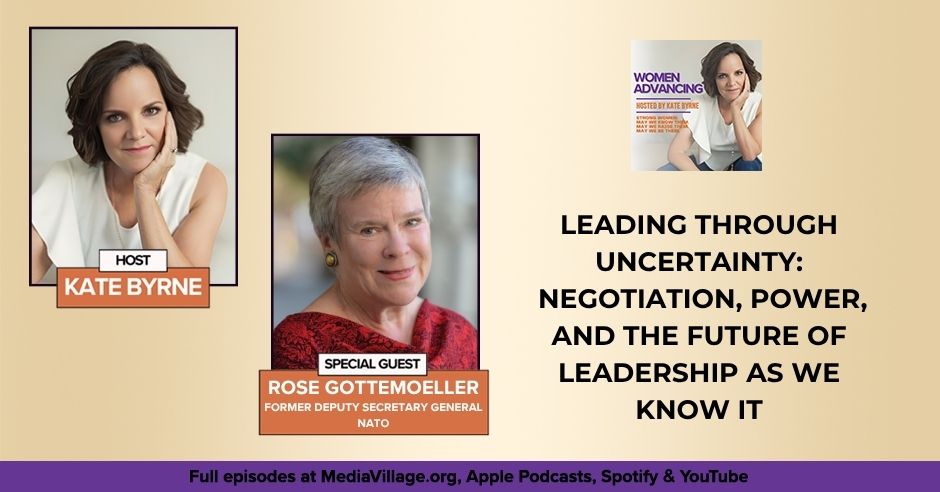
Navigating high-stakes decisions and geopolitical turbulence requires more than conventional strategy; it demands building security through cooperation across complex divides. Host Kate Byrne sits down with Rose Gottemoeller—former Deputy Secretary General of NATO, Chief US Negotiator of the New START Nuclear Treaty, and current lecturer and research fellow at Stanford University. Drawing from her decades spent negotiating nuclear treaties and guiding world leaders, Gottemoeller shares how taking good risks, practicing empathy, and leveraging humor can transform intense disagreement into actionable alignment. She also dives into key lessons from her book, Security Through Cooperation, exploring how adaptability and genuine human connection remain our greatest leadership advantages in an uncertain world.
—
Watch the episode here
Listen to the podcast here
Leading Through Uncertainty: Rose Gottemoeller On Negotiation, Power, And The Future Of Leadership As We Know It
My guest is truly extraordinary. She has spent her career negotiating at the highest stakes imaginable. Rose Gottemoeller helped shape global security as the Chief US Negotiator of the New START nuclear treaty. She served as the first woman Deputy Secretary General of NATO and advised presidents and world leaders through some of the most consequential geopolitical challenges of our time. She teaches at Stanford and continues to explore what cooperation, diplomacy, and leadership look like in an increasingly uncertain world. In her free time, she has completed her second book that’s available through Stanford Press.
Now, unless you do some negotiating of nuclear arms treaties, you may be wondering what any of this has to do with your work. You’ll see, as it turns out, quite a lot. While most of us aren’t sitting across the table from world leaders, we are navigating uncertainty. We are leading through extraordinary complexity, building trust, managing disagreement, and trying to make good decisions when the path forward is anything but obvious.
In this episode, we are going to talk about what great negotiators understand that the rest of us often miss. The importance of taking what Rose calls good risks, the power of empathy, listening, and why humor may be one of the most underrated leadership skills and what diplomacy can teach us about leading in an increasingly complex world. I want you to stay to the end because the KB Takeaways are tight, brief and meaty. Without further ado, let’s jump in.

We’re in for a treat. We are hitting it out of the ballpark. Why? It’s because it is truly my honor, and I mean that in every sense of that word, and pleasure to introduce to you Rose Gottemoeller, who is a lecturer and research fellow at Stanford University, but also former Deputy Secretary General of NATO and former Under Secretary of State for Arms Control and International Security and so much more. Rose, thank you for making the time to speak with us.
It is my pleasure. I’m looking forward to our conversation.
From Sputnik Baby To High-Stakes Diplomacy: Taking Good Risks Early On
We’re going to be ranging topics from leading through uncertainty, negotiation, power, global leadership, and more. Let’s get into it. I would love for you to share a little bit about your journey to getting to where you are now.
I always say that I was a sputnik baby to begin with, because I was only four years old when the Soviet Union launched the first artificial Earth satellite. My dad was thrilled with science and technology overall. He took me out into the front yard of our house in Columbus, Ohio, and said, “Do you see that little dot up there? The Russians have put a satellite up in space. Isn’t that neat?” I was very interested from early on in what was going on with the space race.
At that time, the federal government panicked a bit because the Soviets were getting ahead of us. They funded a lot of science. It’s what we call STEM, but they also financed a lot of Russian language studies. I was able to start studying Russian language at my high school in Columbus, Ohio. That’s how I got my start.
It’s fantastic that your dad went right out the gate and shared that with you. For me, it was my mom who shared. Less the science, but also the tech piece, which is so phenomenal. You have gone here and here. You were just sharing and it happened. It wasn’t a strategic thing. You said yes at these different opportunities. You’ve shown and then different opportunities showed their way to you.
I always get asked if I have a strategic plan and my answer is no. I would say good risks came my way. When good risks came my way, I often grasped at them, whether it felt like falling off a cliff or what. I just felt that this one could work out in an interesting way. I had an opportunity, for example, to join the federal government early on in my career in a very stable position in the Library of Congress.
At the same time, a part-time job came up being a research assistant at Rand Corporation. A research assistant for a man, Thomas Wolfe, his name was, who was writing a book on the first strategic arms limitation negotiations called SALT I. I thought to myself, “That sounds interesting.” It was part-time. I didn’t know if it was going to go anywhere. I decided to turn down the full-time job in the Library of Congress and go with a part-time job working with Tom Wolfe instead. He turned out to be a super mentor. Rand Corporation turned out to be a wonderful place to be a journeyman apprentice for the first decade of my career. I benefited from taking that good risk.
Which is fantastic, especially as a female.
It was new in those days. We were in the first wave of feminism in the 1970s. I started at Rand in 1978. There were doors opening to women. For example, me getting a job as a research assistant at Rand. It was unusual. On the other hand, other women were coming to Rand at that point. We had a little cadre, but we were unusual. We did get some pushback from the men in the room. I’ll have to say that.
I’m sure. That pushback still continues, but thanks to you all. Thank you for at least doing your best to pound down the doors and get in there in the first place. That’s so important for people to realize that sometimes the big and shiny, supposedly the full-time thing isn’t where the magic is at all. When we stretch and take those risks, you find out things about yourself that you never knew or ever would have.

That’s very true because, to be honest with you, I didn’t know anything about the Rand Corporation when I went to work there. This was the site of so much of nuclear deterrence theory, how we thought about warfare in those Cold War years. They were deeply embedded in Vietnam at that time. That was shortly after some of your readers may remember the Pentagon Papers.
The giant leak that came out of Rand with regard to how the war in Vietnam was being fought and very critical of that. Rand was going through a difficult stage itself at the time I arrived. For me, it seemed like a place where I could get a lot of good experience. I could use my Russian because Tom Wolfe wanted me to be looking at Soviet military journals and that type of thing. I could also learn. That was top most in my mind. I wanted a place where I could learn.
Which is key and then from that point on, be forever curious because that’s everyone’s ace in the hole these days. Technology is changing at such an incredible pace. That’s not going to change. You have spent so much of your career negotiating in situations at NATO, where failure carried such enormous consequences. What do business leaders and most people in general misunderstand about negotiations at all?
What Business Leaders Misunderstand About High-Stakes Negotiation
It’s a curious question. I think a lot of business leaders are very good negotiators and they know how to get what they want in a negotiation. One of the big advantages that Americans have, and we have had since the founding of our Republic 250 years ago. That is, we’re willing to risk it all and to fail and to fall flat on our face. We don’t think that is the end of our career or the end of our possibilities. We pick ourselves up and start all over again like the song says.
One of the big advantages that Americans have is we're willing to risk it all and to fail and to fall flat on our face. We don't think that is the end of our possibilities. Share on XThat’s always the attitude that I’ve taken into negotiations. This may not work this time around. I’ll come back again if I have to and if I fall flat on my face, maybe I’ll get replaced in the negotiations. I even felt that way during the New START Treaty negotiations in 2009 and 2010, which was a big nuclear arms negotiation. I was the first woman negotiator there. I said, “I’m just going to throw everything I’ve got into it. If I fall flat on my face, so be it.” That is the great American advantage. It’s our risk-taking willingness and our willingness to fail.
How did you prepare for those conversations? Honestly, they are so huge, but also you are talking about being the woman in the room, etc. How do you just get so focused that you’re not going to pay attention to any little snipes or any little weirds or sides that people take? You must have either scared people.
I don’t think so.
Maybe the fact that you were there or you took yourself seriously so they took you seriously. That’s what I’m curious about because so many people have such a hard time going into these situations where there’s great risk. How did you prepare for that?
I had a significant advantage during the time of the New START treaty negotiations. That is that I had just spent three years in Moscow as the director of the Carnegie Endowment’s Moscow Center. While I was there, I had some funding from Carnegie Corporation of New York to hold a series of seminars to bring American experts on nuclear weapons to Moscow and talk about what the next treaty should look like.
In a way, I had this three year homework period in what we call a track two setting where it wasn’t a government negotiation but it was a bunch of experts, both Americans and Russians sitting down together and thinking about what the future arms control deals should look like. That was a long range negotiation. For me, it was incredibly helpful because it built on my already existing reputation in Russia of being an expert on nuclear doctrine and strategy.
After a while, the Russians became a famous misogynist. Talk about no women in the room. After a while, they become gender blind if you’re a good expert. I find this time and time again and I always say this to women. Unfortunately, women have to be better than everybody else in terms of substantive expertise. Once you’ve got that expertise under your belt, people become gender blind in a lot of circumstances. I found that even with the Russians. I had a good working relationship with the community in Moscow. I knew a lot of people on the US side as well. That was great preparation for those negotiations.
Women have to be better than everybody else in terms of substantive expertise. But once you've got that expertise under your belt, people become kind of gender blind in a lot of circumstances. Share on XIt warms up the room and gets you ready. You had recently written an article talking a bit about unequal power. I’m trying to think of a more elegant way of putting that but you had your observation that Ukraine couldn’t match Russia ship for ship when they were engaged in this. What they did was they changed the nature of the entire contest, which was smart. It made me think, because in the show, we talk a lot about leadership. When you’re the person or the country with less conventional power, which I can imagine some newcomer into a workplace who’s risking it all. How do you change the game?
Where military power is concerned, I always call it the Mosquito Navy of the Ukrainians. They started early on. They blasted the mothership of the Black Sea Fleet of the Russian Federation, the Moskva, it was called, in the first months of the war in 2022, and sank it. They sank it not with any fancy foreign import missile. They sank it with missiles that they had built themselves in Ukraine.
They’ve used their indigenous knowledge and their indigenous tech capability, their innovative powers to develop a lot of smaller drones. A lot of capability and capacity, both air based, sea based and also ground based to go after Russian forces. They have essentially excluded the Russian Navy from the Black Sea. They’ve also closed their airspace.
Now, the Russians are pounding them with ballistic missiles. These are the missiles that are very hard to defend against and the Russians know that the Ukrainians don’t have patriot interceptors at the moment, so they can’t defend themselves. The Russians are going after a weak spot of the Ukrainians but the Ukrainians have figured out all of Russia’s weak spots.
They are going after them with very targeted and less capable, in some sense, systems. Indeed, they are very capable because, in a way, they are not high-tech, but they are driven by high-tech capabilities. A lot of accuracy and a lot of capability to avoid defenses. This is showing the Ukrainians have a lot of smarts about undermining the Russians, despite their putative weakness.
Exactly. It’s also just a great demonstration of where that agility, adaptability, the creativity, and dare I say, sounding trite, thinking outside the box comes into play. We’re just walking in and saying, “The consequences are too great. We don’t have a choice. Here we’re going to go.” The audacity probably threw everybody off balance, then they just went on from there.
I wrote that essay because I was commemorating our own revolutionary war. That was exactly the balance of power in that period in 1776, where the British Navy, the Royal Navy were all powerful. The Redcoats were all powerful. Nobody thought the thirteen colonies would be able to unseat the Brits and force them to concede independence. In fact, we did. It was by some of the same tactics at sea, but also irregular warfare. What we call irregular warfare on land, where they just did not take on the Redcoats directly, but were subversive in the way they went after them. There were a lot of lessons to be learned from our revolutionary war in this regard.
Which is amazing. That is so true. To me, what I’m always forever reminded of, it’s a documentary about the revolutionary war, but also George Washington and the whole notion of leadership under pressure. Throughout your career, you’ve had a wee bit of pressure because you’ve got to make these decisions and moments of a lot of incredible uncertainty. How did you counteract that?
Leading Through Uncertainty: Empathy, Preparation, And Trust
First, it’s necessary to understand and know everything you can about the circumstances. Again, that preparation, that homework, making sure you understand. If it’s a negotiation, who the people on the other side are, what their interests are, what pressures are coming at them from their capital, and try to work with them to find some common ground nevertheless. Empathy is important in terms of being able to prepare and take risks during a negotiation and make decisions to drive forward.
Sometimes, I get in trouble. I got in trouble with President Obama himself because I was freelancing, as he thought, but trying to figure out a way through a sticky issue in our negotiations with the Russians under New START Treaty negotiations. He got mad at me because he said I was not operating according to my instructions. It is important. That’s part of the preparation. That’s part of what you need to take with you to the table, and you work to get your instructions right from Washington.
At the end of the day, sometimes you have to innovate. You have to think about, “If this isn’t working, how do we satisfy what Washington wants to get done, but also what the Russians need to get done?” That takes some very careful threading and doesn’t always work. Sometimes, you do get pounded for it, as I did on that occasion. You never want to get a president mad at you, is what I found out.
I would imagine. I also think the thing there, though, is to your point earlier. One does have the expertise, the empathy and does have a feet on the ground reality understanding of context that others in a faraway White House may not. In fact, you are, in a weird way, doing what you’re supposed to be doing. In the end, it’s ultimately to achieve this goal. I also can probably rationalize all sorts of my actions.
It is a very delicate balance because the capitol is regarding you. You’re far away in Geneva, working every day with the Russians. They worry about you getting a little too cozy with those counterparts across the table. Maybe you’re falling into their traps and maybe you don’t even know it. Those are the warning signs you’re getting from your Washington colleagues.

The way you counteract that is to stay in very close touch and not only in a formal way by requesting guidance and negotiating in the interagency. That’s another negotiation. Also, just staying in touch. This point is so important. Picking up the phone and calling people saying, “I understand you’ve got a concern here. What is it? Let’s talk through it.” In some cases, you have to rebuild their confidence in what you can accomplish.
Trust. That’s the biggest thing. I would say do not rely on email for some of these delicate things because that is the last place where you’re going to build trust. There’s such a misunderstanding. Sometimes there’s a tone that isn’t even intended and was never there, but people hear. You don’t know. You can also gauge from a person’s tone of voice when you’re talking to them like, “There’s something else going on. What’s up?”
Exactly. You can question them further in a gentle way. Sometimes, that is very hard to do in an email. It makes a lot of sense to apply some humor and take a light touch. That’s very hard to do in an email. I believe the power of human contact is very important. It might be something, sadly, that we will be forgetting if we come to depend more on artificial intelligence tools.
I want to scoot on and talk a little bit about that. From your perspective, what opportunities and risks does AI create for diplomacy, national security and international cooperation? It sounds like a duh question, but I’d love to hear it firsthand from you, someone who’s lived in that world.
When AI first began to rear its head a couple of years ago as a tool that could be used not only by military forces, but also in diplomacy. I laughingly said, “That would be great.” The most boring part of any negotiation is the startup plenary sessions when the two groups come together with their scripts and they read talking points at each other. I said, “That’s great. Your AI will read talking points to my AI.”
Learning not to be afraid of failure is a big lesson for young people early in their career. Once you've dusted yourself off a few times, you begin to see that other opportunities will open up when another one closes. Share on XMy thoughts will talk to your bot. We’ll get back together.
“We’ll come back together and we’ll have some human conversations,” I said that jokingly, but I do think that is the utility in artificial intelligence. There’s a certain amount of routine and procedural work that has to go into setting the ground, the foundation for a negotiation. Maybe that is a role that artificial intelligence tools could play in getting that foundation set.
I think that because of, again, the nuance of trust, human mutual confidence, the necessity of ensuring that the other side knows that you are a predictable actor. That predictability is an all-important aspect of any treaty, any nuclear arms control treaty, and other treaties as well. The other side has to understand that once you agree to something, you will predictably implement it.
That is something that can only be conveyed by direct human to human contact over time and building up technical details that both sides clearly understand the nuances of. Again, you have to do that with technical experts at the negotiating table. I do think that there are perhaps some tools that will be useful, but within limits.
I agree. To me, too, I think it is an assist. To your point, because of the necessity for those things that only a human can provide, it raised the bar on us to be that human to show up to be accountable. In this day and age, many people all dodge the bullet, don’t want to take blame, etc.
Isn’t that part of the human condition? Being a risk taker in that regard, willing to take blame, blame is due.
Both and. I remember early in my career, I was so afraid. I was like, “If I get fired,” and I was a big risk taker. That was an odd monkey to have on my shoulder. However, when I did, I was in a very visible senior role. I didn’t understand there were politics at the table. I had been somewhat set up a little bit. When it did happen, I will tell you, part of me was almost relieved because then I thought, “I’m still here. I have other places to go, other job offers. I don’t have to be afraid of that anymore.”
Learning not to be afraid of failure is a big lesson for any. Young people early in their career are setting up a family or setting up a household. They can’t afford to lose their jobs. I do understand that. There are limits to the amount of risk-taking you’re going to take in your 30s and maybe your early 40s. After a while, once you’ve dusted yourself off a few times, you begin to see that other opportunities will open up when another one closes.

Always, rejection is protection. That’s my mantra every day. Let’s talk a little bit about women in power, madam former NATO Deputy Secretary General. You were the first woman to serve in this role. What was that like? How has your understanding of power changed over the course of your career?
Women In Power: Overcoming Steep Learning Curves At NATO
With regard to the NATO job. For me, it was a very steep learning curve because my whole career had been dealing with the USSR, the Russian Federation, the other newly independent states of the former Soviet Union on a bilateral basis. I wasn’t used to dealing with multilateral entities of any kind. Suddenly, I get to NATO. At the time, there were 27 allies in NATO. Now there are 32. Each of them had their own culture, language, and history.
Some were Warsaw Pact or former Warsaw Pact. Countries who had been forced to ally with the USSR. Others, the old Europe, so to say, UK, France, Germany, had been in the NATO alliance from the outset from the late 1940s. It had a lot of different problems, issues, and personalities to deal with. That was a very steep learning curve for me. That’s something I appreciated at the time because it forced me late in my career. I was already in my 60s when I took that job.
It forced me late in my career to push myself to learn and to develop skills to be able to handle that juggling act and it is a major juggling act. That was an important challenge for me. The other thing, though, was oddly the substantive challenge that was handed to me early on was a real estate deal. It was the fact that we had to move from the old NATO headquarters that was falling apart into a brand-new shiny NATO headquarters.
The IT backbone wasn’t ready when I arrived. The project was handed to me and they said, “Make it happen and fast.” I had never had to deal with a problem like that before. I never had to get on the phone and summon the CEO of a major US IT company to fly across the ocean and talk to me about what he was going to do to get this done. As you see, this was an absolutely new challenge and different challenge from anything I’d had to deal with before. It was super valuable. Again, it taught me that I could do things completely out of my comfort zone. That is an important lesson for anybody.
Talk about negotiating with difficult people, because God knows you’ve had them. We have them in a variety of different ways at the workplace, sure. At home, in families, at boards, investors, etc. What is one lesson you’ve learned negotiating with world powers that shockingly applies to everyday life?
Let me just say, I agree with your first point. When people ask me about how to learn to negotiate, I say, “You negotiate every day. You negotiate with your toddler, your teenager, or your spouse. You negotiate in the workplace.” Humans are natural negotiators. That’s how we get what we want without punching each other. Diplomacy is getting what we want without the use of force. I do think that it’s important for everyone to naturally think about how they negotiate and how maybe they can improve their skills.
Humans are natural negotiators. That's how we get what we want without punching each other. Diplomacy is getting what we want without the use of force. Share on XFor me, one of the most important, the signal lesson is that oftentimes you have to know when to back off and when to take a light touch. Humor is an amazing tool in any negotiation. Whether you’re negotiating with the Russians over something critical in a nuclear arms control negotiation or negotiating with your toddler about how many stories they get to read at bedtime. It’s important to think about a range of human behavior and how you can put it to good use in a particular circumstance.
I want to tell you a quick vignette. It’s not my negotiation, but I did a book called Security Through Cooperation, which talks about the space cooperation that developed during the 1990s. One of our NASA people who was negotiating with the Russians during that period to bring together US and Russian space capabilities into what became the International Space Station. He said, “I was puzzled because every time we would get to a rough place in the negotiation and we were slowing down. My counterpart would stop and he’d tell an off-color joke.”
I couldn’t figure out what he was doing. After a while, I figured out that was his way of slowing down the negative vibe that was developing and turning it into a moment when they could pick up and begin again. There you go. Even the Russians exercise humor. In this case, profane humor but anyway, it’s a great lesson. Think about what your instincts are in a given circumstance and how you would diffuse or solve a tense moment. That’s when you can pick up and start moving again.
Staying In Conversation: The Lost Art Of Active Listening And Humor
I had a great opportunity to work with the Karsh Institute of Democracy and as such was a co-facilitator of their civic cornerstone fellowship conversation. Literally, the goal was to pretty much cancel, cancel culture. How do we encourage people to stay in a conversation? Especially when we have different views.
That is so important nowadays.
The thing that I found fascinating, now a disagreement feels like something to defeat rather than understand just a human-to-human. Humor, yes but how do we rediscover that ability to stay in conversation with people whose views are fundamentally different from our own? I encourage people. It’s not about being right. Choose life.
Something I’ve learned about even in my own extended family where there are many different political views across the spectrum. I think listening is underrated but very important. I try to listen and then I try to present my view, usually try to offer a good example. Sometimes, I get rejected and I have to walk away. I remember one family reunion many years ago now. It was when President Clinton was in office. I sat down at a table with cousins I knew were in a different place politically than I was.
Listening is underrated but very, very important. Share on XI was working for President Clinton in the White House at that time. We were chatting. Suddenly, one of my cousins looked at me and he said, “I hate Bill and Hillary Clinton. They are evil people.” I said, “I don’t feel that way. I see the good that they are doing while I’m working with them in the White House.” I got up and left the table. There was nothing else I could say at that moment. I wasn’t going to convince him any differently, but I did feel like I had listened and that I had at least left him with a more positive thought about Bill and Hillary Clinton.
My mom always said, “If you can’t say something nice, don’t say anything at all.” In that situation, you’re right. What I came to learn, to your point, it’s opening a perspective. Giving them a little nugget just to savor.
I hope, in future they’ll say, “We know cousin Rose worked for the Clintons, but she’s not evil. She sat down and talked to us for a while.”
Exactly. Looking ahead, what concerns you the most? Also, what gives you the greatest hope?
What concerns me the most is what I see happening in education in universities nowadays. I’m a lecturer at Stanford. I don’t see this so much in my own students, but I feel like in some circumstances, in maybe many circumstances, the evidence is now accumulating. Students are shelving learning. They’re shelving developing their brainpower and turning to artificial intelligence tools to do their work for them.
It worries me because I love writing, for example. The creative act of writing. For me, it’s sometimes very difficult, but it’s always inspirational once the juices start flowing and you feel like you’re turning out something interesting in the zone. That’s it. I think if young students don’t have that opportunity going forward, they just turn passively to letting these tools take over for their brainpower. To me, that’s my biggest worry. Again, I don’t see it so much in my students at Stanford.
I do demand that they do oral examinations. I don’t let them prepare papers anymore or anything like that. They have to do an oral examination so then I can judge. They use artificial intelligence tools to help prepare their briefings and so forth but they do have to stand and deliver. They have to stand and answer my questions as well. I do think it’s going to be up to educators to be challenging students more and more to make sure their brains are working.
I do some work with the Batten Institute of Entrepreneurship, Innovation and Technology. This is one of the issues that we’re looking at, too, and talking about how we prepare people. I call it the science of opportunity in uncertain times. I can tell you. There needs to be such a reliance on your own brain. That’s also part of your sovereignty, frankly and your individuality. That’s what makes you stand out. Everyone wants to shine but in order to do that, you’ve got to make room for yourself to shine. It’s got to be you shining. Knowing what now, what advice would you give your younger self?
Advice for Future Leaders: Taking Good Risks and Never Apologizing
The first is a piece of advice that I took early on, which is, take good risks and be ready to look at a risky situation and decide whether it’s worth your while or not. Whether it will be a benefit to you. The second piece of advice, again, this was a lesson that was handed to me early on, is never apologize. Often women start, and young men as well, start a comment by saying, “I don’t know much about this, but,” and that is the wrong way to start. If you start with an apology, people doubt your words from the very outset.
Never apologize. If you start with an apology, people doubt your words from the very outset. Say what you've got to say. Share on XI always say never apologize. I had a graduate school professor who dealt me that blow early on because I started out answering a question in class by apologizing. He said, “stop right there. Say what you’ve got to say.” It turned out my answer was right on that occasion. I should have just said it. That has turned out to be good advice to me to my young self and it’s good advice to everybody.
It’s interesting to me. There are so many articulation ads coming on, and maybe it’s just me. They’re coming on YouTube now. All over the place. Everyone is being taught how to speak.
Maybe I should check them out.
I’m telling you I ought to. It’s that advice. In a word that we all say. I have a very bad habit of it, just. I used to say when someone would say, “Hi or hello.” I would say, “It’s just me.”
There you are apologizing. It’s not just you. It’s you. That was what my dearest friend used to say all the time. May she rest in peace. She goes, “Hardly just you.”
Rose, where can people find your books?
I always say go directly to the publishers, Stanford University Press, and there you get a 20% discount on my book, Security Through Cooperation. My earlier book is Negotiating the New Start Treaty. If you’re interested in my views of negotiation, that’s a very good one to look at. They’re both slim volumes and can be very easily and quickly to read. I endorse them both.
Do you have a favorite?
No, they’re both my children. I can’t say I have a favorite.
That’s a very good apt answer. I lied because I said I was done questioning. I just have to ask. How did you get the oomph to write not one, but two books in your free time, which is so not existent?
Interesting that the academic environment at Stanford has freed me up. The first book was my COVID book, and a lot of people wrote COVID books. I had this negotiating experience built up in my brain. I took the COVID years to write Negotiating the New Stark Treaty. In the case of Security Through Cooperation, I was so frustrated with the line coming out of the Kremlin that the Clinton administration, starting with President Clinton, had made these decisions to enlarge NATO to the borders of Russia in order to threaten the Russian Federation with aggression.
That is so not NATO. NATO is a defensive alliance. I also remember that Bill Clinton in the 1990s, his first instinct was to develop a stable and secure relationship with Russia. He was convinced that unless there was a stable and secure relationship with the Russian Federation, there could not be peace and security in Eurasia. Was he ever right? We made a good start in the 1990s. There was a good, close working relationship, not only between Yeltsin and Clinton. Believe it or not, but between George W. Bush and Vladimir Putin to begin with.
Unless there was a stable and secure relationship with the Russian Federation, there could not be peace and security in Eurasia. Boy, was he ever right. Share on XIt all went wrong in the first decade of this century. The book talks about that. I wanted to counter that propaganda coming out of the Kremlin that NATO was all about defeating and destroying Russia. That was President Clinton’s main objective. That was not his main objective. He wanted a good relationship with the Russian Federation.
He understood it from the get go. I can only imagine he’s such an extraordinary mind in so many ways. Rose, thank you so much for your generosity of time, wisdom and pearls. Thank you for everything that you’ve done and being such a role model. Thank you for ensuring that all of your students are using their minds.
I’m trying my best. Thank you so much, Kate. It’s been a wonderful conversation.
Until our paths cross again. Thank you. Women Advancing audience, thanks so much for sharing your time with us.
—
What a conversation. What a mind, what a career and what a life. What a beautiful, humble and generous and sharing so many pearls. Rose, thank you for everything that you’re doing. With my KB takeaways, I’m going to keep them super tight. First, Rose encouraged us as she encouraged herself when she said, “How did I get my career? Good risks came my way,” so she said yes to those things that felt a little scratchy because that’s where you learn more about yourself and you’re always stronger than you give yourself credit for. Take those good risks.
Never apologize. In your conversations, get rid of the word just, don’t, but and anything. If you have something to say, just suggest. Don’t do that. If you have something to say, say it onward. The end. Less words are always better. With regards to negotiation, ask lots of questions and then listen. That’s how you’re going to end up hearing and finding new avenues of where there’s potential meeting grounds for sure.
It’s also an extraordinarily gift in building trust. The more trust you build, the more open a person is and the more likely they’re going to want to work with you versus against you. Something that I thought was interesting and is true, is empathy as something that’s impactful and negotiation. You’re going to understand the circumstances at hand and what a person might be feeling with regards to those. Also, understanding what makes them tick, what their go-to responses are and how they react under pressure.
Those are all great tells. That way, it gives you insight and information as to when to go forward, when to go back, when to lean into, and when to shut up. Lastly, humor. I love humor. I think it’s the winning hand every time. It gives everyone a chance to save face, exhale and realize what we are here for and make sure that you get an eventual win that wins for all. With that, thank you so much for reading. I look forward to our conversation continuing in the days and weeks to come.
Important Links
- Rose Gottemoeller on LinkedIn
- Security Through Cooperation: Space, Nuclear Weapons, and US-Russia Relations after the Cold War
- Security Through Cooperation: Space, Nuclear Weapons, and US-Russia Relations after the Cold War – Amazon
- NATO
- Rand Corporation
- The SALT experience
- Karsh Institute of Democracy
- Negotiating the New Start Treaty
About Rose Gottemoeller
 Rose Gottemoeller is the William J. Perry Lecturer at Stanford University’s Freeman Spogli Institute for International Studies and the Center for International Security and Cooperation. Before joining Stanford, Gottemoeller was Deputy Secretary General of NATO from 2016-19.
Prior to NATO, she served in the U.S. State Department as Under Secretary for Arms Control an International Security at the U.S. Department of State. In 2009-10, she was the chief U.S. negotiator of the New Strategic Arms Reduction Treaty (New START) with the Russian Federation, an experience captured in her memoir, Negotiating the New START Treaty (Cambria Press, 2021).
Her most recent book, Security through Cooperation (Stanford University Press, 2026), explores the potential for renewing U.S.-Russian relations post-Putin.