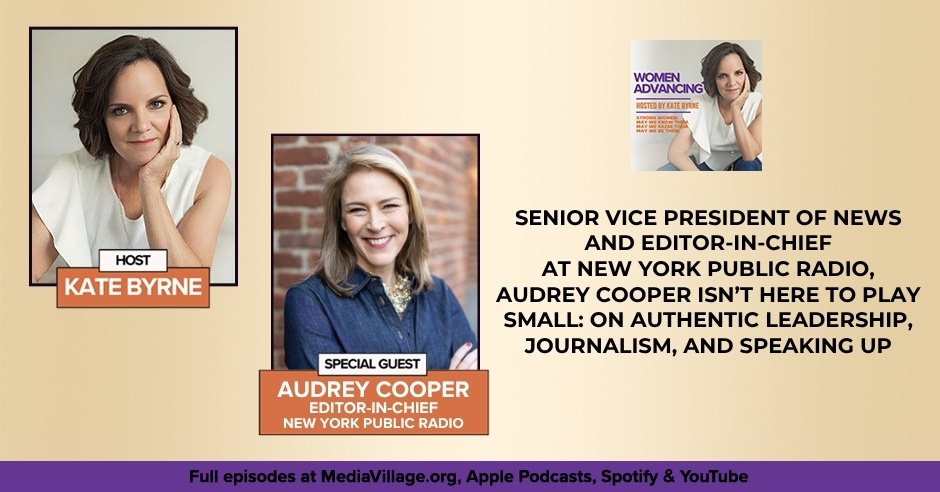
Step into the dynamic world of leadership, as we dive into what it truly takes to drive innovation and lead through monumental change in the ever-evolving landscape of news. Joining us is the trailblazing Audrey Cooper, the award-winning Editor-in-Chief at New York Public Radio, and the first woman to lead that newsroom in its 100-year history, following her pioneering role as the first female to lead the San Francisco Chronicle newsroom. Audrey shares her unfiltered insights on navigating disruption, balancing mission with business, and why curiosity and encouragement are non-negotiable for leaders at every level, offering a compelling look at building inclusive newsrooms and work cultures that genuinely reflect the communities they serve.
—
Watch the episode here
Listen to the podcast here
Senior Vice President Of News And Editor-In-Chief At New York Public Radio, Audrey Cooper Isn’t Here To Play Small: On Authentic Leadership, Journalism, And Speaking Up
Leading the Way: Audrey Cooper’s Pioneering Journey
In this episode of Women Advancing, I’m going to sit down with Audrey Cooper, whom I knew from my days at the San Francisco Chronicle. She’s the Award-Winning Editor-in-Chief of New York Public Radio and the first woman to lead that newsroom in its 100-year history. She was also the first female to lead the newsroom of the San Francisco Chronicle. It seems to be a little trend there.
We’re going to explore what it takes to drive innovation and legacy media, which is not always easy, leading through change, and then building newsrooms that reflect the communities they serve. It’s probably why she and her team were among the first to become a finalist for the Pulitzer. Audrey shares her candid insights on navigating disruption and balancing mission and business, and why curiosity or encouragement are essential for leaders at every level.
Regardless of whether you’re passionate about journalism, trying to figure out how to get started, or you’re into building an organizational culture that spans multiple generations, and is full of inquiry and discovery, or the future of media, this convo is going to inspire you to think bigger about your own leadership journey and what’s your style. When you’re saying things or when you’re inviting things, are people watching? Are they seeing and hearing what you want them to? Check it out. Don’t forget to stay to the end, where I share my KB takeaways.
You’re in for a treat. Why, you might ask? We have none other than Audrey Cooper, who’s the Senior Vice President of News, and she’s the Editor-in-Chief at New York Public Radio, otherwise known as WNYC. Audrey, welcome to Women Advancing.
Thank you.
Audrey and her team have been, how would I put it, was it nominated for a Pulitzer?
We were a finalist for the Pulitzer. Anyone can nominate themselves, but there are only three finalists every year.
That is a great accomplishment. We’re going to learn a bit more about how you were able to bring the team together to that point. Let’s start at the very beginning. Tell us a little bit about your path and how you got started.
Early Career Challenges & Leaning In
I started in journalism as a baby reporter in a very tiny newspaper in a very tiny town in California. I had no idea what I was doing. A lot of the theme will be fake-it-until-you-make-it. That’s what I did from day one. From there, I went to work at the Associated Press, and then I went to another newspaper where I became an editor. For the purpose of your show, that was the first time I was managing a staff. I was 24 years old. It’s crazy to think anyone put me in charge of twenty-plus people at 24. It was wild.
One of the things that you probably know about me is that I don’t like to have a boss. I had some bosses, and I thought, “I could do that. I know what to do.” It was a very eye-opening first year as a manager because anyone who steps into a new management role thinks I’m very good. In my case, I was good at being a reporter. I thought I’d just show everybody how I did things as a reporter, and then they’d see the genius of how I did things, and then I’ll fix everybody.
You find out very quickly that is not how you lead. Nobody wants to be told exactly what to do, and they especially don’t want to be told that by a 24-year-old woman. It was a very steep learning curve, and they were very generous with me. One of the things about me is that I make a lot of mistakes, but I don’t make them twice. I think about what I want to accomplish and how to get people to follow me there. I was an editor at that small newspaper for a few years until there was an opening at the San Francisco Chronicle, which was the big paper in Northern California, and I begged for a job there.
I had begged for an internship there and never got one. Finally, they hired me, and then it was off to the races. In nine years, I went from like a beginning baby editor at the Chronicle to Editor-in-Chief. I was the editor there for six years, then I got a call to come to New York. That’s how I ended up in Public Radio. It’s a long story.
I want to hear a little bit more about making that switch, but before we go down that path, I’m very curious. Why do you think they gave that 24-year-old the job to manage? They must have seen something. I can imagine.
If you’ve hired people, you can tell who’s going to be good. A little bit of it is charisma and interest. I don’t know if you’ve discussed this on the show at all, but I thought a lot about Sheryl Sandberg’s book about the initial reaction to lean in. The idea that women should be at the table and getting involved, and how that’s antithetical to our personalities and our experience, a lot of time.
She received a lot of feedback that it was a very privileged point of view. All of that is true, but for me, it has been successful to lean in, to be at the table, and to ask for what I want. I thought I would do a good job steering a staff. Even with my own staff now, I find people are often too reticent to ask for what they want. The worst thing they’ll say is no. It’s literally the worst thing that could happen. Sometimes, it’s just asking for the job. I was like, “I can do this. Put me in, Coach.”
Best And Worst Advice For Women In Media
Take it to the races. The thing that I love about that is that by you doing that, you embody it. You model, “It’s safe to do that with me.” People get more and more used to exercising that muscle, as it were. What’s the best piece of advice you’ve ever received as a woman in media? What’s the worst that you politely ignored and said, “Not so much?”
I’ve received so much more bad advice than good advice. I had a boss, and he will remain nameless. He told me, “Don’t ever have kids in the news business. It will kill your career.” This is before #MeToo, as you can imagine. He is no longer in the business. That was super illegal, but strangely, it was coming from a good place. This was an era where all top editors had stay-at-home wives. They had a staff to run their personal life. He was saying, “You’re an up-and-comer because you don’t have this family to keep you away from work.”
That was the worst piece of advice. Not only because it’s illegal, but because a year later, I was pregnant. I didn’t listen to it. The best piece of advice, I have spent various periods of my career trying to be somebody I’m not. That’s an experience of a lot of not just women, but people of color in the workplace. That code-switching to be what people think you should be is exhausting. I’m at an age now where I’m like, “It is too exhausting to be who I am not. If you don’t like it, sorry. I’m a pretty nice person. I’m very ambitious. I expect that from a lot of people, but I’m also very generous. I’m not your mother either. Don’t expect me to be your mother. I’m your boss and your colleague.”
That code-switching to be what people think you should be is exhausting. Share on XThat’s so true. I bet that comes into play, given that you’re the first female Editor-In-Chief in WNYC’s history. That’s a huge accomplishment and also a very interesting opportunity to shape, shift, and embody how the station can evolve. What did that mean to you personally? What did you jump in and say, “This is the first thing that needs to be reimagined? This has got to go.”
Navigating Gender Bias And Battling Critics
I was offered the first woman Editor-in-Chief at the San Francisco Chronicle, but it was even more important because it was a bigger organization. Even the whole corporation didn’t have a lot of female leaders in it. The newspaper business is even more than in public media. Public media is 60% female now. That’s not true in newspaper land. I can’t even tell you how different these cultures are. They’re so different, but a lot of times, people expect women to be mother figures in the workplace, and when they’re not, the knives come out.
They treat you often much more savagely than they would ever treat a man, ever. The things that have been said about me, nobody would say about a guy ever. The negative things, but maybe some of the positive things. Some of the negative things said about me, you would never hear anyone say about a man. I’m not sure why that is and why it’s still allowed, but we don’t call it out very often. I had hoped a few years ago that we were getting over that, and it seems like it has regressed a lot.
That’s one of the things that I’m curious about in general. As more women start to take the leadership helm in a number of different news and media organizations, how does that shift the narrative and the story selection, and what aspects of it? You answered one of the questions I was thinking I was going to ask. There’s so much gender bias. It still shows up, regardless of whether you’re the boss lady or not. How do you contend with that? Since you have the finalists Pulitzer thing, that should be able to go high.
That high lasts for about eight hours. That’s about it, unfortunately. I would say it this way. I once gave a speech to a group of Girl Scouts. I was thinking about what to tell them. They were all in middle school, and I decided to discuss my middle school bully. I almost want to call her name, but I won’t because I’m mature now. I went through a hard time in middle school. I think everybody has a hard time in middle school.
I had a particularly rough time, and it gave me what I call alligator skin. It made me want to be successful more than almost anything. For a long time, I said success is the best revenge. Now, I’m trying to say that happiness is the best revenge, or living well is the best revenge. It drove me to damn the critics in a lot of ways. Sometimes, that was very helpful, and sometimes it was maybe too much alligator skin. That’s what women put on to work to be able to go into it sometimes, too, because so much more is expected of us than male leaders.
Happiness or living well is the best revenge. Share on XIt’s almost like putting on your armor.
I may have told you this once, but when I was first named editor at the Chronicle, I was 35. I was the youngest female editor of any major Metro ever, and maybe the youngest editor ever. I went into a meeting with a B-level political candidate, a state assemblyman, or something like that, and they asked me for coffee. I couldn’t say that I was the editor.
I thought about that so much. It’s like, “What can I do to show that I’m in charge, and you’re here to meet with me?” I started wearing heels every day and dressing the part every day. Armor can be an emotional armor, but sometimes, in my case, it’s even what you wear to work every day. Every day, you will not catch me not wearing heels because it’s part of the uniform I put on to say, “You’re going to work today. You’re in charge.” That’s how it is.
Building Inclusive Newsrooms: Reflecting The Communities Served
Own it. Take it. Shifting a little bit into you leading, how do you guide a newsroom, especially now? It’s funny. We’ll do a little bit of a deeper dive into media itself, but how do you handle and balance editorial innovation, and also all the weird existential pressure, without losing the soul of public media, especially where you are?
That’s a complicated question, but it’s a good one. There’s this perception out there in the world that journalists are ultimately driven by money. I find it such an insane thought that there are journalists out there doing things because they think that an advertiser will give them more money. I’ve never met a journalist like that. I’m not saying they don’t exist. National Enquirer is like a clicky news adjacent publication, but real newspapers, real public media, and real reporters do not wake up in the morning and think, “How can I make more money today?”
If we did, we would be in finance, and we would be making more money doing something else. I don’t think anyone realizes journalists do not make a lot of money. They are not in it for the money. They do not have money brains. Even if I wanted to, a newsroom is dozens of reporters, editors, producers, copy editors, photographers, and all these journalists whose job it is to go out and ask questions of people in authority and to give no Fs about the people in authority. If you think about what kind of person it takes, it is also the most uniquely difficult person to manage. You’re managing staff that has no respect for authority and questions everything.
Journalists do not make a lot of money. They are not in it for the money. They do not have money brains. Share on XHow do you contend with that?
Some days are better than others. It’s like any job. The most important thing is that you have a true North and that you articulate that true North every single day. It was one thing for the Chronicle. Here, we say, “Our job is to make New York work for New Yorkers.” That is what we do every single day, and we do that in a lot of different ways. We do it through call-in talk shows. We do it through our website, Gothamist, and we do it through what we decide to cover and what we don’t decide to cover.
You’re not going to see a lot of what we would call cheap crime on our website or our air, because it doesn’t make New York work for New Yorkers. It makes people scared. They might click on it, but it’s not advancing what we want to do, which is to hold people accountable and expose in equities, in improprieties, and to use the power of the populace and the media to help people change their own communities.
Once you say, “Our goal is to make New York work for New Yorkers,” if you have a story idea, like the Diddy trial. That’s down the street. My feeling is like, “How does that make New York work for New Yorkers? It doesn’t, then we’re not going to cover it.” It makes the argument left because everybody believes in that mission, and then they can say, “My job is to cover the courts, but it’s not that court case. It’s this other one where this landlord is screwing their tenant, or the tenant is screwing the landlord, or whatever.” That exposes something that makes New York work better.
That’s a lot about building trust internally, but also externally.
Building trust, but also being consistent, and being able to articulate a reason for what you do. I feel like a lot of people can’t articulate why they do things even if they have a good reason. The articulation of it is important. That’s what any leadership class will teach you. It doesn’t matter if you’re running a newsroom or a gas station or whatever. If you can’t articulate what you’re doing and what you want people to do, how are they possibly going to know how to succeed? I believe everybody wants to succeed. I don’t think people come to work wanting not to succeed. You have to tell them what that looks like.
Also, make sure that they understand. In my experience, so often, people are quick to say, “I get it.” You then realize they don’t get it at all. With the newspaper, that’s a form of local news, at least with the brands that you would work with. Now, you’re doing local radio. Is there a difference or a scope of where one begins, or a scope of influence?
It’s so much different. It’s different and it’s not in so many ways. I left newspapers after being in it for twenty years. I thought this organization had some of the same challenges that I had solved before, but I didn’t know anything about broadcast journalism. I was interested to see what the difference was for those mediums. Our largest platform is our website, Gothamist, followed by the radio itself. What I can say is that the difference between the two is that when you hear somebody’s voice and you know that from this show.
You know instantly if somebody’s full of BS or not. It’s hard to cover it up when you’re talking to somebody. You develop a relationship with that voice and that person. Maybe you don’t like them, or you love them. Maybe you can’t wait to hear them every day. Our Morning Edition host, Michael Hill, whom I’m very proud to say I hired. I love turning on the radio in the morning because I love hearing Michael’s voice. He cheers me up.
He makes me believe that it’s sunny out even if it’s raining. He’s great to listen to, and you don’t get that from just text. You don’t get the same kind of storytelling. If you can go outside and record the sounds of New York City, describing them is not exactly the same, and watching it on TV is not the same. Playing with these mediums has been very interesting. Culturally, I would say it’s all very interesting because public media has grown over the last few decades.
It didn’t start out intending to be people’s primary source of news, as it has become in many cases. In so many communities across the nation, the only local news you’re going to get is from a public media station. It grew like, “We’ll tell you what’s in the news.” By that, they meant what’s in the New York Times and what’s in the Washington Post.
Now, we’re very much trying to do all kinds of news, originally. I would say, culturally, that creates a different dynamic in the newsroom because it’s something that wasn’t baked into the origin story, which has been interesting to deal with. It’s so different for me because how would you not want to go out, get scoops, and uncover the story? Sometimes, we’re like, “We just want to tell a nice story.” It’s like, “No. Let’s not do that.”
No such thing as nice.
Nice is good sometimes, but sometimes, you have to get up to your old boats and things. It’s an industry that has changed a lot. The event of podcasting has changed a lot, like how people commute. Who’s in their car? Every day, at the same time, you’re not anymore. The idea of having a driveway moment where you’re stuck in your driveway because you don’t want to listen to anything doesn’t exist anymore. Who has driveways in New York City? We don’t have that anymore. We have to be a lot more innovative and user-focused and data-focused when we think about how to do what we want to do, which is make New York work for New Yorkers. How do we do that now with all the different ways that we live?
From Print To Public Radio: The Evolution Of Local News
That’s a perfect segue into tech. There are all these tools, and to your point, there’s measurement that’s all of that. Everyone keeps going on and on about AI and ethical AI. Is that even a thing? Is it potentially a thing? With this, the question is, can AI ever support a mission-driven media entity without compromising ethics?
Yeah, sure. All these are just tools. How we use them is where the problem lies. We lived through the invention of Facebook, Twitter, Craigslist, and what that did to the media industry. At this point, I’m a journalist. I want you to get news that you can rely on. If you get that from my social media accounts or from a video, I don’t care as long as you’re informed. The problem is that people get a lot of other crap that makes that harder. People have become lazy and disinterested because there’s so much content out there that’s more engaging.
AI is a tool like anything else. It has a huge potential to help us with news distribution and with writing. Sometimes, people don’t want to read an 800-word story. That is okay. That’s why headlines were created. Journalists are like, “You can’t boil my story down to three bullet points.” Did the creator of the headline think that? Probably. There are lots of ways to use this technology to our benefit. What’s scary to me is that AI will, I believe, eventually destroy search as a function. It will destroy the internet, and like BuzzFeed and others figured out how to play the algorithms to fuel clickbait. I shouldn’t pick on BuzzFeed, but they figured out a way to manipulate Facebook. They search algorithms, and everybody else.
Somebody is going to figure out a way to do the same thing with AI, and it’s going to create more disinformation. It’s going to be harder to find real news unless you already have a source that you trust and is comprehensive enough to serve your needs. As traditional media shrinks, it’s getting harder and harder to sustain something that has the scale to be impactful and has enough people supporting it.
As traditional media shrinks, it's getting harder and harder to sustain something that has the scale to be impactful and has enough people supporting it. Share on XPeople are understanding how important it is. I’m not meaning to pick on this, but Reddit. Reddit started. I can remember where it started. It went through its hiccups. The early-days CTO is a dear friend of mine. There’s positive, but there’s also a lot of hating done on Reddit. How do you figure out which is worth listening to and which isn’t? I could also see if one is taking a look and trying to get feedback. You could say, “Forget it.” I’ve witnessed this with other journalists. It’s like, “There’s always going to be haters.” You still have to listen to some of it or look at it and get a sense that it’s good because at least I made them hate it, or I got them to think. I got them to have an opinion or feel as opposed to completely talk to them, “Forget it. They’re worthless.”
Do you mean criticism on Reddit? I feel like Reddit is a much more civil place than some other corners of the internet. I do not go on Twitter anymore, X, or whatever you want to call it now. I do not go on Facebook anymore. They became so toxic and abusive. I’ve been docked on Twitter. I don’t go there anymore. I don’t need to do it. I feel like, because people in Reddit are self-selecting communities, it’s a little bit better. I think it’s great. What I would always say is that people say to me, “I love WNYC.” They won’t even finish saying what they loved before they tell you what they should do. That’s the most wonderful thing because it means it’s a public trust.
I always used to joke that there are two jobs in New York City that everybody thinks they could do better. My job and the Mayor’s job. Let me tell you. You probably don’t want either one, but it’s the truth. That’s an honor that people feel they have. Where it goes off the rails is that our country has mistaken the freedom of expression with the ability to have freedom of thought. You don’t always need to say it out loud. It’s deep thinking about issues instead of shooting from the hip. That is a problem that we have.
Our country has mistaken the freedom of expression with the ability to have freedom of thought. You don’t always need to say it out loud. Share on XFuture-Proofing Your Career: Patience And Strategic Self-Care
I agree. With all this in mind, what advice would you give to young women who are looking to get started, who are in the trenches, and they’re feeling a little beleaguered, “Will that ever change? Will I ever get up there?” What advice would you give them?
I wish somebody had told me this. It’s going to happen. The thing that I realize now in my career, the recruiter calls and they dry up for three months. You think, “Am I too old now? Am I yesterday’s news? I’m not the hot young thing anymore.” They then start back up again. Everything is cyclical. You have to believe. Nothing is forever.
Too often in my career and my life, I’ve thought this situation now is the one that I’m going to be in forever. From an old woman, it is not true. It gets better. No matter what it is, it will change. The best thing is to go in and figure out what makes you excited. If you’re in a rut at work, and we all get in those. I went on a long vacation. I was in a rut. I came back and I’m like, “I’m going to do this project now,” because it gets me excited. This whole staff is better when I’m excited and in a good mood.
It gets better. No matter what it is, it will change. The best thing is to go in and figure out what makes you excited. Share on XYou have to find it, and I find it in all different ways. I find it by talking to you, listening to a podcast, or meeting somebody in a totally different industry who’s doing something cool. You can find these little sources of inspiration, and sometimes it doesn’t take very much. It takes something different than your usual. I schedule it into my week, like an hour every Friday. I’m like, “Find something that you are excited about, or have a conversation with somebody that you’re excited about, or introduce yourself to somebody.” If I don’t schedule it, it doesn’t happen. That’s just me. Other people may not be quite so anal, but you have to make time for it.
That is such a great idea, and what a great day to do it on, because then you head out into the weekend. That gives you a great mood, then. It percolates, and the next thing you know, you’ve got story ideas or the oomph to get moving into new directions. Would you say that that’s the same advice, knowing what you know now, that you would give yourself?
Yeah, I would also say chill out. Also, I needed to chill out. I always need to chill out, probably a little bit, but I would say two other things. The first is that each step in your career that you take requires different skills. It took me a while to understand that leading a staff of twenty was different from leading a staff of 200 and being in a boardroom. Different things made me successful in those different levels. It’s one of those things where you have to live it to understand it, but it’s so true.
The other thing I would say is that there is almost nothing unless you are a 911 operator. There’s almost nothing that needs a response right away. I feel like the whole world would be a better place if everybody sat on their responses for 24 hours. I don’t mean like, “What are you doing this weekend?” I mean, like any email that sends my blood pressure up even a little bit, I’m like, “Don’t do it now,” because my reaction is going to be different than it’s going to be 24 hours from now. That is the advice I would have given to 35-year-old Audrey.
That last one is so true. I got that advice early on. Oftentimes, what I’ll do is I’ll write it and then I stick it in drafts. After 24 hours or 48 hours, I’ll look back and I will laugh because I’ve had time to let the dust settle and think, “Get over yourself. What were you so worked up about? It’s not worth your time.” If it is, if you want to get something achieved or you’re trying to shift and influence a decision, let’s do it in a way where you stand a shot. If you can get that email that you wrote, you would say, “Bye. Talk to the hand.” Cooler heads prevail.
It’s one thing for men to send those. It comes off differently when women do it, because you get branded a b*tch or your emotional or something. Nobody will say that to a man ever. They will always say it to a woman, or you’re mean, or whatever. Nobody says that about the men. They will say it about the women. I am not going to fight the patriarchy on my own with my emails. I let it sit for 24 hours.
It’s interesting. I had an experience where there was a board meeting I attended, and then we had another meeting, a follow-up meeting. It was fascinating because I was so thrown off. It was the first time in a long time, so old, and I was astonished. I was taken aback like, “What?” I didn’t play it as well as I could have. Now, with the same crew, I knew what I was getting myself into, and I owned it. It was great. They were better able to hear from me. It was acting as if a little bit of swagger but not too much, and then just being me, and knowing where the soft spots are, where they’re going to push back, and then having a response.
Get what you want.
That’s the other thing, figuring out if there’s a way. I had to learn this with this same group. Some of them are ready to hear from a woman, and some aren’t. Who’s the guy in the room who can set me up, and whom I can build upon? It’s not that I like to do it that way and be so manipulative, but still.
There’s manipulative and there’s reality.
That’s so true. Audrey, thank you so much for all of your many pearls. I look forward to seeing what happens next at WNYC. We’ll circle back. I think we’re headed for some interesting times. Especially, let’s face it, in your city, the political situation. We’ll talk about that in a non-political way, everybody. I don’t want to be political, but I think it’s interesting from a storytelling arc and that thing. We’ll schedule a follow-up as we get closer to those things.
Very interesting. No dull times here in New York City.
Things are changing. On behalf of everyone tuning in to Women Advancing, thank you, Audrey. I appreciate all that you’re doing.
Thank you. Bye.
—
KB Takeaways: Reflecting On The Leadership Journey
Wasn’t that great? I am so impressed with the way in which Audrey consistently, from a young age, has stepped into these leadership positions and owned them. It’s not from a hottie standpoint and know it all the point. That gets knocked out of you, but quite a few pearls. Here are my fave KB’s takeaways. First, make a lot of mistakes, but not twice. To me, that choice demonstrates the difference between learning and mistakes. If you learn and receive the feedback, then you can course correct. If not, then it’s a mistake.
Second, ask for what you want and then don’t do a whole lot of follow-up mumbo jumbo. There’s an old saying in sales that whoever speaks first after the ask loses. Don’t be a loser. If what you want, ask for it, and then let the other person respond. This next one was key to me. Be you, not what you think people want you to be. It’s exhausting, and it’s also incredibly inauthentic. It’s going to catch up with you. One of the hardest things to do is to act and be half-hearted. It’s a steady energy drain, so don’t.
Next up, take a beat. Nothing ever requires an immediate response. Wait 24 hours before responding. I’ll often write a draft, and I literally will. I go back to it the next day, and I often laugh and think, “Why was I so worked up about this the first time?” Schedule excitement time or curiosity time once a week, where you get to go learn something or dive into something that you’re curious about.
It’s so rejuvenating and also opens you up to a whole new world and a new network. That’s where a lot of creativity and innovation can come from. Finally, in closing, it’s going to happen. It just is, so be patient. Trust me on that one. Do as I say and not as I do. I’m still always working on being patient. With that, I’m excited to have you join me on the next Women Advancing.
Important Links
- Audrey Cooper on LinkedIn
- Audrey Cooper on X
- San Francisco Chronicle
- WNYC
- New York Public Radio
- The Associated Press
- Gothamist
- SFGATE
About Audrey Cooper
 Audrey Cooper is the Senior Vice President of News and Editor in Chief at New York Public Radio, where she leads New York City’s largest local newsroom. Her newsroom shapes civic discourse in the nation’s most dynamic city by distributing its award-winning audio, digital and investigative journalism on WNYC radio, the website Gothamist, on-demand podcasts and other digital platforms.
Under her leadership, New York Public Radio has been recognized as one of the country’s most forward-thinking public media organizations. It is one of the few radio newsrooms ever named a finalist for the Pulitzer Prize. Audrey has reimagined the traditional radio newsroom, transforming it into a multiplatform operation positioned to serve as New York’s newsroom of record. Her initiatives include launching a Capitol bureau serving all of New York State’s public media stations, redesigning digital products, and pioneering new approaches to local news podcasts.
Audrey is widely regarded as a transformative leader in American journalism. Before joining New York Public Radio, she was Editor-in-Chief of the San Francisco Chronicle, where she became the youngest woman ever to lead a major U.S. newspaper. At the Chronicle, she spearheaded a bold digital transformation that earned the outlet repeated honors as California’s best newspaper and national recognition for innovation and journalistic excellence. Her newsroom won nearly every major national reporting award and introduced groundbreaking collaborative journalism models—most notably the SF Homeless Project, a first-of-its-kind media coalition that has since been replicated globally.
A Kansas native and Boston University graduate, Audrey has been recognized by her alma mater as a distinguished alumna. She lives in Brooklyn with her husband and their 12-year-old son. In her free time she gives historical walking tours and is working on her first book.