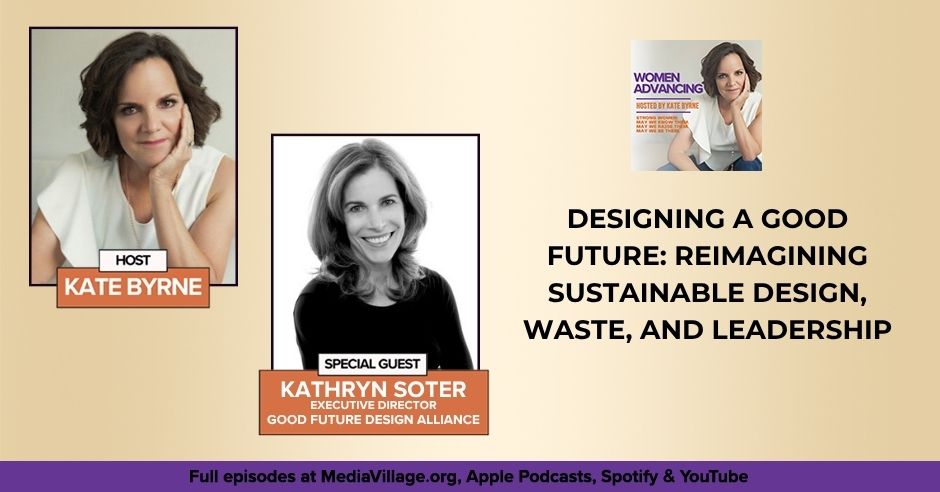
Are you overlooking the unseen systems that cost us the most? In the U.S., a staggering 12.2 million tons of furniture waste is discarded annually—enough to furnish 8.8 million one-bedroom apartments. This isn’t just a waste problem; it’s a crisis of sustainable design, mindset, and leadership.
Today, we welcome Kathryn Soter, Executive Director of the Good Future Design Alliance, who has spent decades at the intersection of media, design, and sustainability. We dive into how to tackle overwhelming problems with “simple baby steps”, why the focus must shift to residential design (which accounts for two-thirds of US building square footage), and how connecting creativity, cost, and impact is the invisible work of modern leadership.
Tune in to learn why the future depends on making the unseen impossible to ignore, and how you can embrace progress, not perfection, to build a truly good future.
—
Watch the episode here
Listen to the podcast here
Designing A Good Future: Reimagining Sustainable Design, Waste, And Leadership With Kathryn Soter
In this episode, we are going to be talking about systems the ones that we don’t see, and the cost of continuing to ignore them. We’re also going to be touching upon storytelling and communicating issues that are important that can tackle problems that are so overwhelming that people are frozen into not taking a single step. How can you translate them into a series of simple baby steps that will result in a huge forward moment?
My guest is Kathryn Soter. She’s the Executive Director of Good Future Design Alliance. I’ve known Kathryn for two scores. The thing I love about Kathryn is that she has spent decades at the intersection of media design and sustainability. She’s helping us rethink how simple things beyond buildings, actually our very own homes, are being built, furnished, and ultimately discarded. One fun fact, holy guacamole, there are 12.2 million tons of furniture waste every year. That would easily furnish 8.1 million people. Think about what we’re tossing.
This isn’t a conversation, though, just about waste. It’s about leadership, translation, and the courage that women are doing the invisible work of connecting creativity, cost, and, as a result, having long-term impact. This is why, honestly, the future depends on making the unseen impossible to ignore. Thanks to Kathryn, you won’t after our conversation. Stay to the end for KB Takeaways. As always, I look forward to hearing your feedback. Let’s tune in.
Transition From Legacy Media To Interior Design
Women Advancing readers, you are in for a special little ray of sunshine because we are joined by a favorite person of mine that I’ve known throughout my career. I have worn the career a lot heavier than she has. Please join me in welcoming Kathryn Soter, who’s the executive director of Good Future Design Alliance. Kathryn, welcome.
Great to see you, Kate. I have good Zoom filters, so I don’t agree with you on the aging thing.
Clearly, I’ve got to upgrade mine. Thank you. I have deep respect for Kathryn because she’s been a leader throughout legacy media. She’s also done some amazing pivots. She’s got a deep heart for sustainability and a passion for good design. During our conversation together, we’re going to talk a little bit about that and how you transition. When you make one shift, there are some things you give up, but there are so many other things you gain. We’re going to hear some statistics that are going to blow your mind.
With that, I shall say to you, my dear, what did you lose? Let’s start there and talk a little bit about origin and courage. The whole legacy media is still there, but barely media-ish. When that whole world collapsed, what did you realize you were finally free to build? How did you get to that spot like, “I can do what I want to do?”
It was obviously disappointing to see the legacy media world collapse. You asked what I lost from that. Number one was a big fat expense account and a company car. All the good old days. I also lost in a sense, because I’m working for myself at home with one assistant who is remote. I miss that sisterhood I had from working at a large, mostly female office in San Francisco.
What I gained, though, was a chance to reinvent myself in a field that I had loved since I was young, which is interior design. Maybe because of my background, I wasn’t shy about asking questions, getting to know people, and poking around to get information. Before long, I now have a new set of colleagues, friends, and a new industry. That gave me the courage to do that.
I’ve got a question. I’m thinking about this. In one way, you traded in one identity, got to shed whatever no longer fit, and got to customize this next one. I know sustainability is near and dear to your heart. Was there a moment when you sat there and said, “I can take this personal passion. This is a responsibility that I can’t ignore anymore. I’ve got to raise the visibility because I do have a sophisticated background. I know how to tell a good story. I know where to go. I have people who can make room for me to tell that story?” All I keep thinking of you, too, is being stuck in California when it’s burning.
It’s an inferno, up and down the West pretty much. There were always childhood influences, too. My grandparents lived through the depression. They never threw anything out. As a kid, every summer when I’d go visit Grandma’s, my cousin and I would head down to her basement because there was a treasure trove of things. It did make me appreciate that in those days, people didn’t throw things away. They fixed or repaired them.
My grandmother saved all kinds of thread and things like that. When I got into the interior design industry, I started working for manufacturers. I learned from my clients who were interior designers about the inefficiencies and processes that are inherent and accepted in the industry. It’s too many small moving parts and too many people to mess it up along the way.
Also, on the manufacturing side, I saw an enormous amount of packaging waste that gets thrown out at scale. It was startling. I joined the Good Future Design Alliance, which was started by an interior designer and others of us in the industry as a forum for bringing awareness to the problem. I eventually took over the organization in 2023.
The Mission And Focus Of The Good Future Design Alliance
What exactly does the alliance do? It’s a great one that maybe people aren’t as aware of, but they should be, to your point.
We’re an environmental education organization. We work with a cross discipline of design and build professionals to come up with solutions to the waste problem. We’ve expanded the mission to educate more and more designers and builders on the role of toxicity in our environment, from building materials and indoor air quality to reducing our reliance on natural resources through reuse, promoting circularity, energy conservation, and all those other good things.
Our niche is two things. One is focusing on the residential design industry because commercial has bigger projects. They have consultants. They have more attention. Projects are bigger and flashier. The residential side is broader and made up of lots of small projects. It doesn’t get nearly as much attention. People in that industry sector are largely undereducated and underserved in terms of resources.
What we try to do is educate through conversations and bring people from cross-disciplines together because we tend to talk to the same type of people all the time. Interior designers talk to interior designers. You learn and can move change if you are listening to the other people on a project. That’s what we try to do.
What it seems to me is a little cross-pollinization. It is also looking at “That issue in one of those worlds is akin to something over here. I could try that, or I could try a version of that.” The thing about the residential piece is everyone shows up at work, and you already know. You’ve already been impacted by God knows what else that’s taking place within your home.
I’ve certainly experienced that here in Charlottesville, in Virginia. Be it with building materials and pipe materials. You name it. Not even that long ago, we’re not talking 1900 old farmhouse by any means of the imagination. What I wanted you to share was, and we tipped a little bit upon it. There are shocking statistics about furniture waste and more. Let’s stop everybody cold, shall we? Spill a little tea on that front if you don’t mind.
Residential Waste As A Bigger Driver Of Pollution
Most people are not aware of the environmental impact in the residential world. It’s pretty much stayed invisible. If you think about it, it’s spread across millions of ordinary, unremarkable buildings. One kitchen renovation in one little farmhouse doesn’t seem like much. Especially when you compare it to a giant skyscraper going up or a big airport. At a national scale, combined, it’s enormous.
For example, single-family homes and multifamily housing make up about two-thirds of the US building square footage, while commercial is 25%. That’s what people don’t realize. Despite the fact that commercial projects are larger, flashier and are renovated many more times over, they have an enormous environmental impact as a category. It’s small compared to the residential side.
Residential construction still outspends commercial roughly by 2 to 1. As it relates to the environment and the impact, the problem is that the data is a little murky because residential waste and emissions are often bundled together with commercial. The evidence suggests that the residential sector is a much bigger driver of waste and pollution than people assume. What happens when we ignore it is that the scale’s hidden, policy gaps persist, and we have big everyday opportunities for change that slip right by us.
The residential sector is a much bigger driver of waste and pollution than people assume. When we ignore it, the scale is hidden, policy gaps persist, and major everyday opportunities for change slip right by us. Share on XWe talked a little bit about this. Numbers alone usually don’t move us towards anything or get us upset. What do you think this one actually has slapped people with a huge bucket of cold water? Is it because all of us have probably done something with furniture waste?
It’s 12.2 million tons of furniture waste that we have dumped every year, but it should stop people cold, but it’s not until we turn that statistic into something more meaningful and something that people can relate to. When we put it this way, in the US each year, we throw enough furniture away to furnish one-bedroom apartments for 8.8 million people. Usually, what people do is gasp. Put that way, people are stopped and thinking, “What are the habits that I am doing that will contribute to that?”
We also need, however, to provide an off-ramp for this. It’s not enough to tell people what the problems are. We have to allow or bring something to them that allows them to participate in changing behavior. Think about it. The good comparison is years ago. We didn’t recycle much at all. It wasn’t until cities put recycling bins out in front of the curb. It became a practice because it was there for us. We have to do more things like that that exist on the large commercial side. Not even so much on the small commercial side. The infrastructure and the incentives still need to be established for the residential side.
One of the things we’ve also talked about is how all this is communicated. It’s not just a sustainability problem, but it’s also a communication problem. It doesn’t connect. You paint a picture like that. It makes you, frankly, a little bit ill. Where do the systems that help that storytelling happen, that communication, and break down? Is it the language? Is it the incentives? Is it the collaborations? Is it one of, “Not my problem. It’s your problem?”
Can I say all of the above?
This is the thing. Sustainability has been spoken about for so many decades. It’s dire. We touch it every day. I think it’s because it isn’t all completely black and dire. People don’t take it seriously, I suppose.
For starters, as I mentioned before, we lack a culture of collaboration in the design industry. Here’s how it goes. We like to hand things off. We’re done. We move on. We got another project. We move fast. Time’s money. A third of construction waste comes from decisions that are made at the design phase before a hammer is swung. It’s the reasons that earlier collaboration would save time, money, and a lot of dumpsters.
To make matters worse, we reward this behavior. It’s costly to the client, but the contractors and the suppliers get paid either way. Sometimes, it’s double. We’re at cross purposes with each other. We’re moving fast. Time is money, but we’re also having to redo things. There’s also probably not enough incentive to do things right. There certainly is much more pressure, ordinances, compliance, and ESG goals on the commercial side, but those largely don’t matter to the residential community.
You can get significant write-offs by donating furniture and even building materials if you need to deconstruct your home. That’s a new concept in residential. It’s not inexpensive because it does slow the project down. If you plan for it at the beginning, then it fits into your timeline. Reusing materials can also save you money. You can either donate them, resell them, or maybe even use them on your project. The problem is one of mindset and a lack of planning for this.
It’s just continuing with the old system.
There’s take, make, waste. I’m done, next.
You may not have seen this, but I’m curious about multiple different generations. As we’re sitting here saying you can sell things, all I think about is Facebook Marketplace. There’s all the DIY stuff. I’m sitting there wondering if there is any data, a marked difference, or practice from younger generations versus older generations. I’m wondering, for instance, if the Silent Generation and Gen Z are maybe similar.
Unfortunately, most of the Silent Generation is largely extinct now.
I was going to say silent and dead from their coffins.
Honestly, they are not as sustainable as you think they might be. Think about it, post-war was the boom days. We had technology. We had conveniences. Dishwashers were being invented. There were washing machines, packaged goods, and all that stuff. That was new and fun. Nobody thought about the impacts of waste back then. During the depression for their parents or when they were children, it was a necessity.
My father used to say he grew up in a very small town. He said, “We never lacked for food, growing up in the depression. We grew our own. We fished in the river. We had a community with us, so we survived.” It was harder in big cities where none of that was necessarily available. You’re right. I have a chart in one of my presentations that shows all the generations. There’s some data that shows what their interest in sustainability is and how important it is to them.
The trajectory from old to young generations is a nice arrow up. About 75% to 85% of Gen Zs are highly interested in sustainability. They look at it as a construct to live by. It’s less than half of Baby Boomers who put much into that or care. They tend to write big checks, but they don’t necessarily practice what they preach or what they support.
Constraints Activate Creativity And The Need For Collaboration
One of the myths that’s out there too, is that we don’t want to be too sustainable because that stifles creativity. What if constraints unlocked that abundance never did?
When you have constraints, it activates creativity. If money is no object and you have a blank check or an open credit card. Anybody can go shopping and buy that Instagram look in an instant. That doesn’t take much creativity. You’re just copying something. You have constraints like a budget, existing building or site issues, your own efficiency goals, waste standards, or health concerns. It takes a lot more time and thinking. It can force you to think harder and be more clever.
When you have constraints, it activates creativity. If money is no object and you have a blank check or an open credit card, anybody can go shopping and buy that Instagram look in an instant. That doesn’t take much creativity. Share on XWhen you enter a field like interior design or architecture, you’re largely very creative people anyway. Spend the time. It’s much more fun in the long run for people. Interesting things can come out of it, too. Sometimes, when you’re not thinking about it at the beginning, that’s where collaboration comes in. If you do have challenges with a project, work with the other team members.
I don’t think clients promote that enough because they don’t understand. They think of it as just a cost. If I get my architect, designer, contractor, or even vendors in early on, I’m paying for all those people’s time. You’re building a brain trust to help problem solve. You can be surprised at how a contractor or an engineer might have a great design decision to help you. That’s the opposite of what happens.
When you think about it, we’ve seen it in other industries. I sit there, and I think of mobile banking. A lot of that took place in places where there aren’t banks. The African continent was one of the huge forefronts and all sorts of things. I hadn’t thought of that point that way before, but that’s a good one. Speaking of collaboration and women, not that males are not collaborative, because they are as well.
Often, we’re the ones who end up doing all of that integrative work that holds systems together without ever getting authority recognition. We get all the responsibility. None of the credit. How does that play out in the design and construction world? I know more women are starting to get more into the construction world because they’re starting to inherit family businesses and such, but speak a little bit to that.
It won’t surprise you that certain sectors are male-dominated and certain sectors are female-dominated. There is more cross-pollination. There are more female engineers now, and there are more women in construction. Conversely, there are more males in interior design. All of that’s great. It takes all kinds to make an industry flourish. Women are often doing that connective tissue work that you describe. It’s essential, but it doesn’t get noticed.
Part of advancing women is finally naming that as a leadership style because that’s how systems actually change. Where it’s the most noticeable and effective is when women run their own businesses or are in leadership roles, not just by title. Often, if you’re in a secondary role in a company, you’re doing work, but maybe not being recognized as a leader. When you have your chance to run your own business, you often can show that it can be done differently.
Part of advancing women is finally naming that as a leadership style because that’s how systems actually change. It’s most noticeable and effective when women run their own businesses or are in leadership roles, not just by title. Share on XAlso, your IP stays your IP. That’s the thing that always used to drive me a little bit crazy when coming up with terrific ideas and then hearing everybody under the sun that became that. You want to help the company, but it’s like, “No, pipe down.”
People are stealing your ideas. You just have to bite your tongue. We’re used to that.
No kidding. Going back to a little bit of more generational archaeology. Something you have said a few different times was borrowing the planet from our children. How does that long-view thinking across generations change how we define success now? We should be harder on ourselves, or maybe not harder, but perhaps more vigilant. What do you think?
I don’t think harder on ourselves is going to work.
I know. That’s me. I’ll put the flag down.
What I do like is, as we talked earlier about this next generation, is that they do care deeply. They’re very well aware of sustainability. They just need to ask their bosses for permission and guidance to pursue the way they want to do business differently. They’re not satisfied with this like, “It’s not done that way. It’s never been done that way.” They’re not likely to work for bosses who know this stuff either. That’s not the way the industry rolls.
We’re working hard on it. Those of us who are in the industry are working hard to push these concepts and educate people, but the next generation gets it faster. That gives me hope. There are things that we can impart and hopefully encourage. Also, allow that younger generation to pursue this and not be deterred by forces that are going against it, which may be the case.
It’s one of those things that I’ve never understood why. Some of this makes sense, yet it’s not been embraced. Part of it too is that we as consumers also are going to have to make some trade-offs. We also have a few fingers pointing back at ourselves, saying, “If we’re going to make a big change, that means everybody has to make a big change.” Which means I’m going to have to shift some of my own expectations.
I’ve heard you mention aiming for 20% doom and gloom and 80% solutions. How do you decide in terms of communicating? This is something that all of us contend with. How do you decide when people are ready to hear hard truths and when they need hope? That can be tricky.
The time for the hard truths is now, similar to how the dangers of pesticides were revealed decades ago with Rachel Carson’s seminal book, Silent Spring. It’s chemicals that linger in our environment and in our bodies. It’s plastic that degrades, but never decomposes. The hope is that we can convince people that the small choices they make do add up. If we all start doing a little bit, it’s a force multiplier.
The hope is that we can convince people that the small choices they make do add up. If we all start doing a little bit, it becomes a force multiplier. Share on XIt’s like the wave at a stadium. One person stands up, and then another person does. The whole stadium is waving. It does work that way. When we see our neighbor doing something, let’s try it. I want people to think that they don’t have to be perfect to take a step towards this philosophy. Honestly, when you think of, “I can’t do it because I don’t know how, and I won’t do it right,” that’s a deterrent. People don’t have to get it right from day one. They just have to start and do something.
Our goal is to reward progress and not perfection. Most certification standards are so high and costly. They unintentionally leave out a large number of designers and builders who collectively could make a real difference. I love a good analogy, Kate. I think of it as swim lessons. You wouldn’t expect your four-year-old to be able to win the breaststroke in week one, or the butterfly.
You just want them to get into the water. That’s what we want. We want you to get into the water. We’ll be there with the floaties, the fins, and whatever you need at whatever level you’re coming into this for. If you want to learn to swim with us confidently, we will be there. We will have done our job. You do not have to train for the Olympics.
Out the gate. Perfectly timed, given that they will be coming to us shortly. Is that some of the thinking that went into how you all developed your 30-Day 30K Design Challenge, where you did this good, better, best framework? Talk a little bit about that because it sounds like it was a good way for people to continue to put the pedal in the water.
We pilot tested it with the 30K. We pilot tested it with a few designers. We’ve developed what we call the low-impact design handbook. Through that, we got feedback from designers on having constraints. We’re going right back to having constraints and working within those constraints. We gave them that arbitrary 30-day timeline, but that’s working days, and a budget of $30,000.
The feedback was great. People got into it. We’d love to roll that out nationally, assuming we can get some national sponsors. It is a nice, fun, and low-bar way to test the waters. The best part that came out of it was the guidebook. We expanded it. We are finishing soliciting projects from our membership to show us examples of each one of the three pillars, which are low waste, low carbon, and low toxin.
We’re going to have photos now. We’re creating basically a magazine. I’m excited about it. We need a couple of months to get it laid out and finished, but it’ll be available to our membership. I look at it as a primer. It’s a way to introduce these concepts in a pretty low-bar way. I’m not talking about dumbing things down. I’m trying to make them more approachable.
They are accessible.
Take a step with us. No judgment. As I said, we reward progress. Not perfection. That’s the beauty and the danger of the environmental movement. We tend to go to the ideals. As I said, if residential wasn’t such a huge amount of the industry, that might be fine. You do have to have ideals to shoot for, but it leaves out too many people. We’re just trying to take a different tack and say, “Let’s lower the bar of entry. Not lower the standards.”
Also, it’s translating it into, “This is a simple thing.” Doing this that you may already do, or you could do, or making this a super easy, simple choice is a thing. That rolled out over a country or over the nation will make a difference. Do that one little thing.
Redefining Success: Legacy, Durability, And Progress Not Perfection
You mentioned something earlier. I don’t think I answered it right. It’s this generational thing, and why that’s important. I want to come back to that. What that means is redefining what success is. What did we build to leave behind a legacy? What we want them to say is, “What did we leave behind?” If you’re thinking legacy, success isn’t just about the beautiful project to leave to future generations. You have to think about the durability and the responsibility, and have a few regrets for your decisions.
If you’re thinking about legacy, success isn’t just about the beautiful projects you leave for future generations. You have to think about durability and responsibility—and about having fewer regrets about your decisions. Share on XIt’s asking, “Did we build something that will last? Can it be repaired? Could it be adapted into something else? Does it harm people or the planet along the way when they inherit it?” I should have reiterated that it doesn’t harm the people or planet. If we can say yes to those questions, but not to the last one, and it’s still beautiful and something that reflects the time, the culture, and that place, that’s real success by doing all of those things.
The Hope In The Next Generation Of Designers And Mentorship Needs
The sooner we do it, the better, which is amazing. I’m thinking about those challenges like the one you’ve done. Does that draw out this whole next generation of designers? If so, what gives you hope? What do they need? You said from leaders, you’ve got to give them permission.
I honestly find the most rewarding conversations I have are with students. If I could talk to students all day, they’re so eager to learn. They want to do something different. I have one interior design school that invites me back every semester to do a little one-hour Q&A with their students. I give them the background. I’m not shy about sharing those scary facts. They pay attention, but you could see that by the questions they ask, they do care. They do want to make a difference.
What I worry about is that there aren’t enough good mentors yet. They may have to become those for the generation after them. It’s organizations like ours and others that are providing good resources, guidance, lots of research, good data, and also resources that they can choose from that will help them make better decisions and chart that path.
There are some younger members that we have who are in that younger generation who want to work on their own. It’s very difficult to get started on your own when you’re young. I applaud those who do. Sometimes, they end up going back to work for somebody else. That’s okay, too. You need practical business experience as well, but I hope that they don’t get pummeled down. We were so used to it in the advertising business. “Stop talking. Do your job.”
I hope there’s a voice for those younger designers, architects, and builders, too, to try to do things a different way. The truth is, it’s happening. It’s just not being recognized by enough people. I can give you plenty of examples of great furniture manufacturers that design with circularity in mind, with no toxins, and with a whole, eco-packaging, take-back packaging, or re-compostable. There are people doing this. I applaud them. I try to tell people, “Don’t give up. Keep trying. Start to support these companies and these industrial designers, and then we start to grow the industry.”
The beauty of this, too, is that it’s essentially a brand halo effect. It’s a part of your brand as a person, as a consumer, as a parent, and as a community member. We all know how everything travels fast. That’s a great idea. What I’m going to do is to make sure that I include the link if that’s appropriate for the guidebook, for sure. Even if there are some of these companies, I’d love to drop that in because the more we can get people aware of all of this, the better.
If you go to GoodFutureDesign.org, you’ll see our website. There is a membership fee to get some of our resources, but it’s not very big. You can also email me at Kathryn@GoodFutureDesign.org. I’d be happy to talk to any of your readers.
Returning To Interior Design School And Postponing The Career Move
It would be huge. Last one, lady. You and I go way back. I was thinking of one thing that I skirted around. Kathryn, everybody went back. You went to interior design school, yes?
I did. I studied it part-time. It was a hybrid learning experience because I don’t have to tell you that advertising is not for the faint of heart and is pretty rough on people over 40. I’d always liked it as a kid. I found this hybrid learning opportunity and started to do that on nights and weekends. It was going fine until my then nine-year-old son said, “Mom, you spent a lot of time at your drawing board.” That was a little painful to hear, but I understood. I did finish my studies, but I did postpone the career move for another fifteen years.
It was beautiful foreshadowing for you. It is frustrating, but still, I want to commend you on that because no part of any of that was easy. You did that for yourself, which is also great and so needed when you have this job with delightful co-workers and a situation. You have kids and everything else that comes with that entire thing at all.
I know this sounds weird. I feel like I’m in the sunset of my career, but I am trying to still do something and follow my passion, or at least try to make a difference. These are the things we all come out of college with an ideal. I’d like to make a difference somehow, and then you get sidelined by life. You’ve got to earn a living. You’ve got to pay the bills. You have kids. You have to take care of them. All those things sometimes derail you from some things that are deeper yearnings inside of you.
Stay the course because there may come a window. When the window does, the opportunity knocks. Jump in there. Knowing what you know now, what advice would you give your younger self?
Advice To Younger Self: Stop Waiting For Permission
Honestly, I’d tell my younger self to stop waiting for permission. You don’t have to have the perfect experience, the perfect education, or even the perfect title to start doing meaningful work. Jump in, if it toots your horn. Also, I’d say that your voice matters more than you think. You don’t need to soften it to make other people comfortable. I’m still getting used to that. I would say I needed to practice earlier. Maybe worry a little less about being impressive or perfect at something. Just care a little bit more about being useful, and the rest will follow.
There you go.
I missed working with you. I don’t think people know how far we go.
We started way back, before there was electricity.
There were big shoulder pads.
In fact, I’ve worn this jacket that has some pads. When I look back, those mid-80s were a fun time. We haven’t aged a bit, everyone.
Not at all. Thank God for Zoom filters, as I started back then.
Kathryn, thank you so much. I appreciate it. You never disappoint. You are so smart. You always have been and continue to be. You are also doing great work, doing important work, too, and doing it with grace. Thank you for everything you’re doing.
I appreciate the forum. I love the title of your show because we do know that women need to support each other. It wasn’t always the case back in our early careers, where it was clawing your way to the top. We do owe it to each other to support each other. I appreciate the opportunity to talk to you. It was wonderful.
It’s my pleasure. Until our paths cross again, thank you.
You got it. Great to see you. Take care.
Until next time.
—
Did I tell you or did I tell you? I don’t mean to belittle this, but Kathryn is extraordinarily capable and competent. You can always count on her for doing something well concisely. She has a gift for explaining how easy it is to take something on. I hope you enjoyed that as much as I did. For the KB Takeaways, I loved what she said with regard to stopping waiting for permission. Go for it. Take it especially when you have confidence in yourself.
Your voice matters more than you think and more than you know. You’re stronger than you think. Don’t soften your voice just so others feel comfortable. That’s what I’m still working on. It doesn’t help anybody. Lastly, in these crazy days, with something like sustainability, and for so many things. It can be so easy to get overwhelmed with the size of the many mountains that we’re facing with regard to different systems that are breaking down.
With that in mind, one step on the foot of the other. Go for progress, not perfection, because not trying at all is not an option. It is, but the outcome is not so good. With that, thank you so much for tuning in. I appreciate it. Don’t be a stranger. Let me know what else you’d like to read. I look forward to continuing the conversation next time.
Important Links
About Kathryn Soter
 Kathryn Soter is the Executive Director of the Good Future Design Alliance, an environmental education and advocacy organization working with a cross section of design + build professionals on solutions to increase the adoption of more circular and regenerative practices. Soter is a recognized subject matter expert, a frequent panelist and moderator, and leads discussions across multiple channels to raise the public consciousness on the industry’s contribution to climate change and human health concerns. The GFDA hosts conferences and talks, sponsors design competitions, and offers educational programs to its membership.
Over 600 million tons of construction and furniture waste is generated annually in the U.S., most of which ends up in landfills, and nearly 1.9 million tons of microplastics from paint are now found in our oceans. These, and other factors, pose significant health and climate challenges which are forcing the industry to change the way it does business.
Soter holds a degree in Industrial Psychology from Lewis & Clark College and later studied Interior Architecture & Design at the Academy of Art University. She has a certificate in Building Materials and Human Health from Parsons School of Design, Healthy Materials Lab. The first part of her career was spent working in advertising for media giants Grey Global and Gannett, followed by two decades in publishing at Condé Nast Media Group. When not planning the future of the GFDA, she enjoys a life aquatic living on a floating home in Sausalito, CA.