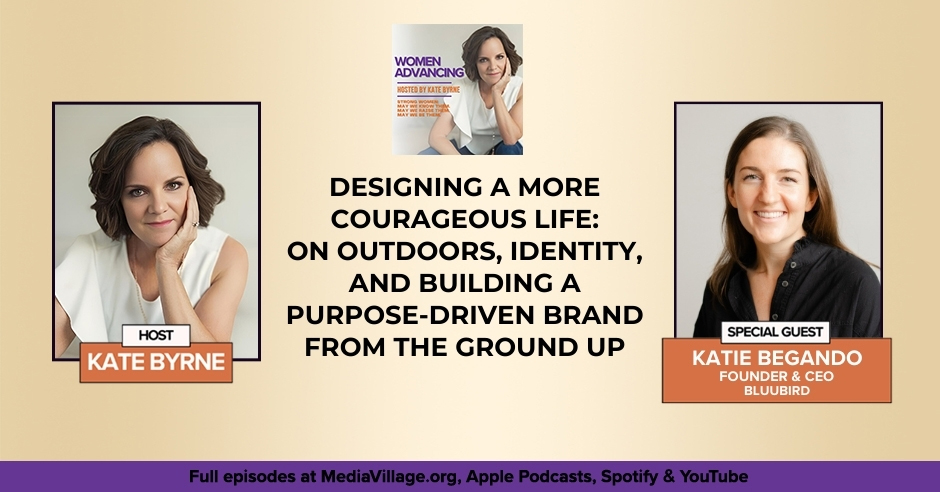
On today’s Women Advancing, I’m joined by Katie Begando, Founder and CEO of Bluubird—a brand built on the idea that influence isn’t just for people with massive platforms or loud megaphones. It’s something we grow, collectively, through trust, community, and showing up consistently.
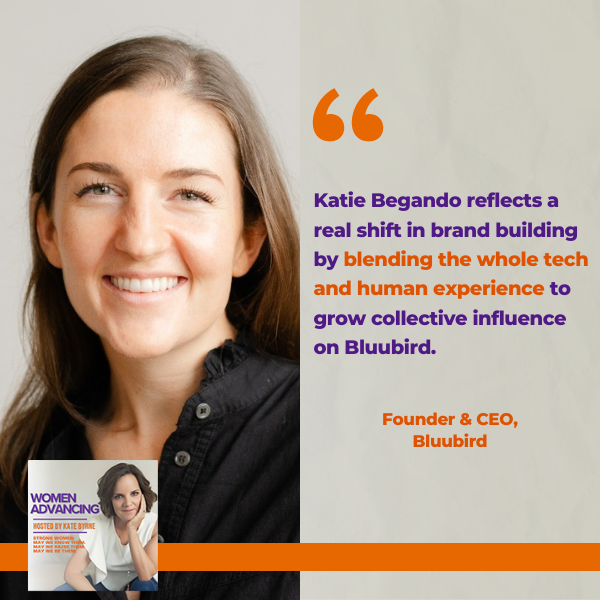
Katie’s story reflects a real shift in how brands are built today. Not top-down. Not alone. But with a village—customers, creators, partners, and believers—who help shape the brand as it grows. In our conversation, we talk about democratizing influence, listening closely to the people you serve, and what it really looks like to build momentum without losing your center.
We also dig into the realities of founding and scaling a consumer brand—the scrappy decisions, the resilience required, and the leadership it takes to keep going when the path isn’t linear.
—
Watch the episode here
Listen to the podcast here
Designing A More Courageous Life: Bluubird Founder And CEO Katie Begando On Outdoors, Identity, And Building The Purpose Driven Brand From The Ground Up
Building A Brand With Trust And Community
Some of the most meaningful businesses don’t start with a big grand plan. They start with noticing what’s missing from your own lived experience and then trusting the people around you enough to build it together. On this episode, I’m joined by a fave, Katie Begando, who’s the Founder and CEO of Bluubird. A brand that’s built on the idea that influence isn’t just for people with massive, huge megaphones. It’s something that we grow collectively, to trust the community and show up consistently.
Katie’s story reflects to me a real shift and how brands are being built now. Not from top down. Not alone, but together with a village. Who’s in that village? Many different stakeholders. You’ve got customers, creators, partners, believers and builders who shape the brand and help it grow. In our conversation, we talked about democratizing influence, listening closely to the people you serve, and what it looks like to build momentum without losing your center.
She’s also going to share a few tips of how she, herself maintains that center. Something that as many of my readers know isn’t easy when you’re busy building something. We’re going to dig into the realities of founding and scaling a consumer brand. Those crappy decisions that you have to make, the resilience that’s required and the leadership it takes to keep going when the path isn’t linear.
That’s right. You can do it step by step. If you were building something you care about wondering, “How do I grow it in a way that won’t kill me but is also leveraging tech, but is also super strong and incredibly human” This episode is for you. I look forward to hearing what you think about it. Let’s dive in.
The Entrepreneurial Leap: From Corporate Life To Startup Founder
Woman Advancing readers, welcome. Welcome to what I know is going to be an extraordinary edition because we are talking with none other than the Founder and CEO of Bluubird, Katie Begando. Katie’s going to talk a bit about designing a courageous life, building a purpose-driven brand, making some big leaps of faith and a lot more. Without further ado, Katie, welcome to the show.
Thank you. It’s nice to be here.
Here you are. How did you get here? Start, leap, jump and share.
How can we talk with the leap? It’s funny. I had somebody ask me, “How do you come up with an idea?” I had this very embarrassing answer, like the fact that I feel I could spend many years stumbling to get here. It doesn’t feel like it was a clean jump but I had a funny career. I spent ten years doing lots of different things. When I graduated from University of Georgia, I thought I wanted to go to Law School or to Litigation Consulting. I had probably the most incredible team I’ve ever had in my entire life.
I spent a couple of years doing that and decided that was not my journey. I want to be completely different. I took a very hard right turn. I went and worked at Delta Airlines. We’re working with putting seats on planes and getting planes over to Asia, which is a neat job. It also was a very interesting place to be working in March of 2020. My job basically was erased overnight. Delta was incredible and kept us all employed. It was a wonderful place to be in that time, but definitely squirrely.
I had some test scores in my back pocket. I whipped together an application and very last-minute went to business school. I went to Business School at University of Virginia and did not know what I was going to do with my life at all. Basically, I had a loose idea that I was going to be figuring it out in the two years that I was at Charlottesville. Consulting felt like a very safe place to figure it out, a way to continue to figure it out. It was also going to be supportive of the fact that I was financially supporting myself in business school.
That was something that felt like lower risk than other alternatives but I was very entrepreneurship curious. I’d take a lot of classes. I’d always poked around with ideas. When I was talking to my mom, she reminded me that when I was in elementary school, people would talk about what they wanted to be when they grew up. Everyone said doctor or scientist and all those things and I said that I wanted to own a coffee shop. Which is very funny
I went and worked at Deloitte for a couple years. When I was probably close to the end of my first year there, my husband and I went on a ski trip to Winter Park to go visit our friends that were living there. We had a nightmare of a time getting there with our equipment. I have skis, my husband snowboards and we have these big human-sized long boxes that you take with you. There’s lots of annoyances that go along with traveling with those based on just storing them in your house, getting to the airport and the window of time that you can check the bag and all the things. I was going to work, a client meeting on the Monday after our trip.
David was going on with our stuff and we got charged about $400 because David was taking both my skis and his snowboards. It was after this death by a thousand cups of experience over. He was so fed up and basically looked at me. He was like, “I wish someone would bring these home for me.” There was something about the way that he said it and the experience we had. I remember getting on my flight to Dallas and he was on his flight to Atlanta. I could not stop thinking about what he said and I was obsessed with this like, “Why can’t someone take my skis to Winter Park for me or to Atlanta back for me or why can’t someone babysit these while I don’t need them? They just sit in my basement all day long. That’s crazy.”
Anyway, my brain was spinning and my wheels were turning. Over the following series of months, I basically told myself, “I’m still thinking about this in 30 days. I’ll take a step on it.” I do have the tendency to have lots of big ideas and I didn’t want to do anything crazy. In 30 days, I was still thinking about it. I had done all this like modeling, this research and all this stuff. I was like, “I’m going to do something about this.” On the night before 30th birthday, I open an LLC. I was like, “I’m not tell anyone about this. This feels sane. I’m just going to do this. It sounds fun.”
I did that, and then over the course of the following year, it turned into a storage and logistics service for oversized outdoor equipment. It was called Red Quarter, which is a terrible name. Google will always be like, “Did you mean reporter?” I’m like no. I tried very hard. After the year that we did that, based on conversations. I had some initial conversations with some investors. I had done my own hard thinking on the long-term path for this. Also, I had to marinate a lot. Is it hard that I want to choose?
It doesn’t matter if you’re baking cookies or building fintech. It’s everything about a startup or about owning your business that’s very hard. You have to choose the hard that you want to take on and shipping, storage, security and all that. It was not my journey. I decided to take a beat. It was a tough time for me because I felt like I failed. I did not want to give up on the startup. I felt like I had finally found the thing that I wanted to run a million miles an hour at.
I was still working at Deloitte at this time. It was very much on some nights and weekends. I still have the security of having my full-time job, but I felt disappointed that I had not found the thing. I was looking over the stuff that we had done over the past year. We had done this big survey and 2,500 people responded. Thanks to Reddit. We basically were trying to prove that travel was the biggest problem that people had with outdoor and athletic gear. I was trying to tell brands like, “Travel is the reason that people are renting their skis instead of buying them. This is a pain in your business. Maybe we could work together. I need to prove this.”
It’s probably not the best practice for you to research. You’re supposed to go and be open minded. I was very much going in with the answer I wanted to find. Something I overlooked when we were doing all that research is that there was a huge proportion of our people that basically declared that decision fatigue was the number one reason that people have a hard time making decisions on their gear. It’s intimidating to make decisions. Especially for gear that’s a big investment like ski boards, golf clubs or something. You don’t know what’s going to be right for you. There’s all this conflicting information from the universe about influencers and paid media that’s biased.
There’s also Reddit threads and gear blogs that are unstructured and giant. Sometimes also driven by affiliate marketing. It just feels intimidating. You end up just asking your friends, but you don’t always have a friend for what you need. Basically, again the wheel started spinning and I started squirrelling on. Over the course of the past year from that point, Bluubird came to be. For readers that might not be unfamiliar, we’re very early so that we have to change the world. Bluubird is a social gear review platform, where athletes can review gear in the contracts of how they use it.
It doesn't matter if you're baking cookies or building fintech. Everything about a startup, or about owning your business, is really hard. You have to choose the hard that you want to take on. Share on XYou are able to leverage wearable devices to be able to say, “I went on this five mile run. Here’s everything about my run. I wore these Hoka and I still love them a hundred miles in, etc.” Other athletes like me can see what I’m doing and what I’m using. You’re able to have that context to say, “I trust Katie as a runner maybe because we’re similar or because I know her or because we go the same places or whichever.” Simply seeing what she’s using and liking is a powerful recommendation, versus someone trying to necessarily sell me. That’s Bluubird.
Bluubird’s Core Concept: Goodreads For Gear And Democratizing Influence
Which is so cool. It reminds me of Spotify, but for gear. Instead of playlists, it’s gearless.
It’s funny the moniker I like to use is Goodreads. If you’re familiar with Goodreads. There’s some breeders out there that I know have the same taste. I’ll usually go to their shelves to be like, “What did you like? What am I reading next?” Which is a better recommendation.
Which I love because it just makes everybody even the playing field a bit for one to become an influencer and a great democratization of influencing as oppose to shiny happy people being the ones. I hadn’t thought about that. The name, you switched it to Bluubird.
The Bluubird with two Us is very simple because it was the most affordable domain available to me. That one was $14 and that was the one. The name Bluubird in skiing or winter sports and other activities for sure. It’s this concept of a Bluubird day. It’s a day where it snowed the night before and there’s not a cloud in the sky. You’ve got perfect conditions and perfect weather. It sets you for this perfect day. A Bluubird day.
I like the idea that if you can optimize the variables in your outdoor athletic experience, you can create that Bluubird day for anyone anywhere. I like that idea of basically giving everyone the opportunity to have their own Bluubird day.

The thing that I also think is cool too is the side results of people using it. Using your product and you said, you’re helping ski people get this Bluubird day. This day encourages them when they are going to go outside. Before they might have said, “I can’t do that. It’s going to be too strenuous, too cumbersome or to everything, everything.” Now they can go with ease and grace. It’s essentially adventuring and wellbeing intersecting.
What does your audience like? Do you know about audience breakdown? I’m just curious. I’m thinking it’s a great opportunity for a lot more women to get out. Not that men don’t need to, but we so often have a tendency to pull back and go, “I want to make sure others are taking care of me and I can’t possibly do what I need to stay behind.”
We like to think of our audience or user base as broken up into two groups. The grouping I think we use internally is like the quantified athletes. The person that’s always in a struggle and always measuring on their wearable. They track everything and all the things. They’re always thinking about or talking that they’re on the gear blogs and Reddit. They’re doing all the things. Those are the people that are going to contribute a lot of content onto the Bluubird.
There’s going to be also the athletes that use Bluubird as a resource, as a reference to be able to get insights. That first group is probably going to do a bit of both. That first group is important to be able to provide value for the second. Whether or not they’re men or women, but with me as a female, it’s neat in my own personal experience. You used the word democratize earlier. I like that. I like the idea that rather than showing someone who maybe scales the Everest on the paid ad by X, Y, and Z brand.
Founder Mindset: Trusting Instincts Over Conventional Wisdom For Leadership
You talked a bit about Bluubird in general. I want to talk about you and your experience as a founder. What’s been a moment where you had to trust your instincts over conventional wisdom? What did it teach you about leadership?
We’re about to be at the end of 2025, and I’ve been doing a lot of reflecting. Rather than resolutions, I like to do a little bit of a retrospective personally over the past year. This has by far been the most difficult year of my whole life. It’s been tough. Not because things have been bad but it’s pushed me in a way that I did not anticipate. I think that my experience with fundraising forced me to get better at trusting myself, my instinct, and my intuition. All the things.
I’m almost grateful that I went through this first foray with fundraising. One of my mentors told me that building a startup is like looking in the mirror. It’s just you. No one’s coming to save you. You’re left to face yourself for all your good and all your bad. I am grateful for the challenge to basically say, “You’re basically going to be doubted, rejected and turned down more times than you could ever imagine.” That’s not me. That’s not just me. It is definitely me, but it’s also every other entrepreneur goes through this.
Building a startup is like looking in the mirror. You're left to it; it's just you. Nobody is coming to save you. You're left to face yourself, for all your good and all your bad. Share on XIf you’re building something new where people are going to reject it like innovation comes from people or things that are unusual or whichever. If you are going to move forward and if you are going to succeed through that rejection, you have to make the decision that, “I still trust myself. I still think I’m right. I still believe in myself. I still believe in this and I’m going to do it anyway.” It’s hard when people every single day are telling you, “This is a waste of your time. I don’t get it or I don’t see it or whichever.” You have to believe in yourself and you have to say, “The signals on the outside are not telling me this, but I’m going to go for it anyway.”
It gives you so much power and confidence to be able to see what happens when you push through that. Now, I feel like a completely different person that I was. I feel so much more confident in myself. I approach criticism and feedback and doubts or anything external opinions. I approached them differently. I still take them in but I don’t necessarily let it crush me the way it made me historically did. I think that it’s important for any entrepreneur going through this to compete mentally prepared for the fact that you’re going to get loads of projection. It’s just part of the deal.
You’re also allowed to trust yourself and say, “You’re wrong and I’m right. I’m going to go prove it to you.” It’s not like a super precise answer in one moment. I would say throughout the year, both through raising money or trying to build this in the industry or whichever. Learning to say, “I believe in what I’m doing. I know what I’m doing is the right thing,” and trusting yourself.
Centering Practices: Why Running Is The Best Entrepreneurial Meditation
By the sounds of it going through, frankly. It’s like a washing cycle, where you go around and then you’re sucked back in. It gives you this chance to develop a deep resolve. You know like you know. I know what I know. I bet there’s also a time because in line between that and being stubborn. I say that part because a little someone I know is that way and I’m perpetually reminded of it, which is a good thing. Are there certain things like practices? I know you’ve used to teach yoga. What are some things you do to get yourself centered when you’re incredibly overwhelmed and everything’s coming at you five different ways? Nothing was turning out the way you thought it was going to.
I love this question. We joked at coffee, which is the woo adjacent product conversation that I love. I’m big into practicing yoga and big into meditation. I would say this was the year but I needed it the most and practice at the least. I learned the importance of taking care of yourself just like my point I made earlier about you know what’s coming to save you. No one’s going to say, “Katie, you’re allowed to go. Take an hour for yourself.” You have to have the ability to say, “I’m going to go take care of my brain. I’m going to take care of my body or my spirit. Whatever.” So very much
It's really important for any entrepreneur to be prepared for the rejections—they’re just part of the deal. But you are allowed to trust yourself and say, “No, you're wrong, and I'm right. I'm going to go prove it to you.” Share on X2026 Katie is going to be much more well than she was. I stepped away from teaching just because it got to be a lot. Teaching is very important. You have to be able to have the capacity to give to your students. It’s a lot of emotional energy that happened in that experience and I was not. I’m in a place in my life where I need to be the student. Beyond yoga and meditation, running is the most powerful activity that has driven my mindset as an entrepreneur. There’s so many ties you can make to running and building a startup.
That’s quite funny. Whether it’s something that I say to myself as a mantra of sorts when I’m running, because I consider running to be a meditation for myself in general. I get to decide if it’s uncomfortable or it’s impossible. Usually, it helps me get out of bed when it’s cold and I don’t want to or it helps me run that last mile when quitting sounds nice. Always listening to your body and taking things in stride for sure. It’s interesting if you can ask yourself, is it uncomfortable or is it impossible? How much more you can do or how much more is possible?
Beyond the fact that running, especially with no music and just truly being with your mind for an hour, gets into a state. You can work out all your thoughts and spend time chewing on everything that’s going on in your mind. It’s also such a neat microcosm of the start of experience because it’s going to hurt and uncomfortable. You’re not in it for the end. You’re in it for the journey and I think I like that about running and how I can train your brain to be at peace with it.
Sometimes you’re going to have runs and they’re going to suck. Sometimes you’re going to have days in the startup that are stuck. Other days, you have these amazing runs and you feel unstoppable. You prove to yourself that you can do hard things. Certainly there’s other sports where I’m sure you could equate this to. I can basically just ride a bike, but people that are into cycling, I’m sure it’s a similar experience. I think that running has done something incredible from my mindset to prove to myself that you can do things that you may have thought were not possible to you.
To me, I agree with the running piece for sure when I was running because there’s such a steady rhythm just as there is. I’ve switched to swimming, but it’s the same thing. You get to choose. There’s a certain amount of response mechanism you have. You can go fast or go slow. You can walk different things just like with swimming. There’s different things. You’re right, it is a lot like running a business and going through all of that. Knowing when to stop and take a breath. All of it.
It’s terrific to have an outlet like that. I had a teacher who always talked about the four types of meditation. In that case, walking/running is wise. Steve Jobs always did it. They often say too, “When you’re feeling over and you’re insecure and you’re having a momentary or self-doubt. Go run or walk amidst the forest and trees,” because it will witness you. All of a sudden, you’ll say, “Now, I remember.” It’s where most of the innovation comes from during that time when you’re just in that zone. I think that’s awesome. Doesn’t Bluubird have a running club?
We dabble with a running club early in the day.
The Power Of Community As A Feature And Moat
That’s fair.
That was earlier in 2026. I don’t know why I thought that January was the month to try and do that. It was 28 degrees outside. I still have a lot of aspirations to get a run club together especially because I see such a massive opportunity. I also see the incredible importance of building community into your business. Community is a feature. It is something where it also can be a remote. It can be a distribution network. It could be so many things for your business.
Building community into a business is incredibly important. Community can be a feature, a moat, even a distribution network, but most of all it adds a human element where people feel like they belong and know they are part of it. Share on XIt also puts a human element to your business where people feel like they belong. Users understand that they are a part of this just as much as the technology is. We tried the run club. There’s a lot of run clubs in Atlanta. I was trying to figure out, “Are we something that supports other run clubs? Are we our own run club? What are we doing with that?” TVD 2026 has some plans. Stay tuned for that.
In general, I’m excited to see where the community builds in our business because, to me, the entire purpose of Bluubird being valuable is athletes sharing their experiences on the platform. Bluubird is nothing unless the users have a voice and they have a third part of it. It’s knitting that together. It’s going to be an exciting part once we launch, which is very soon.
You’ve got the check but the tech is worthless without the people, without both the human beings because that’s the thing. I could see Bluubird ending up partnering with a bunch of the different run clubs choosing different run club influencers and then having them make their recommendations. Other running clubs are going, “That guy from or that woman from over that club does this.”
That’s an interesting idea. I could see that it broadened the community. Sometimes clubs are so homogeneous and it’s nice to intermingle different clubs so that you end up having these serendipitous moments and meet significant strangers. You normally would never have any orbital crossover with and then seeing what ends up happening.
It’s something I learned when we tried to do our own club. It was a nice lesson and they’re like, “If you’re trying to be everything for everyone, you’re nothing.” What a great thing. What’s neat about it, at least Atlanta’s running club ecosystem if you will. There’s lots of different clubs that serve different interests. Those run clubs that meet early in the morning because they’re trying to go before work. There’s run clubs that run on trails only. There’s a running club that has 300 people and it’s mostly for social interaction.
There’s lots of different value props for different run clubs. When I was thinking about, “Are we going to have a run club or are we going to have something that’s going to support other communities?” I’m thinking about the latter because at the end of the day, I want everyone to be able to get what they want out of their experience. Bluubird should be there supporting you as a side character. I’ve got some fun ideas for what that looks like in the next year but that’s TVD.
The Bravest Thing: Compounding Small Steps And Finding Resilience
Tease us with that little carrot. I’m just curious. Along those lines, you’ve referenced 2025 was a rough challenge and also sorts of surprising things came about. With that in mind, what’s the bravest thing you’ve done as a founder personally or professionally that your past self would have said, “What? No way. I can’t imagine that I could possibly start again? Who knows?
This is probably a terrible answer but I would say just truly doing the thing. It’s something that Katie a couple of years ago would have completely balked at. It helps for any aspiring, curious entrepreneurs out there that are like, “I could never.” People will sometimes say to me like, “It’s so brave what you’re doing. I could never.”
I always want to be like, “If I can do it, you can do it.” That’s not a self-deprecating comment, but it’s more my experience. I remember sitting on the couch and going to legal Zoom and opening the LLC. I didn’t say anything about my husband. I think it was like $250 and I did it. Sometimes, people think it’s this decision to do this huge thing in one moment and you have to be so brave. You have to be so smart.
Obviously, you have to carve all of these things. No way am I trying to diminish the power of all entrepreneurs that have done incredible things. It is also like this little win series. I remember being very scared to tell my best girlfriends that I opened an LCC because I felt crazy. I was like, “They’re going to think I’m nuts. I have a great job. I am great and stable. I’m being so silly.” Over time, it gradually builds, where it’s like a compounding interest situation.
I have an incredible team of people who show up for Bluubird every single day and we have a product that’s real. I remember we went to our first trade and it was a very humbling experience to be sitting in that room and being like, “This is real.” It still blows my mind when you see Bluubird written anywhere. You’re like, “That’s a real thing. That’s out there in the wild.” I have like two takeaways from that feeling. One, absolutely nothing is my own doing alone. I would never be here without the people on my team. Every single person that supported me, my best friend that held me when I’ve had a horrible day. My husband is so patient. My dog is next to me in every meeting.
It’s important to know that this is very much supported by the power of the village. Also, if you have the ability and rather than saying, “I’m going to go build a startup.” If you have the ability to take one teeny-teeny step forward in the direction of the startup. You can do that. If you continue to take those teeny tiny steps, then it eventually can turn into something amazing. I don’t know if you’ve ever read or listened to the Atomic Habits book. Have you read that?
The best.
For the first time, I’m listening to that now. It’s my run book. I was talking about how you changed on a flight from like LA and New York or something like that. If you change the direction of the plane’s nose by like three degrees. It changes your landing place from New York to Washington, DC. It’s like 7 feet of difference in California. It gets you like 300 miles of a difference in the ongoing coast. If you can think about what that tiny tiny little degree changes in your current moment. It’s not as scary and not as impossible as it seems. Think about, “I’m going to go do the end result,” which does seem quite intimidating and still does to me. So, alright,
I think that’s true. We make things so much harder and bigger many times and more complex than they need to be. You just need to do this one thing. It also gets you more prepared and ready. When you start to take a few of those steps, you go back and go, “Remember how I used to feel way back there? I still did that. I can do this and this.”
It’s a great way of a nice gingerly way of building up confidence and also just familiarity and ease with unknown. If you get comfortable with that and saying, “I know I’m going to figure it out. Something’s going to happen. Do I need to know exactly what’s going to happen? No. Maybe I don’t need to have control over this. I trust myself and I’m going to make the right response in the right answer.” For some reason, if it isn’t, I’m going to address it when that happens and I know I’ll end up okay.
It’s funny you bring that up because I was having this exact conversation with a guy on my team. His name is Sean. He and I were talking about the high highs and the low lows, especially in the early days. Things can feel so volatile. You can have this amazing breakthrough and you could also have a huge setback and it can feel scary. It’s neat when your brain starts to approach the setbacks rather than thinking like, “I’m doomed. This is doomed. I failed.”
When setbacks happen, instead of thinking everything is doomed, it’s about asking, 'What’s the next step forward?' Practicing that one-more-step mindset doesn’t remove the lows, but it makes everything feel more manageable and possible. Share on XIt’s rather just like, “How do I approach this? What’s the next step forward?” If you can continue to just practice that one more step forward mentality rather than thinking, “I have to go find myself at the end.” It doesn’t make the low holes feel any better but it makes everything feel more possible and manageable for sure.
Agreed. One of the things that I’ve found myself getting in the habit of is feeding my little curiosity and approaching things from that angle with that in mind and from a place of, “I wonder what I’m going to learn from this.” That’s what I try to say immediately when something fabulous is happening and especially when something completely negative and hideous upon first than it looks. More often than not, I come to realize, “Thank God, that horrible thing didn’t happen to me.” It was a way of saving me from myself and my own sanity.
There have been some real lows and they’re still going to. I’ve been doing this. If you include from the very beginning, I’ve been doing this for two and a half years. There have been some moments where I was down pretty bad. To your point, I look back and I think that I wouldn’t be here if that had not happened. Also, you show up for yourself, like, “If I can get through that, I can get through other stuff.” It does give you a sense of confidence and resilience of knowing I’m less afraid of the hard stuff as we move forward because we have successfully survived hard stuff in the past. I am very grateful for the mindset and mental toughness that you do require.
You do. I will also just say finally and I’ll put a fork in this and say, “That’s fun.” I will also say that I think another thing that I often look at is like, “Thank God I got this learning out of the way early.” It goes beyond failing fast. Early things get these things out of the way. They’re going to get bigger and bigger, but you’re going to have better things to reference to.
Frankly, some of your early mistakes can steer you out from making massive, huge mistakes if you keep on that bad trail. I know family and balance are all things that are of mind. Maybe we’ll have a separate conversation of that later on a subsequent or maybe at the upcoming Women Advancing Summit that will happen on October of 2026. Thank you. I’m just curious. What are 2 or 3 little tips you would have for people who are contemplating or who are founders now in terms of getting through and helping them see their way through and not giving up?
Practical Tips: The Two Non-Negotiables For Every Startup Founder
The first I would say is try to separate yourself or at least get comfortable with embarrassment. Many can be made more possible if you can almost get over yourself. I remember in the early days. I don’t want to post on social media, but I’m trying this new crazy thing that hasn’t even been on board yet, because people are going to think I’m crazy.
Being dumb gets you every time.
Again, it’s important to be able to get deep on your ego too and think about things like, “Am I basically in my own way?” At the end of the day, if you can’t get over yourself and be comfortable with failing in public or looking potentially a little bit funny or kooky or whichever you want to call it. If you’re comfortable with that, you can make a lot more progress because it’s not a real barrier. It’s your own barrier. That is you getting in your own way.
If you can get over yourself and be comfortable with failing in public—looking potentially a little bit funny or kooky—you can make a lot more progress. Share on XI would argue that if it’s your peers or your family or whatever. They might find you inspiring or admiring. If you can inspire someone to do something that might find scary or embarrassing, it makes everybody feel more comfortable. It’s like those if you can be the first couple on the dance floor at the wedding, everybody else follows you. They would be like, “People are dancing.” It’s not fun to be the first couple, but we’re leading everybody else. Take one for the team. Be brave. Get over yourself.
The second is to remember that you are made a critical part of the business that you have to take care of as well. It was a hard adjustment for me to go from working in a full-time corporate job to working for myself. At work, there was a time I was expected to log in and there was a time that it was socially acceptable to leave or time that was mine and time that was works. When you’re working for yourself or you’re building your own thing, that line is invisible basically.
2025 was tough for me from a wellbeing standpoint. As I said, I used to practice five times a week and I used to meditate every single day and I run. I was so good and if you had told me you’ll let that slip in the past. I would have thought you were crazy but now, no one’s going to come to your desk and say, “You have an hour to go take care of yourself or you are allowed to go to this book club with your friends.” There’s obviously always going to be sacrifices. That’s part of the deal, but if you don’t fill your cup, it is going to be to the judgment of your business.
Being mindful about prioritizing yourself, even if it’s for fifteen minutes a day or just going on a walk or getting creative with the way that you operate. You are the one that gets to make the rules. Take a meeting in your headphones and go walk around your neighborhood or if you’re trying to think things through, you don’t have to sit at your desk. You can go on a hike and doodle in a way that works for you or whatever. I’m sure that people have their own ways. You have to fill your cup and take care of yourself because a happy healthy founder is what supports a strongly resilient business. I would recommend that.
The third is, if you want to do it, you can. I always assumed you had to be a certain type of person or a with a certain background or a certain amount of wins to be able to go be this entrepreneur. I’ll never forget, I was on a run. We do this founder of underdog in Atlanta and I was on a run with this woman who works in DC. Her startup is I think Ecolytics. Her name is Hazel. She had been full-time on her job and I was still working at Deloitte.
I remember being mind-boggling that she was taking the leap and was full-time. That’s crazy. I can’t imagine ever doing that. It took me longer than I should have to trust and believe in myself to be able to say, “This is something that I could do.” I hope that people know that again it’s not a huge jump. It’s not some brilliant breakthrough. It’s just tiny little compounding decisions to move one step forward every single day. Even if it’s just, “I’m going to go talk to a friend about this idea or I’m going to go spend 30 minutes after work researching something.” If you commit to moving forward every single day, it does become something that’s impossible for you. It’s a lot more possible than you might think. If I can do it, you can do it.
A happy, healthy founder is what supports their strong, resilient business. Share on XAlso, the way we’re describing the needs of setting up boundaries and things like that. That is exactly what you need to do when one is debating, “Do I start a family or not?” I already have gone through that. You already have practice because that’s what it is. If the mothership goes down, the whole shooting match is done. Katie, I so look forward to seeing how Bluubird takes off and source to all new heights in 2026. I have a good feeling it’s going to be your year.
Thank you.
I mean it. Seriously, thank you for making the time and sharing your pearls with all the readers for the show.
I could talk to you forever.
Back at you, and you’ll get a chance in October of 2026. Seriously, thank you so much. I appreciate it. Cheers to Bluubird. Cheers to everything you do.
—
KB Takeaways: Lessons On Boundaries, Resilience, And The Village
I love listening to founders like Katie Begando of Bluubird who had the gumption encouraged to take a leap from a comfortable corporate job. We’ve heard it before and deciding to scratch that itch that she had. Hence, creating and filling a gap with Bluubird. To me, the key takeaways are, you don’t have to do it in one foul or swoop. Move forward one step every day. By doing so, the next thing you know not only will you take traction but you’ll also be more prepared for whatever needs to take place next. Everything will seem a lot less scary.

Second is make those boundaries early for yourself and for self-care. Separate it and get creative with what that can look like. You can do thinking, noodling, musing and brainstorming while going on a run and getting some physical exercise and peace of mind. Be sure to get that in right out the gate. Be comfortable with the fact of just relying a lot on yourself because no one is going to come and save you. That’s not to say you don’t have a village to support you, but it does say in the end, you’re the one who chooses to accept that assistance and that help.
Finally, for the company. Community is so huge for the future. I know, for the most part, everybody knows that. The platform like Bluubird that is democratizing the ability of becoming an influencer. I think it’s so important and powerful. In this day, perhaps, maybe that is what makes technology more humane and it reintroduces us to each other. With that, I will say I look forward to our next conversation on Women Advancing.
Important Links
About Katie Begando
 Katie Begando is the Founder + CEO of Bluubird, a social review platform for outdoor and athletic gear.
Katie is a passionate runner, skier, and yoga teacher and is grateful for the opportunity to devote her career to improving outdoor recreation for everyone.
She is a proud graduate of the University of Georgia and the University of Virginia Darden School of Business, and lives in Atlanta with her husband David and their dog Sam.