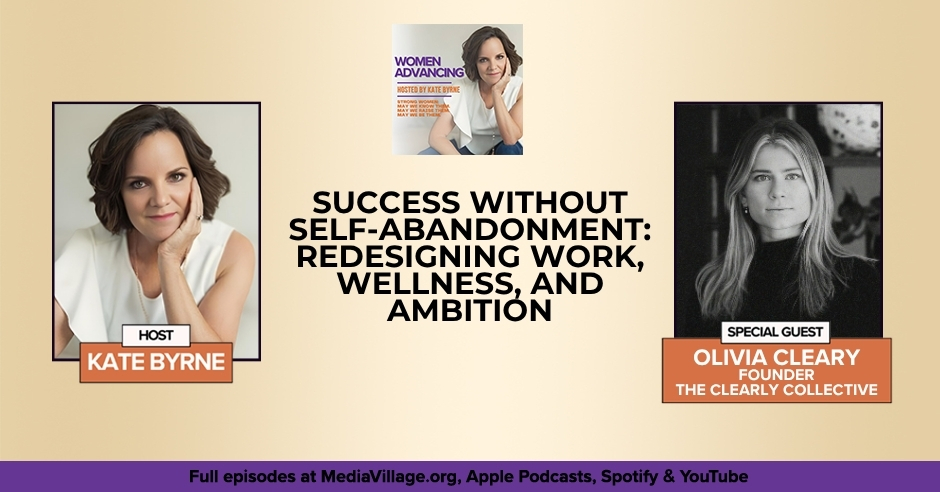
What if the secret to scaling your business wasn’t more hustle, but more humanity? In this episode of Women Advancing, Olivia Cleary, Founder of The Clearly Collective and Forbes 30 Under 30 honoree, joins us to flip the script on traditional career growth. We’re moving beyond the “more, more, more” mentality to explore wellness as infrastructure—not a reward for hard work, but the very foundation that makes it sustainable. Join us as we discuss how to redefine ambition, set radical boundaries, and design a version of success that supports the human doing the work, all without the cost of self-abandonment. It’s time to opt into a career that actually works for your life.
—
Watch the episode here
Listen to the podcast here
Success Without Self-Abandonment: Redesigning Work, Wellness, And Ambition With Forbes 30 Under 30 And Founder Of The Clearly Collective, Olivia Cleary
We spend a lot of time talking about women advancing, but far less time asking toward what? To what end? Too often, advancement is framed as more visibility, more responsibility, more speed, more, more, more, which just weighs me down thinking about it, with very little attention paid to whether the life underneath it actually even works. This episode’s conversation is an invitation to rethink that model altogether. What if success didn’t require self-abandonment? What if wellness wasn’t something you earned after building the thing, but part of how you built it in the first place? That’s right, you integrate it within.
My guest, Olivia Cleary, who’s the Founder and Chief Creative Officer of The Clearly Collective, has made some intentional choices about how she works, where she lives, and how she listens to herself while building a business. This is not a conversation about opting out, it’s about opting in with clarity, and opting in to you. We talk about redefining ambition, setting up boundaries as a business school, using distance, geographic and psychological, to gain perspective, and designing a version of success that actually supports the human doing the work. What a concept. You can end a day feeling well. If you’ve ever felt successful on paper but quietly completely misaligned in your body, your cortisol’s running gray, check this out. Stay till the end for KB’s Takeaways.
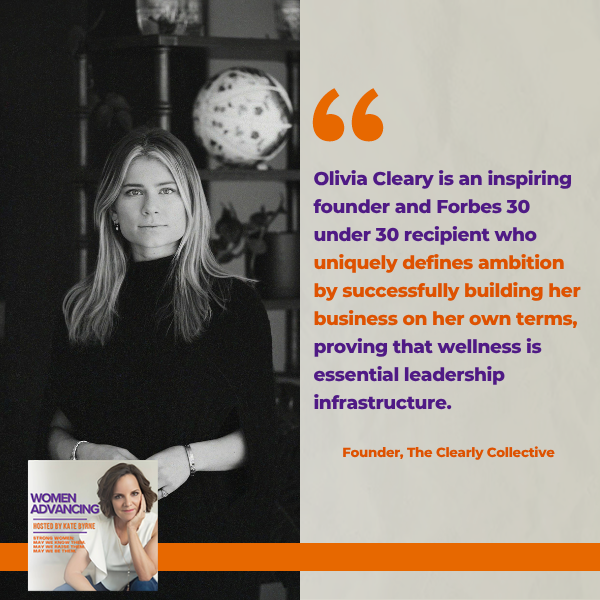
Join me in welcoming my guest, who is extraordinary not in only the level of her success, which includes founding a successful company, becoming one of the Tory Burch Fellows, winning the Darden Business School Entrepreneur Award, and most recently being named to the Forbes 30 under 30. The Founder, CEO/Creative Director of The Clearly Collective, Olivia Cleary. Welcome, welcome Olivia.
Thanks so much, Kate. It’s so great to be here.
Building On Your Own Terms: From Passion Project To Sustainable Success
We’re going to really dive in a bit because I think Olivia has had this extraordinary ability to do what so many of us have wanted to do, and that’s to build things on her own term. She hit a pause button when she needed a rest and a reset, and that only as so many of us love to know, resulted in greater success. Let’s jump right in. Quick little backstory. Tell the story how you came up with this whole beautiful idea.
This was a hobby that turned into something quite viral. Started out as me just trying to make really meaningful gifts for my friends and ultimately, what I did is I used Instagram as a platform for gathering feedback, and the first gift that I made for my friends was a silk scarf inspired by UVA, my alma mater. The idea was I wanted it to be meaningful but I didn’t want any logos, and I also wanted it to feel elevated.
I made that, goes viral in Instagram, and then random people start asking, “Can you do my college?” I started building a little mini collection on the side. I have a full-time day job in architecture and then corporations start reaching out and we really started launching our white label design studio after McLaren, the F1 team, reached out and they called me up. They said, “Can you make us a scarf?” when they saw the scarf, they said, “Can you make a dress? Can you make a car wrap? Can you do like our whole event?”
It opened me up to this whole world where we are now, where I run essentially a white label design studio where we take the essence of a brand, community, or destination and then create products from it. We have our own D2C line, which is silk scarves inspired by destinations and colleges, which is what is most like forward seen, but the reason why I got the Forbes 30 under 30 is because we’re really disrupting the corporate gifting industry.
Yeah, no kidding you are, which is extraordinary. I had forgotten the piece about architecture. Talk to me a little bit about that. It makes sense in some ways because design, structure. That’s an interesting jump.
Yes, it is and it isn’t. At UVA, I did architecture because I’ve always been creative, but the specific program I did was Design Thinking and there’s a lot of parallels between the two because it’s full immersion, start to finish, and the way that I design my custom pieces for clients, whether that’s a scarf or a different type of product, is really similar to how people build houses in the sense of let’s talk to the client. Let’s go to their house, let’s figure out everything that means something to them and then let’s work with them and iterate and bring them along that process to make sure that this is the most meaningful thing ever to them. I bring that same process to the gifting aspect of the company.
Go to the client, understand what truly matters to them, and bring them along the process to create something genuinely meaningful. Share on XFast forward, you do this, you make this shift and life has taken off, which is extraordinary. Has your definition of success shifted
Success for me, I think, has differed through the different phases of the company and I would say I had to go through each definition of success in order to get to where I am now. It started out as proof of concept. Anybody who wanted to buy the product, that felt good to me. It meant that what I was making was good enough. There was an exchange of like a monetary exchange. It evolved to people want to buy my art now. Success now is defined by will they purchase it at the correct value? Am I fairly being paid for the output that I am putting out there?
The next phase of success was defined by just financial sustainability. Can I make this hobby into a life for myself? Once I realized I could be financially stable, it was life sustainability, which is where I am now, where I know what to do to be successful in terms of finance. I know that the product works, I know there’s a market fit, but how do we make this sustainable? The only way to make it sustainable is with that life balance. That’s what I’m in the heart of right now, and still figuring out the nuances of defining that success. I’m sure there’ll be another level of success after that. Those are my definitions of success.
Wellness As Infrastructure: Recover Hard To Work Hard
I’m thinking about that with the whole notion. Thinking of wellness as infrastructure, to put it into structure-oriented, because as you just said, self-care is often framed as something you do after work is done. You’re doing it earlier. How do you think about wellness as a core infrastructure while you’re actively now getting ready to build this next business because you’re going to need to be firing on all cylinders.
When I think about wellness when you’re in a high-intensity period, the way that I think about it is that if you work hard, recover hard. If you are working to the long hours of the night, which are actually that’s what you have to do in order to be successful, then you have to recover just as much. What does that look like? For me, that means massages or yoga. It is very focused on like nervous system regulation. It’s things that bring my adrenals down, bring my cortisol levels down so that I can be at peace because that’s how you can be creative.
Also, a really important part of recovering is the act of doing nothing, which is the most difficult thing you can do as an entrepreneur because you get rewarded for doing things and so you’re almost going against your instinct to do nothing because it’s not productive. What I have found is that if you don’t have that in this hard recovery that is needed, it’s not sustainable. That’s really what where I’m at right now.
Right, because that’s the whole bit of the boundary that you had to learn. Sometimes, you have to learn that hard way to protect that energy because while it feels like it’s not productive, it’s a long-term productivity tool.
Absolutely. One of the interesting things that I’ve found is during these periods of doing nothing, which could be anything from meditating, which I think works for some people, but for me it’s really long walks with AirPods in just so to block out sound, but there’s nothing actually playing. What I like to do is try to be an observer of my own mind and I let my brain run out whatever thoughts are spinning like, “Did I send that email? I need to think about this plan and that plan.”
The moment those thoughts stop, there’s some really cool stuff that happened on the other end of that. It’s really uncomfortable to lean into this unpredictability of whatever that space is, but I’ve always had really amazing breakthroughs in this space of nothingness after I’ve let my brain run out. It actually ends up being creative and productive even though it feels like you’re not leading into it.
During those periods of doing nothing, the moment your thoughts stop, something really cool happens on the other side. It’s uncomfortable to lean into the unpredictability of that space. Share on XYeah, when you think about it, it’s a cool idea. It’s almost like just letting the replay tape go on and on and then it’s almost as though you’re witnessing your neuro self-regulation.
Yes, let it putter out. It’s going to keep going and going, but just let it let it go and then you can come in.
Which is also good and that’s probably a really good lesson too as an entrepreneur because it’s so tempting if something doesn’t happen right away you’re like, “Okay, forget it,” but it gives you that tasty little bit of patience that’s like, “Thank god I waited that extra half beat before giving up” because to your point, something extraordinary just came through. I know this has all been relatively, well, within the last 6, 7 months, this awareness. Was there a moment when you realized that old version that drove you to this? What did that look like? What did you have to let go of to make room for this?
I think for me, it wasn’t a moment or a lightbulb moment. It was I was unhappy. I think what that’s now a signal to me that things aren’t going the right way, but it wasn’t.
What does that look like?
Getting into the psychology of it, one of the first indicators that I know that I’m being burnt out or something is not working the right way is when you have self-doubt and self-thought like you’re attacking yourself and your brain is attacking itself. It’s saying anything like, “Liv, that idea’s not going to work. You’re not good enough for this,” those self-doubts and it’s like if you think about your brain like a computer, let’s just say like computers are not supposed to self-destruct. They’re just supposed to move forward. If we apply that logic to our own brains, why would we want to self-destruct ourselves?
Whenever I get into those little mental loops which are hard to get out of sometimes, especially if there’s evidence that things aren’t going well, the first question is let’s look at the data. Are you actually failing? Is this actually true? The next part is okay well let’s just make a plan to get out of it. Let’s just figure it out. I’ve had a fair share of times when the reality was things weren’t working out and I just needed to get a plan to get out of it and then your brain starts switching once you have a way out of it.
Physically, my check-in system is my anxiety manifests very physically and it always happens in my chest. I always feel a tightness in my chest if something isn’t working well. I’ll be honest, sometimes it just happens during stressful days and you can’t be perfect and sometimes I will have tightness in my chest but it’s either like the self-destruct thoughts or the tightness in my chest that always make me come back. First, have the data analytical approach and then it’s the body approach. It’s okay am I eating? Am I sleeping? Let’s get the baseline back to normal.
Facing Discomfort: Dive In, Listen To Yourself, & Reset Your Life
The thing about all of this is when looking at the things that aren’t working, I find sometimes, it’s hard. It’s scary. It’s like it’s there. For me, it’s a form of procrastination sometimes. There is something that I know that isn’t really right but, “I don’t really want to deal with it,” or “I don’t want to look at it,” or “It’s going to make me sad,” etc. How do you counter all of that? I guess the reality is if you don’t, it’s going to get so much worse. The longer you wait, so you might as well just rip the band-aid off and dive in.
I think the hardest part is the action taking. What I’ve found is I just talk about my problems with all of my close friends and family who know what I’m doing and are interested in what I’m doing. We were having some positioning issues because we have both a B2B brand and a D2C line. It’s like we’ve two different customers and so it’s hard to sometimes talk on our marketing channels to these people.
I’ve been trying to figure out how to reposition, reposition, but that conversation, I talk to so many different people and I talk to people close family friends, but also people who I knew were smarter than me just to get different takes and it started becoming more and more clear what I had to do. Some people would give me advice and I would know that that was just bad advice because my clarity was surfacing. I think for me, I always have to create a very clear plan and that’s done by maybe three months of talking to a lot of different people and just getting input. That’s how I’d say to get out of a rut like that.
I was going to say I think that’s one of the things that I’ve been telling my daughters more and more. I’m like, “It’s fine. You can go talk and you can ask for advice and all that, but just remember everything that people say, it’s going to come with a bit of their baggage on it and it’s going to land. You’ll know the way it lands within you.”
That’s a great thing. Once you realize that doesn’t align, that’s a signal that you’re getting more clear in what you want.
Right, you’re on your way. “I can listen to me now.” things were getting crazy, you were unhappy, and then tell everyone where you moved.
I was living in New York for four years and definitely got caught up in the rat race. I realized that it was too much for me. I needed a break. I was tired, exhausted, and I moved. I first moved to a tiny house in Santa Barbara, California and I lived there for two months. I went to Charleston for two months and then I went to Italy for a year.
It was terrible, obviously. Someone had to do it. I didn’t actually know why I wanted to do it at the time, I just knew I needed to change things up. It wasn’t working for me. I had this opportunity as like a remote person I could work from anywhere. It was like I got to take this, so I did. It was the best decision ever.
I’m so glad you did it because there would be a lot of people that I’m sure a lot of people are thinking, “What are you doing?”
Yeah, I got that.
Another thing is you have to listen to you because at this point what works for you is not going to work for anybody else. One, you’re an entrepreneur to begin with so you’ve already got more guts. You’ve got good intuition. After you just do that, it’s like, “I’m going to do this and let’s just see what happens.” it was going to be great anyway because it added probably years and years to life just for helping you get greater clarity, but also slough off all the old stuff that wasn’t a fit and that’s okay.
I think for me, especially I’m very into wellness, so this is all wellness talk here, but the impact that cortisol has on the longevity of your life is so bad and also, it has an impact on you physically even in the short term. The tightness in my chest was more of a constant thing and I think that scared me. I was like, “I can’t continue to live this way but I still want to be successful and work really hard. I need to balance that. I’ve got to figure something out, something has to change if I’m going to continue to work as hard as I do.” Obviously, living in Europe is a very different lifestyle than the US and it did teach me how to regulate. I was almost forced to by that culture.
Work Your Way: Listen To Your Body, Delegate, & Design Your Own Rhythm
Yeah, and plenty of successful people there. There are other ways to do it. I once worked for a Norwegian company and that drastically shifted so many things. I gave myself so much more permission as a result. For folks who are reading and craving more freedom or alignment but they don’t even know how to start, what’s one permission slip or wish you wish someone had handed you earlier?
I think one of the biggest permission slips that I would give somebody, and this is under the assumption that they are already working for themselves and building this life, perhaps it’s still in chaos mode and you haven’t figured it out. Listen to when your body is tired and take that nap when you need it because you’ve you have worked hard enough to have the luxury of setting your own hours.
Listen to your body when it's tired, and take that nap when you need it, because you have worked hard enough to enjoy the luxury of setting your own hours. Share on XIf you plateau at 3:00 PM, take that break because we know you’re going to be working at 7:00 PM anyways, so don’t contain yourself to the 9:00 to 5:00 workday schedule that you came from. I think figuring out what your rhythm is so important to your success and not everybody works from 9:00 to 5:00. That’s some advice I would give.
I think that’s so true. Figure out what types of things you are good at working on at what hour. I’m much more if I have to do writing, writing for me or anything like really math-detail oriented, first thing in the morning. Just super crazy ass early morning where people think, “You get up at that hour?” I can’t imagine not getting up at that hour. It’s so quiet and this has not started getting filled with all of this. My schedule doesn’t always work for other people, but it does work for me.
I’m so there with you and there’re going to be people taking it push back and they’re going to say, “Yeah, but if I do that, I’m going to fall behind.” Why is that a bit of a myth? I think it’s a myth. I’m totally leading the witness here. You’re living proof. You can listen to your body and you can listen to what it needs and not fall behind.
I’m going to give an analogy that I can’t take credit for. My friend gave it to me. It’s the idea about falling behind. Imagine that every responsibility you have is like a beach ball. Basically, every day, you have to decide how high you’re going to hit that beach ball into the sky because it’s going to come down at some point and they’re all in the sky but you can hit one a little harder so it comes back down a little bit later or you can hit one a little bit lighter. All the beach balls are always going to come down and you’re always going to be able to hit it back up. I think the prioritization of these beach balls is the most important thing you can do in your day.
The second part I would say to that myth is like have you ever tried to take a day off and not do anything? Maybe not do anything but perhaps focus on just one task. I’ll use an example that I’ve done that proved it to me that I can take things off. When I’m in deep design work, I sometimes need six hours of uninterrupted time that I could be using for emails, I could be using it for meetings and stuff like this.
What I’ve found is that if I can shut off the world on Wednesdays and not talk to anybody, I get through so much stuff if I’m not code switching between a million different things. The emails are still there. It’s okay. The other thing I’d say is for tasks that take up your time like email, like decks, use AI. All that basic work, free up your time.
It’s absolutely true. Figure out a delegate all that stuff and it isn’t cheating.
It’s just organization. It’s just systems.
It’s also self-preservation, quite honestly, because then you’re best for you. I’ve started doing that with actually Mondays. Just meeting-free Monday, game changer. No phone calls either. Just that one extra. If I want to do, then I’m doing it on my own thing and I agree, you’re so rested. Also for people, seriously, it’s okay to shut off when you are on vacation.
You have to. That’s a part of the recover hard. If you’re taking the time to go on vacation with a loved one and you’ve spent the money to do it, do not waste it. That’s something I’ve learned.
If you have a right hand, then delegate because it’s a total professional development opportunity. Guess what? It’s a really good one to remember, especially for founders. It can go on without me. When and if one day, anyone should want to exit or have some a succession plan, you will feel more comfortable and the team will feel more comfortable too.
Also, it’s building up to that what’s the bus plan? There’s some terminology where it’s like if you get what’s the probability that if you get hit by a bus the company is going to go under? You need you need to figure this out regardless. You just you have to.
I know there’s some founders who pride themselves on, “The company is me.” that’s great but do you want it to live on after?
I think that that’s also tying back to your first question too, definitions of success. I think the beginning success is that this company is me. As you phase into more of a I think where I am now, which I used to be that old mindset, the success is that this company can still run without me, which will help this to be sustainable.
Advice For Younger Self
For me too, I think. I had someone talk to me about this notion of back casting as opposed to forecasting. Figuring out, if my ultimate goal at this point in time is to get here, how can I roll it back? How can I reverse engineer? What do I have to do? What kinds of things have to take place to make that happen? Olivia, thank you so much. One last thing, one last question. I’m so anxious, I want to give you time back, but knowing what you know now, what advice would you give your younger self?
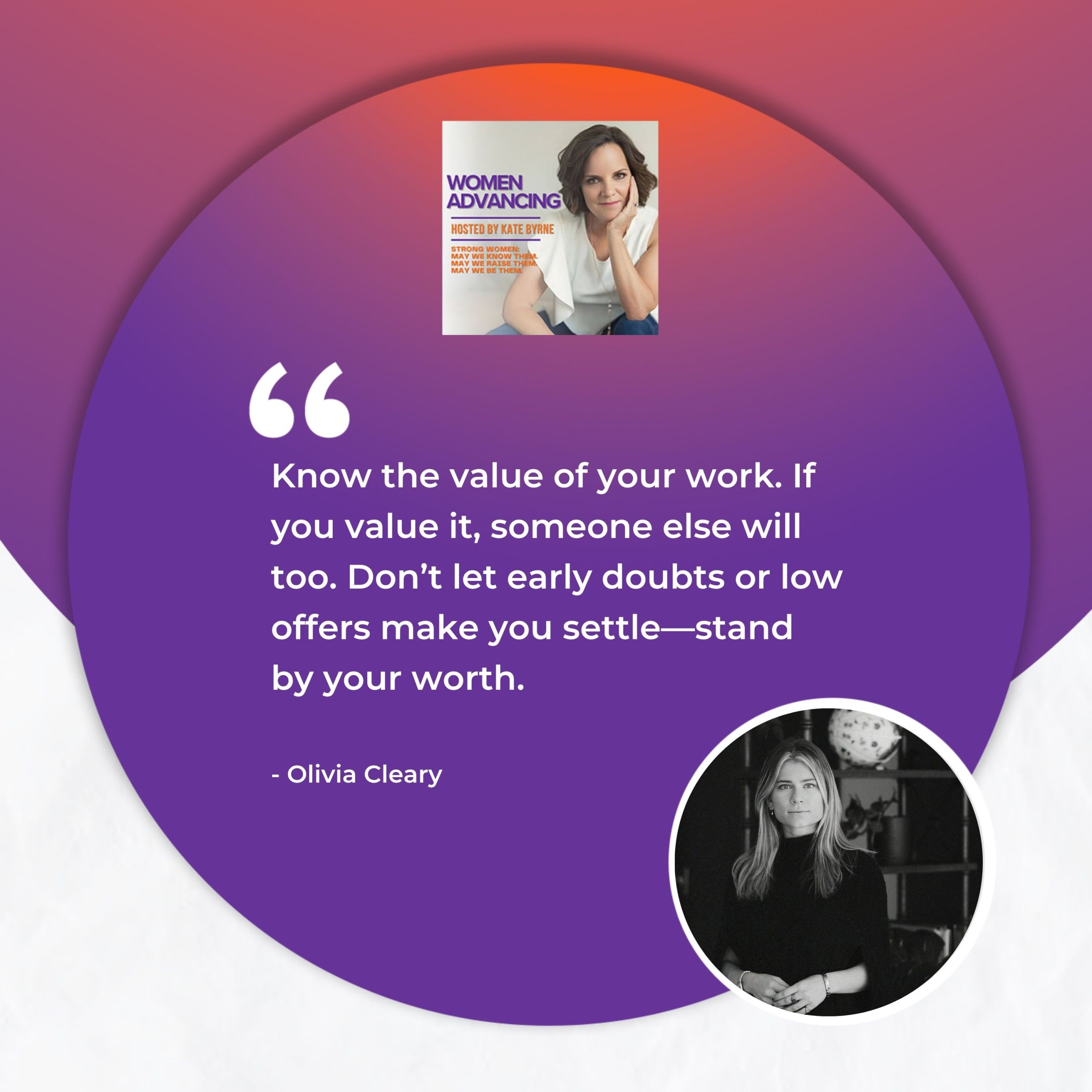
I think the advice I would give my younger self is to know the value in your work and if it’s something that me or I value, there will be someone out there that values it just as much. Just because someone’s trying to cheap you out, which happens a lot when you’re not established, that does not mean that you should buckle down for that. You should always understand your value.
It’s one of the quickest things I think so many of us tend to undervalue. We get so upset because people underestimate us and yet we’re usually the first ones to set that bar. I cannot wait to see what happens next with you, Olivia. For those of you, Olivia and I are going to be doing a panel together at the Tom-Tom Festival, which is happening in Charlottesville, Virginia at the Innovation Summit on April 23rd, 2026 from 2:00 to 3:00. By all means, if you find yourself or are inclined to want to come to Charlottesville, which you should because it’s a lot of fun and this festival in particular is amazing, make it down there.
Absolutely. I second all of that. It’s a great place to even just hang out for the day.
Alright, Olivia, to your continued success and thank you so much for sharing your many pearls.
Thank you.
—
What a fantastic conversation and so positive from a young founder. I love it. She’s been through a lot as in ups and downs and all arounds and she’s really continued to rise higher and higher. Imagine your idea what started off as a hobby on a Insta page going viral. Amazing. One of the things that I keep coming back to in the conversations like this is how quietly radical it can be to actually design a life that actually fits us, which is so stupid.
What Olivia reminded me of is that clarity isn’t something you just hustle your way into. You have to stop, you have to take that beat, and it often comes from changing your vantage point and slowing down and stepping back and listening more closely to yourself than to the noise around you. Advancement isn’t always looking like acceleration. Sometimes it looks like discernment, sometimes it looks like boundaries, sometimes it looks like the choosing wellness not as a reward but frankly as a downright requirement.
Here’s what I want to leave you with. What if the next level of your work doesn’t ask you to push harder but to design more intentionality? That question alone can change everything. My takeaways, success doesn’t have to cost you yourself. In fact, it’s really far from successful if you no longer exist. Wellness is leadership infrastructure. It’s not a luxury, it’s a must-have. Distance, be it geographic or psychological, that creates such extraordinary clarity. Boundaries are in fact a business skill, as well as a personal skill. You’re allowed to redesign your definition of ambition and your definition of success. With that, I look forward to seeing you next time on Women Advancing.
Important Links
About Olivia Cleary
 Founded by Olivia Cleary, a graduate of the University of Virginia School of Architecture and a 2026 Forbes 30 Under 30 honoree in Art and Style, the studio began in 2021 with a single hand drawn illustration on a jumpsuit created in New York City. What started as an exploration of architectural storytelling in wearable form has grown into a practice shaped by research, spatial thinking, and a deep respect for context, expressed through hand drawn illustration and precise craft.
As The Clearly Collective has evolved, Olivia’s work has received recognition through the UVA iLab Incubator in 2024, the Kathryne Carr Award for Entrepreneurial Excellence in 2025, and the Tory Burch Foundation Fellowship in 2025. These honors reflect the distinctiveness and discipline of the practice she has built.
Today, The Clearly Collective is a multidisciplinary design house with a global community of collectors and collaborators. Our work spans heirloom grade silk textiles, bespoke commissions, and narrative driven design for hospitality groups, heritage organizations, private clubs, cultural institutions, and global brands. Each piece is illustrated by hand through a process rooted in architectural research, storytelling, and precision craft.
While silk remains our signature medium, the studio continues to expand across new formats and materials. Regardless of scale or discipline, our mission remains constant: to create designs that hold memory, express identity, and carry story.
The Clearly Collective is led by sisters Olivia and Amelia Cleary, who guide the studio’s creative and operational direction. Olivia leads design as Founder, CEO, and Head of Design, and Amelia oversees operations as COO, with financial leadership from CFO Mary Houle. Together they form a fully women founded and led core team. The studio is supported by a broader network of women across key disciplines, enabling the practice to scale while preserving its singular creative voice.