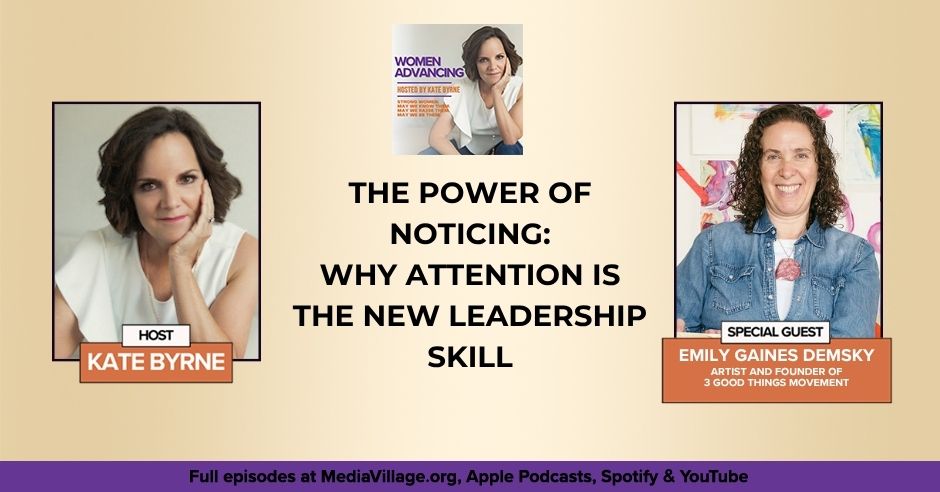
In a world engineered to drag our attention toward negativity and urgency, the ability to consciously direct our focus is a radical and powerful leadership skill. Artist and advocate Emily Gaines Demsky joins us to explain her transformative 3 Good Things Movement, which moves beyond standard gratitude exercises into a tangible, daily commitment to noticing beauty. By learning to anchor our awareness in the simple, quiet joys surrounding us, we can interrupt the cycle of despair, cultivate resilience, and develop a flexible, “hawk-eye” perspective that helps us connect dots, solve problems, and lead with clarity even during difficult times.
—
Watch the episode here
Listen to the podcast here
The Power Of Noticing: Why Attention Is the New Leadership Skill With Emily Gaines Demsky, Artist And Founder Of 3 Good Things Movement
This conversation is deceptively simple and yet quietly radical. It has to do with where we place our attention, our ability to shift perspective, and how that’s really an extraordinary act of power, the key leadership differentiator. My guest, Emily Gaines Demsky, who is an artist and advocate and the founder of the Three Good Things movement, does not just care about art. She helps people see differently.
She really helps shift perspectives, and in a world engineered to pull us and drag us towards fear and outrage and urgency and focus on all that’s wrong and negative, that ability to notice what’s actually good, present, and possible, probably one of the most powerful leadership skills we actually have. We will talk a lot about the difference between gratitude and noticing.
Why small things matter a heck of a lot more than we think, and frankly, could be your pathway to something enormous, and how perspective itself is a huge, massive form of power. The question is not just what’s happening around us. It’s what we’re training ourselves to see. Let me know what you see, and be sure to say it at the end because I have got a ton of KB takeaways. Let us start noticing. By all means, at the end, be sure to share your three good things.
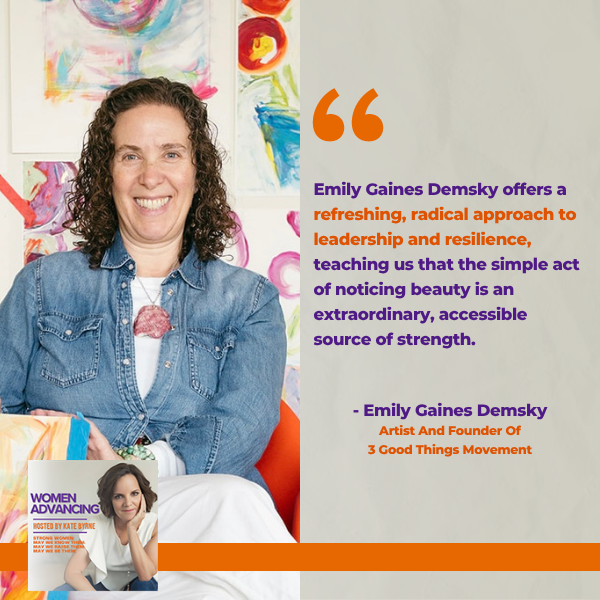
Women Advancing audiences, you’re in for a treat. Please join me in welcoming Emily Gaines Demsky, who is an artist and advocate and the founder of a really cool movement and effort called Three Good Things. We will get into all of that and more. Let us start. Emily, welcome.
Thank you for having me. It is a thrill to be here with you.
Redefining Creativity As A Perspective Tool
It is my pleasure. I want to start off a little bit because so many people wish that they could do art or be creative. One of the things that I love is the way that you see, and it is on your website, art as really a perspective, and you describe it as bringing light into the world, but not in a naive way. What does it mean to you to use art as a perspective shaper rather than just some sweet, pretty little thing to look at?
I love that question. Here is what I will say. First of all, I want to talk about people who feel they are not creative. I hear that often. I believe everybody is creative in different ways. Maybe you are creative in the kitchen. Maybe you are a creative gardener. Lots of times when I am painting, I am working with my non-dominant hand because I am trying to get out of my thinking brain and into the experience of what I am doing. I do believe everybody is creative.
In terms of how I feel that art brings light to the world and changes the world, I believe deeply that every time we are exposed to something new, something beautiful, it changes us. It might be a tiny change, but I like to say that if I can place a speck of beauty before your eyes, it will change you in that moment. Maybe it lifts your spirits, maybe it makes you think about something, maybe you cannot stand it, but in some way, it changes you in that moment. When that happens, it changes the trajectory of where you are going.
It changes the way you are thinking, the way you are showing up. We are changed by everything we encounter in the world. If I can bring beauty before your eyes, then it changes you, I hope, in a positive way. I will add to that as we move, and we will get to this. I know when we talk about the three good things we practice, but as we move through challenges in our own lives and in the world, it can be easy to fall into a darkness of sadness and despair. I truly believe that in order to hold on to hope in our lives and in the world, we have to hold on to our awareness of beauty.
So well said. The thing that is so true. I love the word speck. The fact that with that statement alone, the truth is, good thing, bad thing, who knows, but you’re moved. You feel it breaks through that numbness, not only just your vision, but really your senses, and your heart opens. Everything about you wakes up.
I call it interrupting autopilot. We are moving through our days. There is a Sanskrit word in yoga that I think is called sadhana. It is the groove that we wear in the world as we walk through our routines over and over again. I love a routine. We have to interrupt that autopilot. It keeps things fresh. I will say one other thing about the art and the perspective, which is that I used to feel shy about the fact that I paint flowers. I primarily paint flowers. The reality is, I paint flowers because they are a guide. They are a symbol of hope and possibility. We bury a little seed in the dirt under the surface of the earth in the dark. That seed opens in darkness and reaches through the dirt for the light. The flower is our guide. If the flower can do that, it reminds us that we can do that too.
Season after season after season.
If I have houseplants, I have houseplants. They mean they grow toward the window. We can do that too.
They go to the light. It is so beautifully put. Share a little bit now because you just referenced the three good things practiced. I am curious how it came about. Because I know it did not come from a good, a good moment. It was literally you practicing what you preach, walking your talk. Share a little bit about that, and what you understood about that period and perspective that a lot of people sometimes only learn the hard way.
The Origin Of The Three Good Things Movement
The true origin point happened when I was 25 years old, and my father was dying of cancer. He came to Thanksgiving that year, and he had written this, basically a manifesto on life that he shared with us. It included the words, “I am thankful for the blessings of life and love, and I am thankful for the lessons I am privileged to extract from my trials and tribulations.” I did not really understand the power of the words at the time, but they have stayed with me my whole life. In the summer of 2015, I was going through a difficult time.
Personally, my daughter had had an accident, and my grandmother had died. I felt like I was standing outside the pastry shop, looking in through the window at this beautiful array of pastries, and I couldn’t get through the door. I knew that there was good in the world. I knew that I could learn from my challenges, but I did not know how to access them. I remembered that a friend had told me about a thing she did with her friends, where they sent each other emails each night with a list of good things from their day.
I remember when she told me this, thinking to myself, “That is really nice, and I am already grateful, and I do not think that would make any difference to me.” Here I was in the summer of 2015, and I was really struggling to find my way out of grief. I was looking for the tools. I knew it was possible, and I was looking for the tools. I sat down, and I wrote to my friends, and I said, “I am going to try this thing.” I started sending my friends an email each night with a list of good things from my day. My friends started writing back to me.
In order to hold on to hope in our lives and in the world, we have to hold on to our awareness of beauty. Share on XVery quickly, everything changed because all of a sudden, we were on this collective quest for evidence of goodness in the world. We were waking up in the mornings to emails with lists of good things. Imagine starting your day that way rather than starting with the headlines. Really, everything changed very powerfully. In all honesty, I have sent myself an email with a list of good things from my day every single night since August of 2015. I have sometimes emailed with those friends, sometimes emailed with other friends.
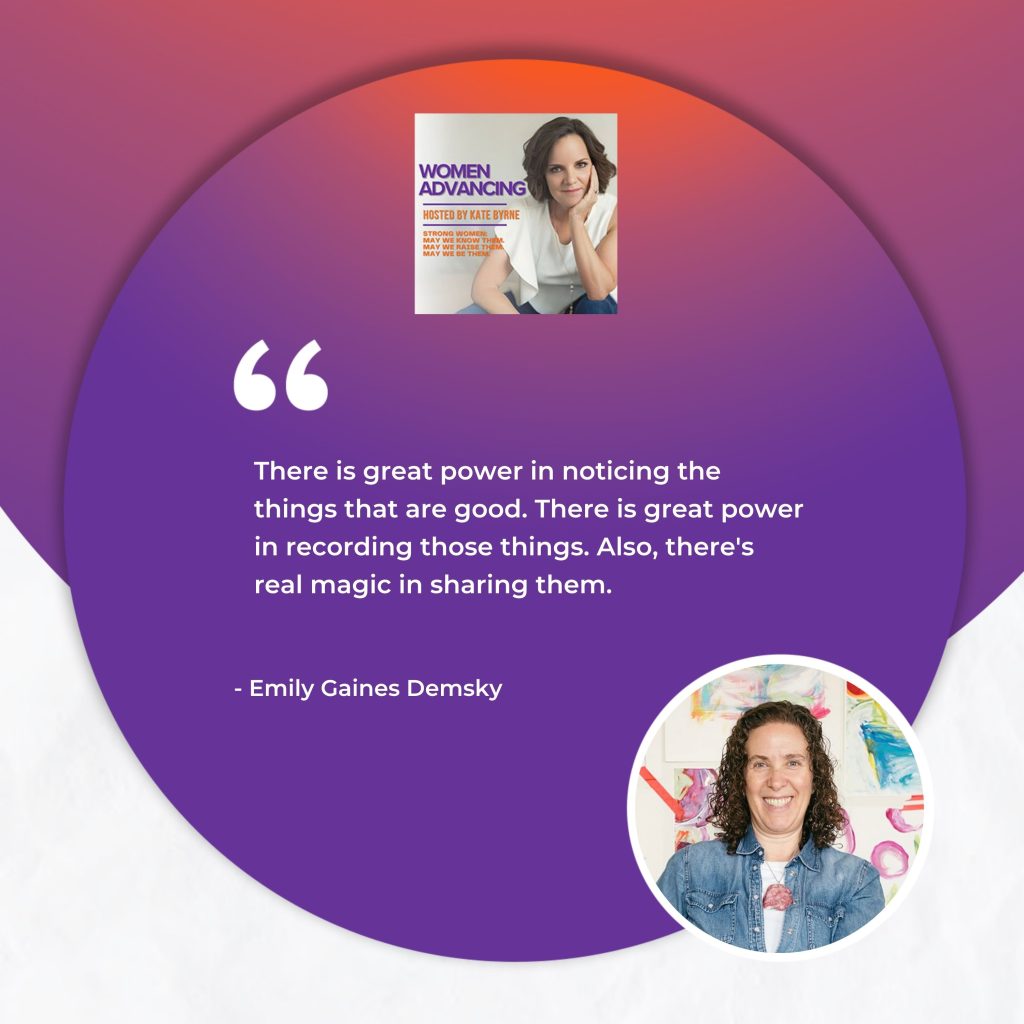
I have emailed with strangers whom I met along the way because, for a long time, if I would meet somebody who was struggling, I would say, “I do this thing. Do you want to? I will email you, you can email me back.” I collected people, and there is great power in noticing the things that are good. There is great power in recording those things. Also, there’s real magic in sharing them. I did that quietly with a handful or a couple of dozen folks over many years. In the fall of 2024, when I felt that the despair in the world, in the atmosphere, was so great, and I had a dear friend who said, “We do not have to do everything, but we have to do something,” and I did not know what to do.
I thought, “This helps, I know how to do this.” I started this Substack, and I started talking about this practice and sharing more widely. Over the course of fifteen months, it has snowballed. Now I sit down each night, and I send a list of simple good things from my day to more than 58,000 people. People are invited to then share their lists of good things in the comments. Here is what has happened. First of all, people write to me all the time, and they say, “This has changed the way I walk through the world. I see things differently.”
Second of all, we have built a community, and we have built bridges across different areas because there are high school students and great-grandparents. There are people of all religions. There are people from six different countries that I know of. There are people, there are executives and farmers, and people who are so different. Everybody loves the night when there are clean sheets on their bed. You see that come up over and over. There are certain things that we all love. It expands our awareness of the humanity of the other.
That is exactly what I was going to touch upon is the humanity of the in this day when everyone is so numbed out, dissociating, compartmentalized, frankly, getting as small as they can be just so whatever is coming does not hit them, blows over as opposed to standing tall, standing big, making open, even when I was just describing that, it really made me think about how it gets, it is so dense. It is such dense energy. It is so heavy. It blocks you and clogs you up. Whereas good, and it can be so simple. That is the thing. We are going to get into that next one. We are talking about noticing versus gratitude. It is just the simple things that we are so lucky, or that mean something to you, that bring that speck of joy in your life.
We evolved as a species to detect threats and danger as a means of survival. That is essential to how we got here to be able to outrun the predator, for example. The hard things are really calling our attention, whether it is something in the news that you are reading that is horrifying to you, or pain inside your body. If you have a pain in your body, it is talking to you all the time. The hard things are really loud. We have loud, good things. There are birthdays and weddings and graduations. Also, there are so many good things that are whisper-quiet. My favorite pair of socks, the open window in spring, are good things. They are happening whether we notice and name them or not.
No, it is, it is absolutely true. I can completely understand why those who have historically not been watching, looking, or noticing. How something like this practice would literally open their eyes, but also really more of their heart.
My husband asked me recently if I think that some people are just glass-half-full people and some people are glass-half-empty people, and if that impacts this. It is a great question. I have seen this practice impact people who are glass-half-full and people who are glass-half-empty. I said before that when this friend first told me she did this thing with her friends, I was like, “That is not going to make a difference for me. I am already grateful,” but it does make a difference for me, even though I am already grateful. Somebody else I know who really has struggled to find feelings of gratitude or see the positive in difficult times has also benefited from it. It does work both ways.
Why “Noticing” Outperforms Traditional Gratitude
Let us talk a little bit about that distinction between gratitude and noticing. Noticing is probably sometimes more accessible, yes?
Yes, I think. Go ahead. No, finish your thought.
No, I was just going to say, and more, I do not know, more real, more honest or something than trying to be grateful because sometimes it is hard. You want people to feel grateful, but you also do not want it to be manufactured.
Yes. Kate, when you look up the word gratitude in the dictionary, the definition is a state of feeling or being thankful. How do you summon a state of feeling? There are ways to create conditions that might lead to a state of feeling, but we have all read the reports of how gratitude is linked to positive outcomes in life satisfaction and longevity, and I believe in that. Also, lots of folks bristle when you start to talk about gratitude because they do not feel thankful, and they do not know how to get there, and so it feels unavailable to them.
This practice, tell me three good things, does not ask you to feel anything. All you have to do is notice what’s good, name it by saying it out loud, taking a picture, or writing it down, and then share it. Whether you text that picture to a friend or leave a comment on the Substack or talk about it at your family dinner table, sharing it with somebody else is the piece that creates the connection, creates the community, and frankly, I think is the secret sauce in the practice because it is fantastic to notice. It is really helpful to name the things that are good. It amplifies them.
It gives them substance outside of your own awareness, especially right now when our awareness is flooded with input all of the time. It’s hard to remember the nice thing that happened at 7:15 this morning by the time you get to the end of the day, right? If you write it down or take a picture, or say it out loud, you are more likely to remember, but sharing it is where we really strengthen the neural pathways in our brains, shine a light for other people to be able to see more of what’s good, and then expand our awareness of the humanity of the other person.
Good things are good things. It does not have to be universal. It does not have to be special. Share on XIt really seems to me that is what exponentializes it. It anchors it. Others witness it. You witness it. Somebody responds and says, “I love clean sheets too.”
Yes, exactly. Last week or two weeks ago, I wrote about penuche frosting. Do you know about penuche? It’s a brown sugar caramel. It was my father’s favorite fudge at the fudge shop growing up. I have this frosting recipe that I make around his birthday each year. I wrote about this, and people have heard of it, but it is not common. Many people responded and said, “My grandmother used to make penuche this.” It was just this point of connection for so many people. It is a reminder, really, of how we are all the same, even though we are all different.
It is a reminder of something so simple as candy, fudge, frosting, or your favorite, whether you were a Fritos person or were you do not want to be. That is the part that I think may seem silly, but it is really not. It is such a great starting point in so many ways for connection to seeming, at least to seeming strangers.
I will tell you two things. One is that I am constantly reminded. I love it when this happens. Hundreds of people leave comments on the Substack each day. Lots of times, people are all over the world. Lots of times, people will write, “The sun was out, the sky was blue.” Sometimes somebody will write “rain” on their list of good things, and every time it happens, I am so delighted to remember rain is a good thing. It makes the flowers and trees grow. We need rain. Some people prefer rain over the sun. It depends on the day. It depends on the person. Good things are good things. It does not have to be universal. It does not have to be special. You do not have to be on vacation. The simplest things, the rain is a good thing. My rain boots are a good thing.
It is such a good recall, too, of understanding that everyone has different life experiences. They’re coming from different places. I am just sitting there thinking because coming from California and Northern California, where there are so many fires and such, either that or there was huge rain, primarily we had the fires, so coming out here to Virginia, I am so cognizant and appreciative of the four seasons.
I, and Maryland, I say that all the time. I love living here because I love the seasons. I might like some more than the others, but I believe I appreciate each one because of the others.
Training Your Brain To Notice Goodness
Yes, because of the shadow side. It actually takes time to train yourself. I do not even know if I want to say train myself, but that’s probably the right word, I guess, to notice what’s good because right now, as you just said earlier, everything is being dragged down into what’s negative and what’s awful. It keeps us stuck.
That is why I call this a practice because practice takes practice and practice makes practice. In the same way, Yo-Yo Ma does not stop practicing. The practice is something that goes on. We do it regularly. It is not a means to an end. The end is the practice. I always say, when we practice, so it would be easy sometimes to say, “It’s a great day, as everything went so well today, and I have so many things I do not even know where to start.” I do not need to make a list today.”
When we practice on a good day, it helps develop the muscles so that when we get to the hard day where we think, “I do not even know what to do with this,” we already have a muscle memory that teaches us how to do it. It is like any other practice, whether you’re lifting weights or learning to play the piano, it’s anything like that, it’s teaching your brain a new skill. This one is so simple. There are folks for whom the noticing comes easily, and there are folks for whom it does not. When the noticing does not come easily, here is what I like to say. First of all, it helps that other people are sharing because sometimes that sparks something for you.
Practice takes practice, and practice makes practice. Share on XThere are lots of prompts to generate the notice. For some people, it’s a body scan. I’m paying attention to my body. What are the parts that are working? Frequently mentioned opposable thumbs. It was simple. It’s such a good thing. My heart is beating. I woke up this morning. It can be about your physical body. It could be something, Kate, from your seventh birthday party. It does not have to be from today. It can be old. It can be repetitive, because turning our attention to something good is turning our attention to something good.
I was going to say when. Good is good. There is no limitation on an expiration date.
If it is hard on a particular day, then there are lots of other access points to get into noticing. When all else fails, I do come back to, “My heart is beating. The air is moving in and out of my lungs, and I have opposable thumbs.” No kidding.
Balancing Light And Dark Without Toxic Positivity
How do you hold both the hard things and the good things? Because of your point, they’re both there, and so you do not want it to be like “Pollyanna, la la la.”
Correct. I actually think this is what held me back from sharing the practice for so long, when I was doing it quietly on the side, that I was concerned about the appearance of having toxic positivity. This is not toxic positivity. This is not, I say this all the time. This is not instead of what’s hard in the world. What’s hard needs our attention. If you have pains in your body, you need to go to the doctor.
If you are worried about what’s happening in your community, you need to step up and take action. What is hard needs our attention. This is in addition to what’s hard. This is so that we do not lose sight of the fact that there is good in the midst of the hard. This is how we keep our spirits and our hopes alive and hold a vision for a brighter future. As long as we can keep stoking the fires, the embers of what’s good, we can keep hope alive inside of ourselves and in our communities.
That’s a great visual, actually. I can see it through your words. I cannot help but think I started thinking about leadership, right? I guess, in some ways, perspective is a form of power?
I think it is. I believe that it is. The way I see the world is that we do not choose what happens to us, but we choose the way we respond. In that way, I do believe that perspective is power. We choose what story we attach ourselves to. We so often think something is true. When we investigate it, it turns out there are other ways of seeing something. I used to say when my kids were little, we would be in a restaurant where there were those glass salt shakers.
I would say to them, some people would look at that and say it’s clear, some people would say it’s full. Some people would say it’s square. It’s all of those things. It is not any one thing, and there are so many different ways to see it. The more we can be flexible and nimble in the way we look at problems, look at our lives, look at the world, the more potential we have for creative solutions.
That would be a great way to understand how perspective can really help leaders, and how it actually impacts how they lead, I would think.
I would just add to that, Kate, tell me three good things. Practice is so simple. It takes you two minutes to do this, but it is a little loosening of the fixed, can be a loosening of the fixed mindset, or that stuck energy. It is just enough to maybe untie a knot. It does not necessarily have to be related to the problem that you’re having. Doing this mental exercise creates a facility with thinking differently and space.
If you are worried about what's happening in your community, you need to step up and take action. What is hard needs our attention. Share on XAll of a sudden, solutions can come. I was also thinking, by having that more positive perspective, it certainly would, I think of it akin to a resting heart rate when you work up, and then your heart goes up, and then you quickly, it helps auto-regulate. Similarly, this perspective would certainly help your resilience factor. I am going through a rocky period, but I got it.
I see this in people all the time who say to me, “I thought everything was terrible.” I realized a guy wrote to me recently and he said, a gentleman wrote to me and he said, “My father is in hospice, and my siblings and I have been sleeping in the hospice room with him for two weeks, and our spirits are really low. I introduced them to this idea, and we all started naming good things, and it changed the way the mood is in the room.”
It changes the air in the room. Once you start with this practice, you will see that you can go from not being able to notice what’s good to being able to see the good in the midst of the regular days, to being able to see points of light even in really hard times. Ultimately, I see people saying things like a woman said to me yesterday, “I went to visit a friend who is dying, and it was really heavy on my heart.”
Now that we’re talking, having this conversation, I can see how lucky I was to have that visit with my friend.” The reframing, and it is a continuum, and we do not all have access to all of that every day. Also, when we say three good things, that is not the sum total of our lives. That is not a picture of somebody’s whole story. We are all carrying heavy weights. The weight of the world is heavy. Sometimes it is really hard to get to those things, but it is a continuum, and the whole range is there for you.
Scaling Perspective: Zooming In And Out For Leadership
I also think it really helps you take a beat and realize, as you said, altering the perspective and saying, “Things happen for me, not for me.” If that’s the case, then what positive, as your friend brilliantly did. How else can I be looking at this?
You remind me, I do not think I said this before, but at my father’s funeral, my father was sick for six years before he died. In all the times the rabbi visited my father, my father never asked the question, “Why is this happening to me?” Alongside my father’s words at that Thanksgiving dinner about the lessons we can extract from our trials and tribulations, my takeaway was that I can ask, “What can I do with what’s happening to me? What can I learn from what’s happening to me?” That has been my guiding force.
That’s stunning. I was going to say, one of the things in terms of accessibility, and you started to talk a bit about it, is making it small. Talk a little bit about it, because sometimes something small can lead to something enormous.
The more we can be flexible and nimble in the way we look at problems, our lives, and the world, the more potential we have for creative solutions. Share on XI like to talk about zooming in and zooming out. If you’re having trouble finding something, if you’re having trouble noticing something that’s good, one possibility is to zoom in. What is the smallest possible thing at this moment? Sometimes I say, “My heart is beating” as the smallest thing, but actually I would say that’s the biggest thing, because that’s keeping me alive. It could be as small or as big as waking up this morning.
It could be as small as the technology that enables us to have this conversation. It could be as small as the blueberries I ate right before we got on the call. It could be tiny. Also, it could be a giant zoom out to say the Artemis moon mission, and we’re looking at the pictures of Earth from outer space. It could be as big or as small. I find your point about leadership and perspective that tilting the lens in some way or another frequently changes the way we see things, and it can frequently lead to unlocking solutions.
It’s because you can see the opportunities and you can connect dots that you probably would not have otherwise seen at a different angle.
I will tell you, I am an avid beachcomber. I love nothing more than walking on a beach. I collect seashells. I arrange them, photograph them, and put them back on the beach. I notice when I am looking for shells on the beach that sometimes I get to the beach, and I do not see anything. It’s just an array of brown. You get down, you crouch down, and you get close, and you see all the little things that are there. Sometimes you’re crouched down, and you’re looking, you do not see anything, and you need to stand up again and look at the whole picture.
Advice To Your Younger Self: Trusting Your Voice
I call it the hawk’s eye perspective. It’s higher because all of a sudden, you can see the vastness of it all. With all of this, knowing what you know now, what advice would you give to your younger self?
I love that question so much. The true advice I would give to my younger self is to use my voice, to trust my intuition, and to share what I know to be true so much earlier than I did, and to not hold myself back because I was worried about whatever I was worried about that seems insignificant now.
Yes, that really is. We all, especially if you’re not well rested and you’re overwhelmed, it’s really easy to get into this place, like, but then I often will stop myself and think this sometimes happens with regards to speaking or presenting or something along those lines. You have to realize you’re like, “Wait a minute, it’s two minutes of my life.” FYI, I am but the gateway to something else much bigger. That’s who they really want to listen to.
That’s so true. I had this epiphany a few years ago. I have always said that I felt like all of my work is about bringing light into the world. Yet I was holding back. I was keeping my work. I also had paintings that were in a closet, and I realized, “I am literally and metaphorically hiding the light. I am not actually doing the work. It is not enough to think about it or make a painting.” It has to go into the world to do what it is meant to do, to do its thing.
The wider the net, the greater the chance of changing the trajectory of where we're going. Share on XOne last thing, spill the tea on you paint flowers. That’s because of the light.
It’s because of the light. It’s truly because they represent hope and possibility. I used to paint flowers and horizons, so landscapes with a lot of sky. I do not paint those as much anymore. I used some still lifes and some figures, and other things. In 2016, I had a show that was only flower paintings. The title of the show was Grow Into the Light. That’s why I paint the flowers, because I’ve watched the tulips on my kitchen table lean. One day they’re like this, and the next day they lean over. I’ve watched them lean into the light. I’ve watched my house plants. I see this leaning toward what is possible. For me, the flowers are a symbol of that reminder.
Emily, thank you so much.
Thank you for having me.
Sharing light, shedding light, making light, highlighting light in the world with all that you’re doing. If people wanted to get involved in the three good things, how do they go about doing that?
Thank you. They can find me at Tell Me Three Good Things on Substack. If you Google Tell Me Three Good Things, Substack, it will come right up. There is an option to be a free subscriber. You get five posts a week, and there is an option to become a paid subscriber with a discount on the paintings in my shop. It is a small gesture of thanks, but that is where the practice lives. People can also go to my website, EmilyGainesDemsky.com, and that will direct them there as well.
Let me just say her website is beautiful and stunning. We will be sending and including links to all of this.
This is open and available to everyone. The more the merrier. I truly believe that this is an individual practice with collective benefits and societal impact. I feel that the wider the net, the greater the chance of changing the trajectory of where we’re going.
I’m right there with you. I am going to go on and start naming my three good things.
Please. I love to see it. Thank you so much for having me. This is so great.
—
Wasn’t that a cool conversation? I love having the opportunity to just take a beat and look outside the day-to-day and really notice all that is amazing in our lives because there’s a lot. KB takeaways, they’re going to land a little bit more towards the spiritual, quite frankly, and I do not think that’s a bad thing. Attention is not neutral. It’s directional. Where we place it shapes not just what we see, but what we believe is possible. Do not get down in the dumps.
Take a second, think about, “How else can I look at this? How could this actually be happening for me rather than to me? What are the lessons I could be learning here?” Noticing is more accessible than gratitude, because you do not have to feel grateful to begin. You just have to be willing to see what’s there. What are some simple basic things, as we were talking about? Opposable thumbs, air that you breathe. This is not at all about bypassing reality. It’s about expanding it, holding what’s hard, and what’s good at the same time.
That piece is so critical, and that’s what helps us really live a large life. Small is not insignificant. It’s foundational. Smallest moments are often the most available entry points to do the shift, which sounds crazy, but it’s through little people and then a whole world of opportunity beyond it. Perspective is, in fact, a form of leadership, and the ability to orient and reorient your safe self, as the case may be, and others towards possibility is incredibly strategic. It also fuels resilience.
That is a big takeaway for me, and looking at that as a power as a power tool and what we amplify grows and not in a manifest everything way and not to be naive, but in a super very real human attention and behavior way and an AI-shaped world. Human noticing of me becomes a key differentiator. The ability to recognize what’s real and what’s meaningful and alive around us may be one of the most valuable skills we have. No one’s going to be able to take that away. With that, thanks as always for joining me. I look forward to the next conversation on the show.
Important Links
About Emily Gaines Demsky
 Emily Gaines Demsky is passionate about the power of perspective. She makes bright paintings of flowers – the ultimate symbol of hope and possibility – and she is the founder of Tell Me 3 Good Things on Substack, a growing and vibrant community practice where we Notice, Name + Share simple good things each day as a way of developing resilience and building bridges across difference.
Emily is the creator of the f/LIGHT DECK, a tangible tool to help curious people shift their perspective and shift their lives. Emily collects fountain pens, and all of her shoes are red. She and her husband live in Baltimore, Maryland, and they are the parents of two young adult children.