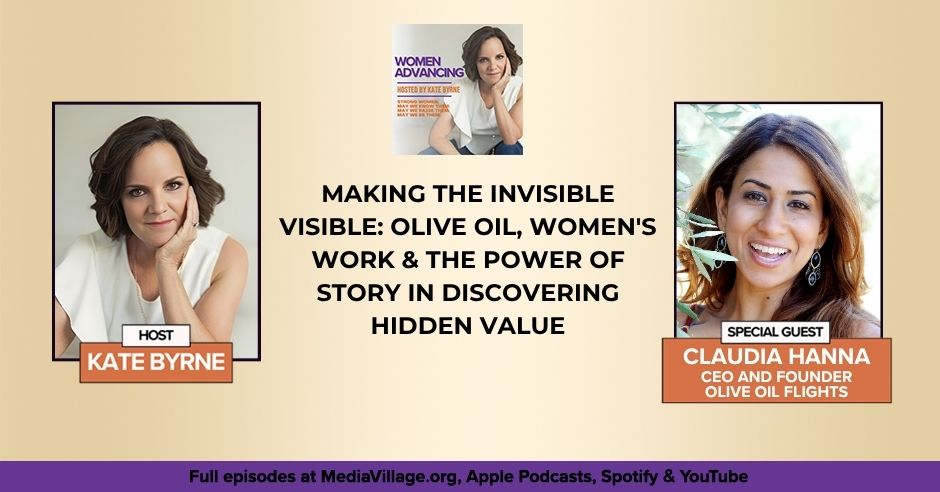
Most grocery store shelves are packed with flat, stale commodities masquerading as premium kitchen staples, but genuine culinary value requires uncompromising standards. Host Katherine Byrne sits down with entrepreneur and certified olive oil sommelier Claudia Hanna to break down how Olive Oil Flights is transforming the way consumers experience culinary craft. Claudia explains why up to eighty percent of supermarket bottles are already rancid and how treating olive oil like fine wine alters your palate. She details her direct sourcing network across the Mediterranean, routing resources straight to resilient female farmers who refuse to cut corners. You’ll discover what happens when you reject corporate burnout and anchor your career in purposeful, intentional craft. Real leadership isn’t about rushing to scale, but about establishing transparent systems that put ownership back into women’s hands.
—
Watch the episode here
Listen to the podcast here
Making The Invisible Visible: Claudia Hanna On Olive Oil, Women’s Work & The Power Of Story In Discovering Hidden Value
Have you ever had a feeling like, “This little thing in my stomach, that’s an idea, and I’m going to run with it”? That’s exactly what our guest, Claudia Hanna, who is the CEO and founder of Olive Oil Flights, did when she recognized, “There’s a whole world behind one of the oldest food types that we have, and that is olive oil.” For centuries, it has nourished families, anchored cultures, and fueled entire economies. Yet, we know so little about it, where it comes from, and how it’s produced.
Frankly, surprisingly, there’s a ton of women doing all of those things. Claudia Hanna is an entrepreneur, olive oil sommelier, podcast host, and American Public Television’s If This Food Could Talk. She’s the founder of Olive Oil Flights. We explore why olive oil deserves to be experienced the way we experience wine, which is in a richer method. She is bullish on this and believes that, you know what, just the way we look at wine right now, olive oil is going to be right along the same lines. It will be something that we go in, and we have dramatic tastings, and we mix and match just like we mix and match our wines.
She also talks a bit about how her work has really helped her get a better understanding of the broad community that’s driving both the products and the well-being. It is just such a great reminder that when we look more closely at our food, at our history, and at one another, we often discover such extraordinary stories we’ve been missing all along. There’s a huge potential here. How do I know it? Claudia’s already, by the time of this podcast, she would have already broken even, and if not, gone beyond that. Kudos to Claudia, kudos to all of you for tuning in, and let’s support this amazing new burgeoning field of olive oil flights. Let me listen in now.
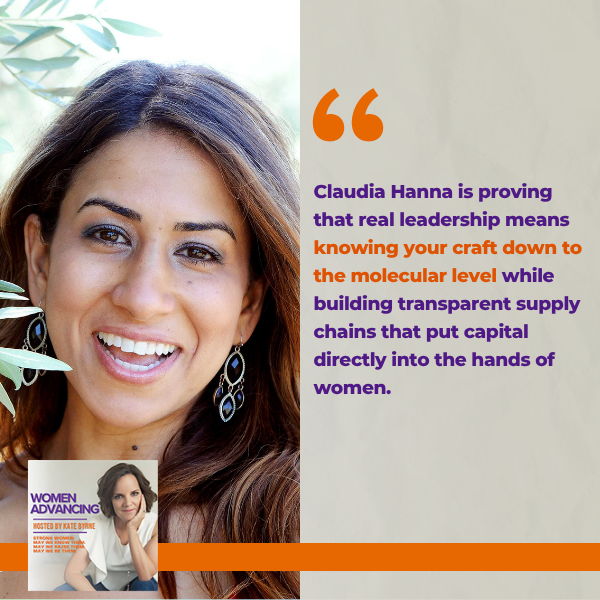
Everyone, welcome to what, personally, is going to be, I already know, one of my favorite conversations of the year. We are so fortunate to be joined by Claudia Hanna, who’s the CEO and founder of Olive Oil Flights. Have you ever had an idea that you just knew was a thing and you were supposed to jump on it? That’s exactly what happened with Claudia. Yes, we’re going to hear about it. Claudia, welcome.
Thank you, Kate. Thank you. Hi, everybody.
I’m going to jump right in just because I’m so proud of you, not to be a mom, but I am a mom. I cannot help it. It comes out, especially with olive oil flights. What inspired you to start it? When you were out there, I know you did a lot of travel and food is a deep passion of yours. What problem did you see in the marketplace that others were missing?
I’ve been teaching Mediterranean cooking classes at the University of Virginia for over ten years. It was fine. I taught recipes, I taught techniques, I taught some history. One season, I remember it was in the fall. As you mentioned, I travel a lot. We have a second home in Cyprus. We have our own groves. We have a few trees from which we press our own oils. I came back, and I just brought some olive oil back from my groves into the classroom one fall morning. I was like, “Guys, we’re going to be making,” I do not remember what we were making, I was like, “We’re going to add my oil on it.”
Spotting Rancid Supermarket Olive Oil
Everybody stopped. Everybody was like, “Where did you get this?” I was like, “From our trees.” They were like, “This tastes nothing like the olive oil we have here.” I knew it intuitively. I just didn’t understand why. I got into research mode, and I discovered that about 70% to 80% of the olive oil that we have on our shelves already in the supermarkets in the United States is already rancid. They’re old, they’re stale, they’re rancid. By definition, that means they are no longer even considered extra virgin olive oil, despite what the label says, despite how much money you paid for it. I went and studied.
I’ve become a level two olive oil sommelier. I realized that there are 2,000 varieties of olives in the world, and nobody knows it. I fell in love with olive oil, by the way. It’s just this weird thing. I do not know why, it’s just that I love it. I love how old the trees are. I love that they are. It’s the anointed one. I love the mystique and how you use every part of the olive tree. Olive oil itself is very misunderstood.
Treating Olive Oil Like Fine Wine
It has a lot to do with our labels in this country. I studied to become an olive oil sommelier, and I realized that olives are just like grapes. Keep in the back of your mind, that’s why it’s a flight. There are varieties. There are terroirs. In your head, you might say, “Can I have a glass of red wine?” “Sure.” You might want a Pinot Noir. You might want a Cabernet. Depends on what you’re eating and what you’re in the mood for. Olives are the same. There are Koroneiki. There is Leccino.
There is Biancolilla. There are 2,000. They all have their own variety. They have a flavor profile. What it grows around, whether it grows around sage or tomato vines, it takes on those flavors, the terroir. At the end of it, I say, “You’ve got the terroir. We’re just upping your food levels. We have food pairing.” Again, Cabernet Sauvignon with your steak, you might want a Picual from Spain to slather right over top of it.
What’s interesting about that is your timing’s really interesting to me because there was a big whoosh for people really getting into wine, especially in Virginia. We are the region that was blessed. I think last year is the one to watch for a lot of different reasons. Diversity is one of the key reasons, I might add. It’s why I believe a number of California young vintner talent is actually leaving the fields of California and joining us out here. It’s interesting because the timing is a terrific pairing. I can imagine, especially too, that olive oil’s got such health benefits at all ages.
Testing Freshness Through The Throat Burn
Yes. My answer when people say olive oil’s healthy, I say yes, it does need to be fresh. Otherwise, the way you know if your olive oil’s fresh, so really, Kate, go home and try it out. Take a sip of your oil, rinse it around your tongue, then swallow it. You might have to do this a couple of times. Try to do this when you have a virgin mouth, a glass of water, not a lot of coffee or anything. If it leaves a residue in your mouth or does not leave a little burn in the back of your throat, then you’ve got an old flat oil. You want it to have a nice, clean finish. You want to have a slight burn in the back of your throat. The burn is kind of much. I like a little burn. Those are the polyphenols that work.
That’s what makes olive oil so healthy. Yes, I do think there is this timing, personally believe, hand over heart, that olive oil is going through a revolution. In the 1970s, wine went through a revolution. That’s when we started getting into “Let’s learn our varieties, let’s learn the terroir.” We understood that a French wine is different from a California wine. That’s when it all started moving from the commodity stage into this scale where we’re really looking at putting layers and premiums, immunization through the process. Olive oil is going through that process right now. I’m very proud to be part of it.
That’s really exciting. Let’s talk a little bit about the business model. The notion of olive oil flights. It’s one of those deals where I love people like you who can say, “We do it like this. I’m going to apply it to this.” It is a unique concept. How did you develop the business model? How did you know? You might not know, how did you have that confidence, “Yes, this is going to work,” that customers would, in fact, embrace it?
Most supermarket olive oil is already rancid before you open it. Real extra virgin oil needs fresh harvest dates and proper storage. Share on XIt’s a knee-jerk reaction sometimes. I did talk to a lot of people before I went in. There was no customer discovery. I’m not stupid. This is not my first business. It has been proving well, I have to say. It was a knee-jerk reaction. It’s a little bit of the women’s intuition. If something makes sense and I cannot believe it has not been done before, it’s like, “Oh.” We do this online. I’ve already said we said cheese. How many varieties of cheese are there? We do not just say I want cheese. We say I want a Gorgonzola or I want a provolone. There are different varieties.
There are different types of cheese out there. There are different types of olives. When you apply the same mechanisms, it just makes sense, and everybody gets it. If you let people try. I’m giving, you asked about the business model. Mine is that you could buy a single flight, and it has three bottles of single-variety, single-estate olive oils, so you can taste them side by side. It comes with a pairing guide. It comes with a tasting guide.
This is how fruity, bitter, or pungent. These are the terms that we, as olive oil judges and sommeliers, use when we’re judging oils. I’m basically giving you a sommelier in a box. That’s my focus. I want you guys to be just as educated as I am. There are a lot of people with whom it resonates. I think Americans are smart. We want to know what’s in our food. We want to understand the process. I try to give as much education, make it fun, and make it accessible.
I’ve taught this class literally to children, to eight-year-olds, because it’s fun. In my daughter’s class, they were like, “This one tastes like dandelions.” I’m like, “Dude, you’re right.” It was grown where there’s a lot of sage, where this one’s coming from. There’s a lot of herbal grassiness. They’re eating dandelions. That’s what they can recall. It’s a lot of common sense. When it starts to resonate with people, you know you’re onto something.
Absolutely. I know one of the things you mentioned about your daughter, actually the history of olive oil overall. As I understand it, I have contributed quite a bit. Share a little bit about that because I thought this was both really cool and really interesting and such a fabulous industry for everybody to get into.
One of the pillars for me, I’m involved in an organization that’s a nonprofit organization called Women in Olive Oil, one of the founding members. Women in Olive Oil has over 2,000 members. It’s more than that, 2,500, 3,000. I’m not even sure anymore. We get together once every couple of weeks on the Zoom call, if you have time. I do not get to make all of the Zooms. We get together, and we share, “This is what I’m working on.” There are olive oil producers, there are marketers, there are scientists, there are chefs, there are importers, everybody who touches olive oil is part of this. Is female specifically for females, specifically, to be part of it?
Backing Female Farmers Across The Mediterranean
I literally source all of my oils from female farmers around the Mediterranean. I’m working with twelve female farmers everywhere from Portugal to Palestine. Literally because, for me, in my little brain, I’m like, “Kate, farming is hard.” Can we all say that farming’s hard, right? Imagine being a farmer in the Mediterranean or the Middle East. Now try to be a female farmer in the Mediterranean or the Middle East. It is flipping hard. This is my way. I know these women personally. I speak a few languages. My parents are Egyptian and Greek. I speak Arabic.
I speak Greek. I speak Turkish. I literally fly to Lebanon. I have flown to Tunisia. Flying to Greece before we hopped on this call. We are going to Greece. I’m meeting with Demetra. I’ve met with Rose and Christine. I’ve met with these women, and I taste their oils, and I trust them. It’s my way of giving back to these women directly. No middleman. No middle person, and we’re supporting them. They have high quality. They give me lab analyses. This is all their labs because I require it and because we’re all professionals in this industry.
That slight peppery tickle in your throat isn't a flaw. It's proof of high polyphenol counts in fresh olive oil. Share on XThere’s just so much more transparency than what you get, unfortunately, in a lot of our supermarkets. I understand they have turned olive oil into a commodity. I’m just trying to be one of the people to bring it out of that commodity mode. Having that transparency, it really does help. It’s also because I love these guys, I trust them so much, and I want to give back to them directly. It’s resonating with Americans. It’s like, “Where do I want to put my dollars?” They understand that.
Question then, as I’m understanding the whole process, great, we go, “We want to do a flight of olive oils.” Are you then collecting those different olive oils?
I think so too. It tastes really good. You get a little pairing guide. This is a food game. That’s my play because olive oil that’s in Israel does taste different than the olive oil that’s in Spain. It just does. It’s the terroir. It’s a different variety, and it’s the terroir. I’m specifically choosing, because I know I had to study this, the varieties that are the main, the quintessential Spanish, the quintessential Tunisian. I’m choosing the varieties that grow, especially in that region.
Obviously, I’m sure that a lot of these women have come up against just that in their environments. We all do. They, in particular, I think, have probably come up with, I do not know, obstacles, or some cannot work, or they’re allowed to work, which is interesting. I would think in some countries they’re not. What have you learned from them in terms of resilience and such? What do you want to implement, or what have you begun, or you notice, “I’m going to be implementing best practices that they have that you are now incorporating into how you hold yourself as a leader, but also the business”?
Very good question. I had not thought of that point. Resilience is the word that I would have used for these people. They are hard workers. A lot of them, I’m thinking of one, not all of them, but some of them have taken over family farms. Their father used to do it. Alexandra is the one I’m thinking about in Croatia, her grandfather. Perhaps he didn’t have any sons. I never asked her. Alexandra’s taking over it in Croatia, and she’s done a marvelous job. You know what I love about women? One of the many things I love about us, they show up really prepared.
Demanding Absolute Scientific Transparency
They’re not winging it. I’m not saying all men wing it, but these guys are not. Dr. Sonda, she’s a doctor, and I cannot remember what her PhD is in, probably something within agriculture in Tunisia. She has started a co-op of female farmers, water growers in Tunisia. She was like, “I am not exporting or putting my name on anything that’s crap.” She is putting her name, she brought in a whole scientific lab analysis to her farm. That is very unusual to spend that kind of money.
Most people, most of us, would take their olives, press them, and then take them to a third-party analysis. She was like, “I do not trust some of the lab analysis that’s happening out there.” She was like, “I’m bringing in analysis in-house so we can do things quite fast.” She was claiming that some of the analysis requires bribery. There’s bribery. She was like, “I just didn’t want to play with that.” What I’m remembering is that these women have a lot of grit.
My God, I have a dear grower. Her name is Rose from Lebanon. Her groves are in Southern Lebanon. They have been bombed. They were decimated several years ago. She had to start over again. This woman has now been winning awards. She’s still, and I have to reach back out to Rose to see how she’s doing with this year’s harvest. She won a gold medal in a Greek olive oil competition a few months back with her current crop.
Don't compromise your brand on blind trust. Rigorous in-house testing protects your standards and shuts down inferior shortcuts. Share on XShe’s just the most resilient person I’ve ever met, and two, she was like, “I’m not going to wing it.” She went and studied. She’s also a level two olive oil sommelier. She is an MBA holder. She and I are quite similar. She just does not play around. She’s like, “I’m going to know everything I need to know and then make sure that my product is excellent before I put my name on it.” That’s what I really appreciate about these guys.
I would imagine they probably feel, to a certain degree, like, because of the situation, I may get only one shot. I have got to bring it, like no other. With that, I would also think about just culturally spending time in all of these different cultures and seeing how the women handle their lives, balance work and life, and farming and all of the ends. Has that shifted your definition of success at all?
Rejecting Corporate Burnout For Sustainable Living
Absolutely. I do not think you know this. I do not know. Maybe you do, Kate. My husband is from Cyprus, and we spend part of the year living overseas in Cyprus. That’s when my love affair, olive oil, began. The way that life is handled in the Mediterranean for me is intoxicating. I remember when we moved out there, I had three children. I’ve got two older kids. I took a massive break and then went back for number three, the eight-year-old. My other two are now 21 and 20. When Ella and Ben were young, we moved to the island so that they could have a young, like they could have their early education out there.
I was working. Nobody would expect you to work. They’re like, somebody was sick. They’re like, “Go home, take care of your babies.” School is out by 3:30. Go home, take care of your child. I was working at the university. I was teaching finance. I have an MBA. I was teaching finance at the American University out there. It’s a much more pleasant way to live. The concept of burnout or the concept of juggling so much that you cannot breathe does not exist.
Everybody knows that we’re on this earth for a finite amount of time, and that your family is really lovely. Your main concern, or it should be. There’s such a deep, and someone’s always there to take care of you. I remember grocery shopping once when I had my first two were only 18 months apart and I had like a little three year old and a one year old or something like that, two and a half and one. I couldn’t get my hands together to do the grocery shopping. Some guy who worked at the grocery store, he was like, “Let me get your baby for you.”
In America, you’d like, nobody touches my baby. You might be sick, you got COVID, like whatever. He was just like, he held my son and was googling so I could pick out my veggies and fruits. It was so innate and natural and kind. I’m like, why are we not doing this country here? Why am I like, “Someone’s going to steal my baby if I give it to them?” I do not know. The vast majority of us are good people. We’re not. We put up walls. I just want to see some of those walls come down. We’d be happier if we did.
I’m so totally with you, because I know a lot of people know I got back from, I traveled to Japan. This was one of the things that amazed me. There is so much just doing the kind thing, the human thing, just being considerate, “Can I help you? You’re in my train seat, but you know what? I’ll take your train seat. Do not worry. You’re old. Stay seated there.” It’s that connection through that shared humanity piece that I do not, I mean, I have a few ideas why we’ve lost it, but we can get it back.
Honestly, it’s going to be on us to get it back. Things and entities like olive oil flights can really help us get there and get to know more about the people behind what we’re eating, what we’re putting in our bodies. You know this, and I want to talk a little bit because I know you know it because of your fabulous podcasts that you have on American Public Television. That’s called If This Food Could Talk. You know, food just tastes better when it’s made. Not to be juju, but I’m going to with love and intention, right?
Totally. There’s actually scientific proof about this. It was really interesting. I read it not too long ago. I’m an avid cook. I cook, told you, I teach, I’ve been teaching it for a decade at two universities, actually in Virginia. I love hosting dinners. When you were sick, I actually brought you some food. Did you know scientifically proven food tastes better when someone makes it for you? I didn’t know this, and I think there is, and I shouldn’t have said it without thinking out, but if I cannot source it, I will source it and send it to you.
That is the reason that when someone’s ill, when they get food sent to them, it’s a feeling of love and emotion that is tied to the word. It’s not just “I’m going to send you food from this eatery.” That does not have the same effects on your health or even on your mental health. It was literally the amount of time and energy. There’s something with your body, and I’m not sure if it’s your endocrine system. I really cannot recall what it was, but it’s like food is better than something someone made for you.
It’s literally tangible, edible compassion in your hand and love. Let me talk a little bit about this fun-filled, fabulous podcast of yours. Again, If This Food Could Talk, American Public Television, what inspired you to do this? How do you think storytelling helps consumers better get an understanding of food, culture, and history?
Again, it all started with those cooking classes. I could only get twenty people in a classroom at a time. I also lead culinary tours overseas. I take people to Greece, Cyprus, Turkey, Israel, and Egypt. I take people to the Mediterranean. Again, I could only get in all of my classes, the tours, like everybody else, I could only get twenty people on a trip. I can only get twenty people in the classroom. Otherwise, it just gets too big. How do I reach more people?
Great storytelling turns everyday commodities into meaningful cultural experiences that connect communities. Share on XVirginia Public Media at the time, a few years back, was looking for new podcasts to start a podcasting studio. I basically pitched them. I was in a room full of podcasters who are people who had an idea for podcasting. Most of it was on history. Politics, think Thomas Jefferson or something with Virginia State politics. I was like, “I do Mediterranean cooking, and I just thought it would be fun to have something like cooking and history in a podcast.” That was the one they picked up.
Cool.
Scaling Your Impact Through Storytelling
Virginia, they wanted something that entertained people, but that felt good. From there, VPM, I think, if I remember correctly, the consultant who was working on creating the podcast studio moved over to American Public Television. They’re based in Boston. They took me with them. They said, “Listen, we’ve got this great podcast host. She’s an educator at these two, JMU and UVA. We think that she would be able to get, she would be a good addition to there.” I’m the first podcast that came out of APT. It’s called If This Food Could Talk.
We are now in season five. I have to say, I am absolutely delighted with it. I have been able to meet the most interesting people from this. I’m sure you understand it, Kate. You get to just have this window into like this other person’s world, and you get to step into it for a few moments and learn about what they do. I’ve been able to learn about Chinese food, the history of pizza, Greek ice cream, yogurt, and the history of olive oil. It’s been a lot of learning, but what makes people tick?
Where do their passions lie? It has been so much fun. Usually, they get to send me a great recipe afterwards. I get to make it with my followers. It becomes like a community of people who are learning and eating and growing together. I’ve been very fortunate. I’ve been able to reach much more than the twenty people in a classroom. We’re able to reach thousands of people, thousands and thousands. It’s awesome.
Which is huge. What are you hoping for when that happens, like when someone tunes in, what do you hope the audience takes away? I can think of a couple of things.
Mostly, it’s the connection to what that person’s bringing to the table. If someone is like this cool guy, Rob Apelion, that I just talked to, Rob is one of the most interesting people I’ve met, for example. He has just written not a comic book, but a graphic novel about his background, an Armenian. He was set in time in the 1500s in the Ottoman Empire. We’re going back in time through his lens. We had to do this whole history of the Ottoman Empire. It was all about food and recipes. It was a family, an Armenian family in the 1500s under the Ottoman Empire, with a graphic novel and a bunch of recipes.
He and I got to chat, and we both have this Middle Eastern background. We got to connect over some of the foods, but I would never, I am not that creative a human, Kate. As I told you, I’m applying something called the wine industry and applying it to olive oil. I’m like a copy-paste girl, but because I was like, “Why do not we do this?” This guy is taking a group, like creating a graphic novel. Who created a comedy book for the Armenian Ottoman Empire? What he did, he did so cool. It’s introducing those kinds of people to our followers, to our audiences, but it’s also that they just got a glimpse. I do not know. I feel so fortunate that I’m able to do that. I’m that little bridge.
It opens up their eyes. It also demonstrates and does a perspective, let’s say, aperture widening of how it’s such a craft. You’re not just making it, not just doing it, not just slapping. There are such different pieces, and there’s such significance. I learned that in Japan. You serve this to do this. You serve this to get this. You serve this to do this. Do it in this order. Do it with this. It’s kind of chemistry, biology, but also psychology and sociology all combined, which I never really thought of it that way. Opening up to that. As we close, which I hate because I could talk to you on and on about this. I got to ask, knowing what you know now, and you know, a ton. What advice would you give your younger self?
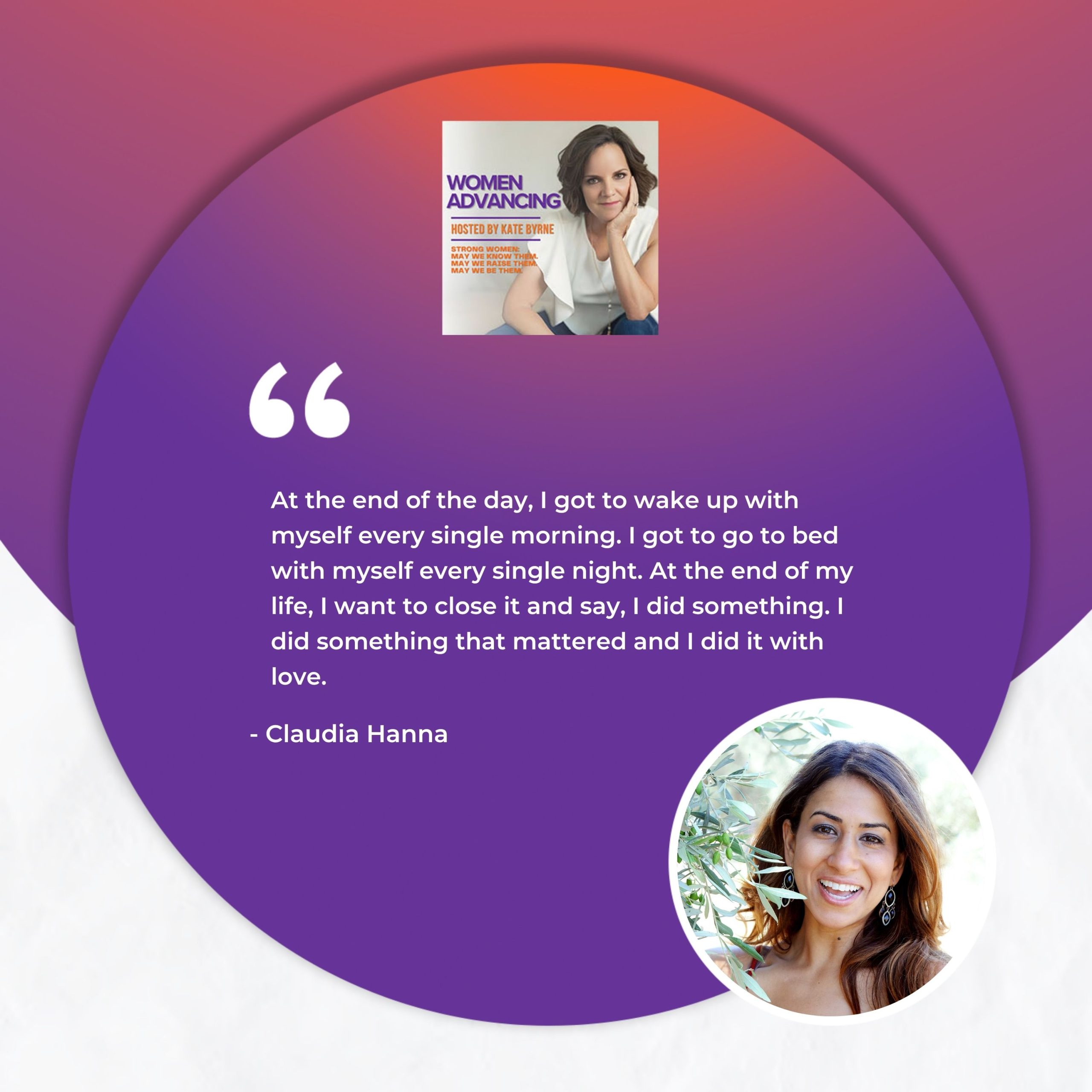
When I was younger, Kate, I wanted to do everything. I wanted my mom to be proud. I do still want my folks to be proud. I wanted to do everything right and in the right order. I do not think I spent enough time figuring out what Claudia enjoys. I do not think so, because at the end of the day, I get to wake up with myself every single morning. I have to go to bed by myself every single night. At the end of my life, I want to close it and say, “I did something that mattered, and I did it with love.” It took me a little bit longer. I am not one of those people who like to shoot through the roof in my twenties and figure it out.
I’m really not. I do not regret having an MBA. I do not regret having done any of the work that I did. It all has come to play. I would tell myself, “Claudia, slow down. Claudia, figure out what you love, what you enjoy, where you want to spend your time, and be more pointed with it instead of just spraying.” I did the whole thing like, “Great thing.” In the end, I wake up with myself, and I want to be proud of what I do and make a good contribution to this world. That’s for me. That is my own thing. That might not be anybody else’s. That was what I wanted.
That’s terrific advice. I feel like you’re an angelic messenger for me because it’s so, so true. Many of us, when we were growing up, and because we have mothers who were in different generations and had different access and abilities to do things. I myself also, “I’m to do this because my mom didn’t get to where my sisters didn’t.” All of a sudden, it’s true. You wake up, and you go, “Is this even mine?” Honestly, everybody does as Claudia says that half a beat and pause that you take will make all so much of a difference. It’ll just help so much. Claudia, last thing. Do you have an app yet?
No, we do not have an app. We have a website, OliveOilFlights.com.
Claudia, thank you for opening our eyes, for opening our hearts, and for bringing really good deliciousness into both.
Thank you so much, Kate, for having me on this. Women, I love you guys.
Until our paths cross again, we’ll see you next time.
Bye.
—
I knew that was going to be an interesting conversation. I love how, talking with Claudia, the expanse was sure, foundership, but culture, definitions of success, and so much more. Here are my KB takeaways. Not all oils are created equal. Wine often reflects the geography, the climate, cultivation methods, the terroir, and generations of expertise. Make sure that you taste yours because the majority of what we have on the shelves is already rancid, even though they are not spoken to be so. Who’s behind a lot of the olive oil? Women.
There are so many regions beyond just Spain and Italy that we should be trying. Places like Lebanon, Greece, and more. Third, the stories behind the products matter, understanding who’s actually creating what we consume. It tastes better. There are all sorts of extraordinary science that reflects this. Think of it this way. You’re actually contributing to a greater economic opportunity for a group that often does not have access to it. Lessons learned from Mediterranean cultures.
They so often put emphasis on shared meals, on seasonal ingredients, and on communities slowing down all the practices that support both health and well-being. Curiosity, that’s a leadership skill. That’s what got Claudia here, and knowing that she was on to something, so be sure to continue to listen to your gut. Finally, lessons learned, success is not always about scaling faster. Sometimes it’s about preserving traditions and honoring expertise and really creating meaningful connections between people, just like the ones that Claudia is making. With that, thanks so much. I look forward to the next Women Advancing conversation.
Important Links
About Claudia Hanna
 Claudia Hanna is an entrepreneur, Olive Oil Sommelier, food storyteller, and serial career-pivoter who traded power suits and corporate finance for Mediterranean kitchens, food adventures, and a life split between the U.S. and Cyprus.
She is the creator and host of If This Food Could Talk, a food history podcast with APT Podcast Studios, and the founder of Olive Oil Flights, where she’s on a mission to make people think about olive oil more like wine: discovering varietals, terroir, flavor, and the perfect pairing to up their food game.
Taught to cook by her Egyptian-Greek mother (Kamilia) and Cypriot mother-in-law (Tulin), Claudia now teaches Mediterranean cooking, tasting, and olive oil courses at the University of Virginia. When she’s not in the classroom, she travels to groves to hand select the best olive oils from her female founders and shares them broadly around America.
She has appeared on NPR, BBC, The Splendid Table, VIrginia Living Magazine and numerous podcasts and media outlets.