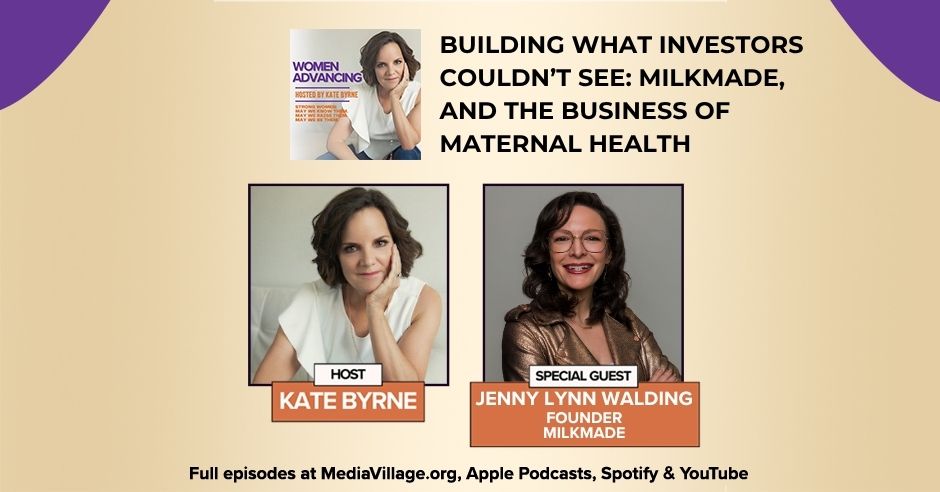
When you are getting ahead of the market curve, your business ideas may face a lot of skepticism and naysayers – but you need to trust your own instincts to succeed. Kate Byrne is joined by Jenny Lynn Walding, who shares what it takes to successfully build a new category in maternal health that investors do not recognize yet. She looks back on the origins of her lactation portfolio company milkmade, from how she secured funding for it and how she overcame the difficulties in building a strong community around it. Jenny Lynn also discusses the importance of educating your funders, vendors, and audiences, as well as pumping up the volume of your inner voice instead of giving in to the pressure of suppressing it.
—
Watch the episode here
Listen to the podcast here
Building What Investors Couldn’t See: Jenny Lynn Walding, Milkmade, And The Business Of Maternal Health
Can you imagine turning down a company that actually addresses 70% of the market and has proof that at least 51% of that group uses your product? That’s something that venture capital continues to do. Those products represent women’s lived experience. If you’ve ever tried to explain a problem in maternal health, specifically breastfeeding or any kind of logistics of early motherhood, to a room full of investors who have never personally encountered it, you quickly realize something important. That market’s obvious to you, but to them, it can feel invisible, even though many of them have females of significance in their lives. That could be their daughter, their wife, or business partners.
That’s the terrain that our guest, founder Jenny Lynn Walding of milkmade Innovations, has been navigating as she builds this company that is a combination of technology and infrastructure around breast milk and maternal care. It’s a category that affects literally millions of families, but has long been overlooked by traditional venture capital.
In this conversation, we talk about what it takes to persist in the face of skepticism, pumping up the volume on your instinct, to build a category investors don’t recognize yet, and to trust your own understanding of a problem, even when the market, or at least the people funding it, hasn’t caught up. Sometimes, the hardest part of building a company is execution. It’s convincing the world that the problem you’re solving is so real. Tune in at the end for KB’s takeaways. Let me know what you think. Let’s dive in.
We’ve got such an interesting topic to discuss. That is creating a market that is so important that most of the investors miss. How do you handle that? When you know you know, there is such a there-there. Why? It’s because you actually lived it. It’s so often a taboo topic that so many don’t mention, or they feel uncomfortable talking about. That’s when you double down. Not only do you talk about it, but you also start a company about it. Please join me in welcoming the founder of milkmade Innovations, Jenny Lynn Walding.
Thank you so much for having me. It has been an absolute pleasure meeting you in the community and being hosted on this show. Thank you so much.
The Origin Story Of milkmade
It’s my pleasure. It’s such an important topic. I’ll let everyone know it’s an issue I had with my first child. Why don’t you talk a little bit about what milkmade Innovations is? That will help frame and set up the unfortunate challenge that you sometimes face.
We are a lactation portfolio company, but our first product, our MVP or minimal viable product, that we are working on, is a smart nipple shield. For context, this would be a dumb nipple shield. You can go into a pharmacy. In Walmart, you can buy these. This particular one is from Ceres Chill. This is innovative because it can change color. It’s heat-sensitive. Why you would want that is because they’re typically clear, and they’re hard to find.
These were created to help with inverted nipples for breastfeeding. They were created as a barrier or a sheath for nipple pain or trauma that can occur. As one who’s navigating this space, your breasts and nipples never see this much activity until it comes to infant feeding and breastfeeding. A lot of times, we’re talking about 51% of moms and breastfeeding parents who use these to help get them over the hump of those initial breastfeeding challenges that one can experience.
We’re talking about 70% of moms who experience challenges. What we are focused on is addressing the question, “Am I making enough milk to sustain my baby?” That is the seeing is believing conversation. When we talk about what the differentiator is between pumping milk into a bottle, providing formula, or breastfeeding directly from the breast, each one has its own challenge. For the breast, you don’t have those insights into what is going on.
How much is the baby taking? Is the baby intaking? Am I producing enough milk? Are there other things that can be going on? What does my milk look like? Milkmade is the vehicle for getting those types of information into the parents and providers hands. I want to highlight that we’re not just for parents. We’re also to help support providers in their care.
At least in my day, so many people spoke just about the breastfeeding challenge. It was about latching. Plus, there are so many other aspects. It’s pretty clear how you came about this and the various depths of understanding you have of customers that others may have missed. Milkmade finds itself at an interesting intersection. You’ve got motherhood. You’re fem tech and med tech, but not quite. Also, modern entrepreneurship. When you were going through all this, when did you realize, “There’s a real market here. This is a real company waiting to be built beyond just a problem I’m facing?” What was that moment? How did you decide, “I’m jumping in?”
We are also biotech because human milk is a biological fluid. We also bridge into infant tech. There are pediatric devices. The maternal-infant diet comes together and forms this unique two-patient model. Where do we have multiple patients coming into a clinician setting and trying to navigate where the problems are coming from? Is it coming from the mom or the breastfeeder? Is it coming from the baby? Is it a society work setting? There are a lot of areas that we can improve upon.
The number one reason why people stop breastfeeding is perceived low milk supply. Share on XIn terms of this a-ha moment, women share. I lived in Australia. That was where I went through this with my firstborn, birthing and breastfeeding experience. That shaped my outlook because in a national healthcare plan with ample access to care, and how that can change trajectories. I won’t say it was mandatory, but we had these mother groups. You’re highly encouraged to attend. You’re being brought in with women who have infants at the same age as you.
They’re usually within walking distance. You all show up at this very localized space. It’s encouraged that you find your group. You find your tribe. You start going out for coffee with them. You start navigating from the home, which can be uncomfortable and challenging for new parents. I don’t want to say commiserating, but it’s normalizing that this is difficult, going back and forth on things that have worked and not worked, and hearing those challenges.
Through my life, as I’ve iterated it, I became a certified lactation counselor to help provide what I received and the types of community that I had in Australia here in the US. This is not a singular problem. This was not just my daughter’s and my issue. This is a problem across the spectrum of infant feeding that parents are faced with. Honestly, for a stat, this is the number one reason for breastfeeding cessation.
The number one reason why people stop breastfeeding is perceived low milk supply. That’s called PIMS, Perceived Inefficient Milk Supply, and then actual low milk supply. What do we have going on here? For one, PIMS could be a thing. It could be this anxiety that parents face of not knowing how much their baby is taking in, or it could also be a mom’s intuition of possibly knowing that her baby’s not getting enough.
How do we know the difference? How do we empower parents with these types of lactational insights? How do we also provide these parents with agency and conversations to bring to the provider and say this? I hate to use this word. “I’m not crazy. My baby’s crying all night long.” We have these feelings. We know these feelings. If the next workflow is, “Give your baby formula or go pump,” you’ll be able to see. We’re starting to change that particular infant feeding diet. We’re bringing more things in. Each one of those things adds its own nuances, its own layer of complication. We’re not focusing on the root cause.
Biggest Cultural And Financial Barriers In Pitching milkmade
The thing that I like about this is making it real. I liked the whole notion of normalizing what is. “This is a situation. I’m not alone.” Helping build a community through that is something that is so incredibly intimate. Seventy percent of moms face challenges with breastfeeding. Is that right? You said 51% of moms use a product like a nipple shield to aid in this. Is that correct?
That is correct.
Those are pretty valid stats that this is an issue. I also know that there have been some challenges I can only imagine in getting financing. Is it because it doesn’t fit in a tidy little box in somebody’s spreadsheet in terms of traditional venture-backed categories? What have been some of the biggest barriers culturally and financially when you are pitching this idea?
When I’m pitching to moms or to parents, they get it right away. Even very active grandfathers get it. There’s definitely a community that you can tell right away, they light up like a Christmas tree. They get it. The real problem is who’s in the room that I’m pitching to. What are their KPIs? What are their key performance indicators that they’re looking for when it comes to their venture fund thesis?
When we talk about who gets the love, it’s pharma. It’s not pharma that’s maybe taking care of something for a rare disease. We’re talking about something that is oncology or cardiology, or something that can impact many people. I know I’m preaching to the choir here, but when there are people who are comfortable using women’s health as a niche, that is a problem. We are 51% of the population.
When we talk about infants, we’re now talking about a lactating community of women. This is now a subset of a subset. The way that I try to flip this is if I’m in a boardroom, or I’m on a stage, and I’m in front of people, every single person that’s taking up space in a seat once was a baby. I don’t care which modality or which pathway you were fed as a baby. If it was breast milk, donor milk, or formula, it’s all milk-based. If you were a baby, as we all were, how would you have wanted to be fed, or how do you want the next generation to be fed? How do we want to improve access to bettering all of these pathways?
It’s almost like how we want to improve access to intimacy. This is going to be a strange dot to connect, but stay with me. It is especially in an era when we are so detached. We’re escaping to a screen, all ages, everybody, not just kids. Get real. We’re freaked out about AI bots doing everything. How can we increase access to humanity, to connection at the most intimate level?
This is an interesting conversation. I don’t want milkmade to be needed.
The goal would be to have it be that everybody gets it.
I want this all to work. Even pumps, love them or hate them. They are a function of being away from your baby. Some people want that. No judgment. Some people don’t want that.
Some people don’t have a choice.
It’s because they exist, that is an opportunity for you to go to work, and you can still pump. Mind you, not in a bathroom. The Pump Act was passed in 2022. Your employer and workplace should provide a clean, safe, non-bathroom space with access to a sink, a fridge, and all of those things. This is a PSA to advocate for yourself. It’s tech. Especially what I’m building, it’s this fine balance where I get pushed back on, but breastfeeding’s natural. You shouldn’t need technology. That’s one. We do want technology. It would be great to know, but we can’t drive parents and increase their anxiety by having data. We see this with scales.
Even adults obsess about numbers, data, metrics, sleep scores, and all these things. They have to be actionable. Third, having connectivity with your infant, as in imprinting, looking into their eyes, is imperative to breastfeeding success. If they’re looking at a screen, that can then impact their output. It’s this fine balance of how much data is the right amount of data. How’s it being received? When is it being received? Who’s analyzing it? What actionable insights have you been given to help improve the trajectory of your breastfeeding outcomes?
It’s interesting because I hadn’t thought about this data piece. Are we in an era where people could fixate on that? Some perhaps take it so to heart that it adds to potential anxiety. “I need to be the best at producing this. This is going to be another demonstration of my ability as a mother.” Women will use this potentially to go overboard again and keep themselves captured in a state of not enoughness. I would love to think no, but I just know how different generations would embrace this in different ways and take it to extremes. You can’t help that because that’s how different people are wired.
The Hatch Scale was on Shark Tank. That’s a change table for babies. You can register it from Babylist, buybuy BABY, and all these box stores. It’s a change table that you’re changing your baby on, but it has a built-in scale. That is then reported. Trust me. That probably would have been on my registry because I was the parent who had to run out a hospital-grade scale. It was because my infant was failing to thrive despite exclusively breastfeeding. That was seven weeks of hell. It’s straight trauma from her side and from my side.
To bring this very relevant, my milkmade baby is always worried where her next meal is coming from, still to this day. This doesn’t mean it’s a one-for-one, but it’s something always in the back of my mind. Is this because for the first seven weeks of your life, you were hungry and your needs weren’t being met? This is like the Fed Is Best movement. Obviously, we need to feed our babies, but so much of the shame and stigma was on my side. I could make the milk. It was on her side. She could not efficiently feed and intake milk.
The future of milkmade is being able to capture the duality of breastfeeding. It’s not just milk flow. It’s a latch, which is what the baby brings to the table. It’s their ability to suck and swallow. It’s their ability to be free of any type of oral restrictions or anomalies. She was a tongue-tied baby. I went on to have another baby who was also tongue-tied. For the record, I also was tongue-tied, but I was bottle and formula fed. It wasn’t caught until I was sixteen.
Maternal Health: The future of milkmade is being able to capture the duality of breastfeeding. It is not just milk flow. It is also a latch, which is what the baby brings to the table.
For my second, I already knew what to look for. I ensured that my midwife was an IBCLC, which is a certified lactation consultant. It was caught very early. She couldn’t care less about food. I have to beg her to eat. This is my life. Please, nobody use this as guidance or anything along those lines. As parents, we have guilt. We have this severe mom guilt. These are things that I think about.
My hope is that through milkmade, we are curbing parental anxiety, not inducing it. We are providing these insights that parents are already trying to achieve through antiquated means. For context, I shadowed a lactation consultant in the office. They were doing the weighted feeds, where you strip a baby down, and you weigh them. Prior to this, the lactation consultant is trying to calibrate the scale. She’s lifting the 10-pound weight, putting it on, lifting it up, and putting it on. It’s back and forth. Two scales are both not matching up.
The baby is being breastfed. They’re doing these iterative check-ins to see how much the baby is intaking. The baby lost weight. How does a baby lose weight through breastfeeding? These are the inaccuracies that can occur with scales. Your hospital scale is not the same as your pediatrician scale, which is not the same as your lactation consultant scale. I would love for all of that to be completely mitigated and not a function of the obsessiveness over weight, versus switching the view on intake of milk.
Insights And Experiences Of A Woman Founder
I was going to say we wonder why there’s a fixation on weight and anxiety if it starts there and goes from there. I’d like to get a sense from you, more for you, on this aspect. How’s it becoming a founder and leading a company in this space? Has that changed your sense of yourself as a professional and as a woman at all?
It has. First and foremost, I recognize my privilege of being able to even do this. There have been some hard choices that have been made. For context, I drive a 2004 vehicle. One part of my secret sauce is that we live very lean. Kids aren’t going to camp and are not going on family vacations. It is a hard conversation because that means that my family is in this. My family is behind this, especially my youngest. When I filmed her as she went off to school, I was like, “What do you want to be?” I do that on the first day and the last day of school. She’s like, “I want to work for milkmade.”
This means something. I joke that that is not nepotism. It’s nipotism. The fact that I have this whole family rallying behind me goes far when it comes to founding because these are not easy days. This is, for lack of a better word, insanity or a level of madness. I hate to say this, and I hate to own that this was who I was. When my youngest was born in the US, for context, we lived in Wisconsin at the time. I’ve moved many times. I’m a serial mover. We moved from Wisconsin to Virginia. The conversation that I had with my husband was, “Whoever’s job can bring us to Virginia is what we were after.”
I started interviewing for jobs. I never once said I had kids. I would reference family in this high-level context, but I was never saying, “I have a baby at home. I’m breastfeeding them.” I didn’t ask questions about maternity leave, nothing along those lines to give an indication that I was unhirable. Through pivoting away from that and becoming a founder, first of all, I’m not earning a salary. I want to be very clear on that. Through not being tied to an employer, I have a voice. I can speak my mind.
I can call into question advocacy, policies, why things are the way that they are, and what we can do to improve them. That is what I consider the corporate handcuffs. It is not being able to show up in your authentic selves. There are plenty of communities that are not able to do that. From a parent’s perspective, it is shrouding this whole side that these are life-defining traits that you have that you can’t authentically show up as yourself.
That was going to be my next question. You pretty much answered it. There’s already been so much talk about investing in women’s health and the care economy. I don’t think we begin to even scratch the surface. I was going to ask from your vantage point, what are investors, policy makers, and even consumers still getting wrong? I don’t want to build off that because you said quite a bit just there.
I referenced these pervasive metrics. You have solutions that the world needs. We need clean water, for example. You’re like, “We’ve got to pitch these to the investors.” We need clean water. If they don’t see a return, it’s not, “We’re saving lives. We’re creating healthier communities. We’re helping to enhance longevity. We’re reducing cancer.” The people that milkmade is trying to attract are the philanthropic funds, people, or angels that they see a value here, but it’s this question of, “Are you investable?” You can be a billion-dollar company legitimately and not meet the actual threshold or the bare minimum requirement that that particular fund is looking for.
You can be a billion-dollar company legitimately and still not meet the actual threshold or the bare minimum requirement of your target fund. Share on XOften, it’s also, “Can you do so within the timeframe that I’ve set this whole thing up for?”
Exactly, because there is a limit to how much they are happy to provide you with money, but they’re getting something in return. As a person, or a business, as myself, as milkmade, it also has to make sense and cents. It has to make sure that if we’re borrowing equity, but we’re giving 80% of our company away, and somebody else is leading the helm, and they’re like, “No, we don’t want clinical evidence,” or “No, we don’t care that this is accessible for people in rural communities who need it the most,” those are the types of things that we have to keep our North Star and hold it. It can’t be at the function of them losing our core mission.
If you could redesign one aspect of this for investors, what would it be? Is it the timing of their ROI, the 5X or 10X, or the rate of return?
In a perfect world, there would be more diverse representation of those who have money. That would drive funding. One of the things is longevity. Everybody loves talking about it. I wouldn’t even say that this is the next thing on their horizon. It’s here. People are talking about it. People are obsessed with oligosaccharides, which are these specialized sugar molecules that are in human milk. They’re interested in this for adults to help people who are in their mid-30s or 40s to help improve their nutrition, or their gut microbiome, or lengthen their telomere.
If we flipped the script and we said, “Longevity is important. We want to reduce cancer. We want to reduce asthma, eczema, and all these other things that human milk can do,” why aren’t we focusing on this at day dot or day one, and actually even pre that? If we could even just focus on pregnancy and enhancing healthy pregnancy, education, and reducing diseases and disorders, this is going to take us a lot further than helping the corporate bros down the line when they’re in their mid-30s.
It’s all preventative care. It’s preemptive at the very base level. It’s getting to the root of the problem and the issue, something which I don’t think in general we’ve ever been good at. We always enter these situations in medias res, right in the thick of the middle of it. Knowing what we know, let’s do this, but it’s such a band-aid fix, as opposed to doing what you said. In my dream, there will be no need for my company.
When we talk about capitalism, greed, and where money gets infused into what, this is the problem. We can sit here, and I can give you a ten-page paper on why doulas are important for birth outcomes. We have to prioritize that we want healthy births. We would want advocates alongside you as you’re birthing. Less is more, but we also have to have access to that more if things go wrong. On the flip side, more education goes a long way.
So often, it all goes back to education.
More support, more advocacy, better policies, and all of these things can change the trajectory of care and outcomes. That is ingrained in me because I received that in Australia. I saw what is possible. When I came back to the US and got to go through this birthing and breastfeeding all over again, “I know what I need. I’ve got to find it. I’ve got to curate it, cultivate it, and pay through the nose for it to get what I had in Australia.” Trust me. Pelvic floor support is automatic in Australia. Why? It’s because when a government is fiscally tied to its constituents, they want to save money. Maybe they care. Maybe they don’t, but money talks.
When we’re talking about ensuring that they aren’t paying for you down the line when one in three people are incontinent, and they’re dealing with this on the backend, they’re like, “No, you had a baby. Let’s get you help. Let’s get you support.” Here, it is $150 a pop, more in other cities and states. How many people can afford that? It’s not always covered by your insurance. It’s not always accessible in your community. Who can afford that? Who can afford long-term pelvic floor support to reduce or cure incontinence?
Jenny Lynn’s Advice To Her Younger Self
Knowing what you know now, what advice would you give your younger self?
It’s very Phoenix-esque. I hit a wall with motherhood. In those early weeks, I was questioning all the things. Now, I’m a full-fledged mama. I love it. I love all the drawings. I’m surrounded by all their artwork and all this stuff. I love it so much. At the beginning, question everything and trust your instinct. Trust yourself. So often, and especially as women, we are told to mute that. I would say turn it up.
That’s that lean in, but I’m talking turn up that volume of your senses of what’s happening, your intuition with your baby, and with yourself. That is going to take us much further than pushing it down and having it come out decades later as repressed trauma. These are things that can then be actioned. That’s where we have power behind taking this singular trauma that we think we’re just facing. It’s through turning it up, voicing that, and realizing it’s probably most likely that other people are experiencing these problems, too.
We need more grace for ourselves, but our community needs to uplift us. We should be on pedestals, but regardless, we need to be surrounded and supported. Share on XSo many of us, after we’ve had a child, think, “I’m the only one who’s getting it wrong,” or “I don’t know what to do. How do I do this? Where’s the manual?” The truth is what works for you and that specific child, because it’s going to be different with the other one or the other. It’s like anything. Not to clinicalize this, but it’s a customized relationship because everyone is wired uniquely. You have to find your vibe. You have to be patient with yourself and have compassion and grace.
The same goes with your baby. There’s so much pressure not to admit. Sometimes, I am so angry. Sometimes, I am so scared. I have no idea what is going on. What I found was that oftentimes, when I was at that point, it almost forces your surrender to listening to your gut. Listen to your gut. Listen to yourself going, “Hands off the wheel. Go. Show me. If I weren’t so busy criticizing myself, what would I do?”
When you are in that space, that’s all the agita that you’re building up and your anxiety. Your little one is an energetic sponge. They’re feeling it right back at you. That doesn’t change. That goes true for the rest of life. That is so quick to understand. They often say, “As above, so below.” What you’re feeling as without, it’s showing you what you’re actually projecting. Take a moment and be kind to yourself.
You saying it is so freeing of that. Your baby is so different. Each baby is so different, but you also are so different. You’re in different stages. You might have a different employer. You might live in a different country. You might be with a different partner. It is such an untemplated experience. Some people will say, “I had a cesarean with my first. I’m going to have to have a cesarean with my second.” Make those decisions, but each birth is different. Each outcome is different. Each baby is different. I’ve had people push back on me. “Your product is only for first-time moms.” It’s as if your first baby is the learning curve you need. That’s the learning issue that you have.
So many people have said to me that they’ve had four babies, and they’re like, “First baby, super hard. Baby two and three, easy. Fourth baby, I had no idea what I was doing.” It’s so different. You have babies who have allergies that have had potential birth trauma. You just have no idea. I couldn’t have said it better. We need more grace for ourselves, but our community needs to uplift us. I believe we should be on pedestals, but regardless, we need to be uplifted, surrounded, and supported.
Discussion Wrap-up And Closing Words
Jenny Lynn, thank you so much for what you’re doing and bringing this situation and this opportunity to help and heal generations to come. It’s heartening. I can’t thank you enough for bringing it to light and sharing it with us on Women Advancing.
Thank you so much. You had referenced communities that need it. That’s it, having this long-lasting impact. We need to improve breastfeeding rates. We need to improve the equitability within breastfeeding. If people want to breastfeed, and we know that they do, people can get support and lactational insights. Thank you so much for having me.
Thanks so much.
—
KB Takeaways
It was a fascinating conversation with a real-life issue that so many don’t even realize is a problem. Why? It’s because it’s unspoken. I’m so glad that Jenny Lynn is bringing it to light. One of the reasons, too, why it hasn’t gotten a lot of funding is that a lot of men may not share in the lived experience that so many of us women have with difficulty. That’s why creating a product such as what milkmade does is so important.

My key takeaways are the notion of normalizing difficulty. By doing that, making things that we’re ashamed of is a way that you can build a community. In this day and age, when everybody is so busy detaching and escaping behind a screen, I can’t think of a more important time to reach out to one another and start talking about what’s going on. Second, educate, educate, educate. That means educate your funders, educate potential vendors, and educate your audience, because that’s going to help build out your product base.
Lastly, as a founder yourself, it’s so tempting when you get those denials for funding to think, “Maybe there isn’t something there,” but there’s that instinct deep inside you that tells you, “Yes, there is.” Instead of stifling that inner voice, pump up the volume, listen loudly, and then watch what happens. As always, I am appreciative of you hanging in, staying in, and letting me know what you want to hear more of. I hope you come and join us in the next Women Advancing conversation.
Important Links
About Jenny Lynn Walding
 Jenny Lynn’s personal breastfeeding challenges abroad inspired milkmade’s creation. From undiagnosed tongue-tie to months of breastfeeding struggles while living overseas, she knows the journey intimately and understands the isolation many parents feel.
As a Certified Lactation Counselor (CLC) and former Marketing Strategist, Jenny Lynn combines entrepreneurial vision with clinical validation. She’s a woman of action for LACT-ion, supporting other families on their infant feeding journey.
With patent pending, milkmade has the potential to not only be life changing but life saving.