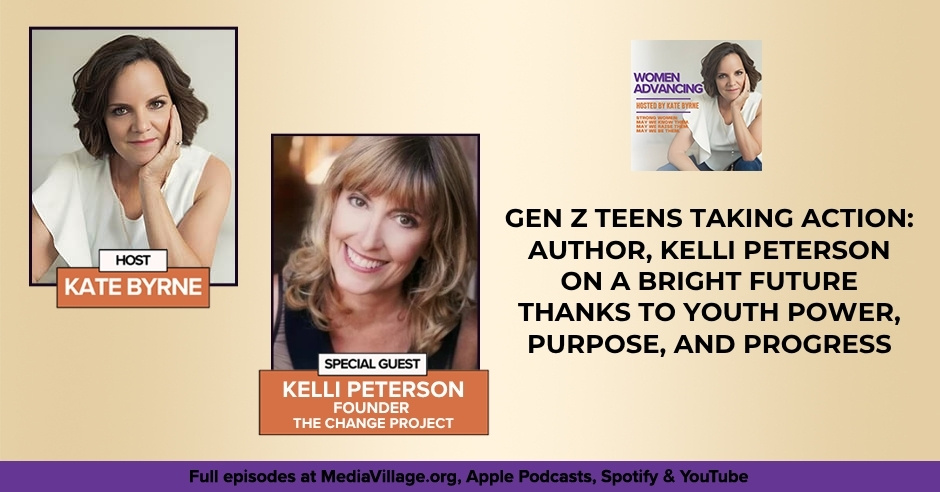
Discover the incredible power of Gen Z youth engagement and why their voices are not just a side show, but a smart strategy for the future. Kelli Peterson, author of Gen Z Teens Take Action and founder of The Change Project, joins us to reveal what this generation is getting right, what adults still don’t grasp, and how we can all better support the next wave of leaders. Kelli shares her insights on purpose-driven leadership, the importance of believing in yourself, and the transformative power of civic engagement, proving that global influence can indeed meet kitchen-table wisdom. Get ready to be inspired by the fresh perspectives and impactful actions of Gen Z.
—
Watch the episode here
Listen to the podcast here
Gen Z Teens Taking Action: Author, Kelli Peterson On A Bright Future Thanks To Youth Power, Purpose, And Progress
How Gen Z Is Raising The Bar
My guest, Kelli Peterson, is the author of Gen Z Teens Take Action, and she’s the Founder of The Change Project. Kelli doesn’t just talk about youth empowerment, but she has been building systems around it for the bulk of her career, be it from boardrooms at places like Virgin Unite to grassroots circles with teen change-makers themselves. Kelli spent the majority of her career proving that young voices are not just a sideshow, but a very smart strategy.
In this episode, we’re going to explore what happens when global influence meets kitchen table wisdom. Kelli opens up about what Gen Z is getting right that adults still don’t get, and how we can all show up better for the next generation of leaders. We’re going to talk about courage, believing in yourself, civic engagement, and why writing Gen Z Teens Take Action was as much a revelation for her and her own journey as it is a roadmap for others. If you care about purpose-driven leadership, youth power, and the future of pretty much everything, you’re going to find this conversation is definitely for you. Be sure to stay to the end because I share a couple of key takeaways. Believe me, there are many.
From Corporate To Cause: The Accidental Activist’s Journey
You’re in for a treat. We’ve got Kelli Peterson, who’s the author of Gen Z Teens Take Action and the Founder of The Change Project. Kelli, bring it on. Share your gems. I’m so excited to hear what you have to share.
I’m so excited to be here, Kate. It’s awesome. Thank you for inviting me. Thank you for having me. It’s great to catch up again after all these years.
We always do fascinating things. I’m just saying. Kelli, share with everyone a little bit about your start.
I knew this question was coming, and yet still, I look at my past and I think what a bumper pool table.
See, everyone. That happens. Kelli, this is the thing. Many people think, “Everyone has such a linear line. It was so straight,” or if it wasn’t, you went on a path, and then you went on another, and it’s not true. Sometimes, the best stuff happens when you are in a bumper pool room.
It only starts to make sense at the end of the game when you so strategically planned all of those ball bumps, whatever it is called. This was fun to think about because when I was in college, I was a Communications major. I very specifically wanted to help people with that major. I studied Sociology, Psychology, Political Science, and the culture of communication. What was I going to do with that?
I had no idea, like maybe people graduating from college back then who were a Communication major. Very quickly, I learned and became a lifelong agency gal. I started in recruitment advertising. Someone said I should try event marketing, which I did for about ten years because I’m a people person with a lot of energy. I moved up through the ranks of event marketing and ended up in a career that I love, which is brand strategy.
By the time I joined Sterling Brands in San Francisco, I had been with a range of satellite office marketing agencies. I say that because being with satellite offices or in new founding agencies gave me the bandwidth to wear a lot of hats and to always be pushing the limits. I never worked in a super corporate environment, even though I was serving corporate clients.
It’s the best of both worlds in that sense.
It was, and I didn’t realize it at the time. You’re bouncing back and forth. The other thing that I was lucky about is that even when I was working in recruitment advertising, Disneyland was my client, all the way through. I had the Nestles, the Häagen-Dazs, the Apple computers, Sunset Magazine, Nintendo, and the Xbox. I was always getting to work with big clients. I was always getting to work with people and getting trained in agencies that knew what they were doing. It was always about big stakes. I was super lucky in that way.
Fast forward to maybe about 10 or 15 years into my career, and I ended up at Sterling Brands. I ran the San Francisco Strategy office. I was the general manager. I worked with the smartest people. I got to travel all over the world, which tapped into my “I love people, and I get to travel” thing. We were working on great, amazing campaigns. I was getting to practice the business side of my brain, and we were doing strategy. It was always about understanding what the customer wants and connecting it with what Levi’s wants to give them or what the NBA is all about.
However, this was not enough. The other side of me, or the other bumper pool table that was pulling me in different directions, is that my mom and I volunteered from the time that I was 11 or 12 through the time of graduation. When I moved to San Francisco, I went to a volunteer fair. I ended up joining and then became president of the board of an organization called Make*A*Circus. You’re a long-time Bay Area person. You raised your daughters here. Did you ever hear of Make*A*Circus?
I think I did, but vaguely.
They had been around for 25 years, and they brought a circus to a park near you everywhere in the summer in the Bay Area. They taught circus skills from age 2 to 18. They had latchkey programs and foster kid programs, basically teaching kids confidence through the art of the circus.
That’s great. Literally through the art of play and feeling okay with it.
Yes, exactly. We had a gym, a flying trapeze, and acrobats. We trained quite a few of the Cirque de Soleil teens who went on to become Cirque de Soleil teens. It was also my first dip into whether we are a circus arts organization or a service organization. I was navigating that polarization. I ended up having to quit that position because I was traveling so much at Sterling.
Fast forward, I’m working at Sterling. It’s all fantastic. Hurricane Katrina happened. I went down to Mississippi and used all my vacation days. I stayed there for a month and helped out. Bono was launching (RED) around this time. I decided I have to do something. I have to give back somehow. This is the why that then shapes the rest of the half of my career. A year and a half later, I quit Sterling when my boss wouldn’t let me open a sustainability practice. How rude, right?
Yes. The nerve.
I know. Also, yay for me, because sustainability probably isn’t my jam. I’m more of a people person. We were on a flight going to Geneva to work with the global fund to fight AIDS, tuberculosis, and malaria. I asked my client how I could start working in this field. He said, “When can you start?”
What a great compliment.
When you’re completely dejected and you open up, and then your client says, “Come work for us,” so I did. That’s why it’s funny. No plan, bumper pool table. It all makes sense because I kept following what I was feeling and who I was, which may or may not have been a good thing at that time. I spent the next five years working for big NGOs. I tended to work on seven-month to yearlong contracts because that’s how NGOs work. I worked with the Virgin Foundation, I worked with the UN, and I helped launch the Global Impact Investing Network. I did their brand.
I forgot about GIIN. I forgot that you did that.
That was super cool. I got to follow a lot of trajectories around how these NGOs work, and how they do work. I was always coming at it from a corporate fundraising and a communication standpoint. How do we appeal to the corporate world? How do we make doing good appeal to corporations in a way that they can invest? At the end of the day, it’s all about a business. I did that for five years, and then I needed to get back to California. California is not the heart of where big NGO work happens. You don’t get your choice of things, and things don’t move that fast anyway. I came back to my old agency. They took me back after 5 or 6 years. I realized immediately that it was a mistake because it was too far down the path.
Sometimes you have to do a little bit of a flight to safety, touch base, especially when you’re coming back and you’re getting resituated, only to realize that you outgrew it. There was a reason why you left in the first place. You were too big for it, and it was too tiny for you.
It wasn’t where my heart sat. I was told that I should wait until I had made a lot of money to try to make a difference. Maybe that was the smart thing to do, but I didn’t choose that path. To finish that off, the last twelve years or so, I came back and realized I couldn’t stay there. I didn’t feel good about staying there. I quit and re-instigated The Change Project. I have been doing both corporate work and social impact work ever since.
That is awesome because, honestly, it’s true. Your experience in your CV is like a moth to the light. Places like Virgin Unite, UNICEF, etc., it seems like it’s always stayed close on purpose. What’s a common thread? Is that the common thread, like global and your grassroots? You have such a cool combination of both, and not everybody does. You’ve got global work, but then you’ve also got this grassroots fire of, “How do we start spreading the word and creating a movement?”
I think that was driven from a very young age. My grandmother traveled a lot. She was on a secretary’s salary. Every year, she got to spend two weeks going somewhere and taking these pictures with heads cut off in these foreign places that got my imagination going. I have been very drawn to other cultures and how other people live my entire life.
When I was going through that, was it about sustainability? As all these movements were coming up, I realized sustainability was probably a little too dry for me. I was always drawn to making it equitable for people. People have the power, like helping people realize their own potential. I think everyone has a gift to give, but not everybody realizes they have that gift, nor do they know where to start.
Everyone has a gift to give, but not everyone realizes they have it, nor do they know where to start. Share on XI think UNICEF was to keep kids alive until the age of five. This is only clear in hindsight. Make*A*Circus was about giving them the ability to have some type of self-confidence because they can tumble by the age of three. I had a client at the end of 2016, where we did the rebrand or the update for the Adler Planetarium in Chicago. The Adler Planetarium had an amazing president who stepped in. She wanted to bring science to every neighborhood in Chicago. Basically, look up. It’s back to empowering people with whatever is there and whatever is needed.
Unlearning Old Habits: What Big Orgs Need To Drop
I was going to say their own advocacy that we do it. You’ve had a great combination of large major institutions and then also youth-led up-and-coming. What’s one thing big organizations need to unlearn, and what could youth change-makers borrow from the global playbook?
It’s interesting. We used to live in a time when these partnerships happened a lot more. There was more money for these types of things. I think big organizations and startups were all trying to figure that out. I think big corporations move more slowly. They have to establish consistency. They’ve got stakeholders, they’ve got money, and they’ve got year-long budgets. You have youth and change-makers. I was thinking about the last time we saw youth come forth on these topics.
The topics they’re coming forward on or these serious topics, like gun violence. They’re brash, they’re young, they’re fearless, and they take no prisoners. Because of that, and because they see things so clearly, and they can say what they want, partnerships had to happen because big organizations cannot. However, there are moments when they can get behind youth, and they can create this awareness. My brand background has always afforded me, and what I’ve always believed in is branding for good. If you’ve got a clear purpose and you’re not changing your hat as a brand every two minutes, you can get behind initiatives when they come up and amplify them.
Gen Z’s Secret Weapon: Why We Should Be Listening To Teens
You become the platform, which is fantastic. That also only endears both your internal stakeholders, your staff, your team, your customers, and also the people in your community and around it. Only good can come from that. That gives us a little breadcrumb over to your book, Gen Z Teens Take Action. It’s part blueprint and then part call to arms. Talk a little bit about the book. Did it teach you anything about this generation?
Yes. There are a lot of lessons. It was a total joy to interview these teens. Honestly, I felt like it was an honor that had been bestowed upon me. The point of the book is to say teens are doing some cool things right now, and we need to be listening to teens. I don’t know where we stepped away from remembering that teens see so clearly. We celebrate teen musicians and celebrities, yet not these teen change-makers. Times are tough right now. I think that’s part of the challenge. As we all know, teens are our future. They see very clearly, and they are doing some cool grassroots initiatives because of the tools that are out there right now.
Getting back to these teens who are doing something great, is there something in their story? What is their origin story? Why did they feel empowered to do this? What secrets do they have that potentially could be shared? It’s a story. Is there something that will connect with another teen to help them realize, “I can do this too?” Teens are being stifled in all of the communication tools that are available. Is anybody listening, or are they even being encouraged? That’s the call to arms, rah-rah piece of it.
I went into each story. I mapped out the line of questions. As you know, I interview for a living. I had this whole thing mapped out that I was sure I was going to uncover. I was sure the story was going to be like, “What did you encounter? What almost held you back?” It wasn’t that at all. It was their perspective and the uniqueness of the circumstance that they came into, all of their backgrounds are totally different. Quite a few of them went through some very painful circumstances and self-learning, as teens do.
What they decided to do with it, because they did overcome it and they did want to share with others, is they shared these stories with such courage and vulnerability and without a shade of self-doubt or self-judgment that we as adults tend to carry, like, “Should I share this?” They shared it from Point A to Point B, not with a “Yay, I did this,” or “This was hard.” It’s incredible what they did while going to school, while growing up as a teen. It’s like having this, “I have to do this,” not knowing what to do, and then figuring it out, and starting to talk to people.
This is the thing that I’ve been blown away by myself. When talking to young entrepreneurs, nobody understood voting, so I built a platform to teach them all about it. I never did it before. I’ve talked with the founder about quantum computing, and she’s like, “I couldn’t understand it.” I then understood it, and I realized, “Many more people should understand it.” Not everybody thinks that way, so there’s curiosity, but there’s also this delicious generosity of, “I learned this cool thing. You might find it cool too. If you do, yay. If you don’t, no harm, no foul.” There’s no taking that part personally, it seems.
As they unpacked their stories, none of these teens was out looking for attention. When I reached out to them, it was amazing that they accepted my offer to write about them. First of all, I never thought about the fact that we’ve got teens under eighteen. You’ve got to jump through some hoops to talk to somebody and tell their story. Yet, they were out there doing this work. I was hopeful. My hope is to amplify their work and then connect that to other teens because that’s the power of story. You hear something and someone else’s story, and it gets you to start thinking about what’s going on or what maybe you’re pondering.
That's the power of story, right? You hear something in someone else's story and you just start thinking about what's going on. Share on XBeyond The Stereotypes: Deconstructing The Gen Z Narrative
With that all being said, what then would you say are some of the inaccurate narratives people keep repeating about Gen Z?
It’s interesting you ask this because I have a corporate client right now, and we are in the middle of trying to figure out what Gen Z is doing next. I love this question because I think it’s very hard to categorize what’s happening with Gen Z right now. If you think about the last five years alone, COVID, and this isn’t a political discussion, but bombs are being dropped, we have a 15% immigrant population, and armed guards are chasing them down, how many people know an immigrant in their life? We have increasing percentages of teens being affected by what’s happening in our world, in the economy. Other than social media and digital platforms, they’re just surviving right now. I think it’s hard to categorize what has been so easy to do with Gen Y, Millennial, Boomers, Z. Who knows?
It’s an entirely new landscape. I completely agree with you. When you go back to when they were born, it’s honestly exhausting. With guns so rampant, also, no wonder everyone is anxious.
That’s the thing, too. All their parents are anxious. Their neighbors are anxious. Their teachers are anxious. We’ve never been so anxious. Imagine growing up in that world. I don’t know, even in our lifetime, if we’ve had something like that. I would say probably World War II, maybe Vietnam. That at least only came at you through the TV.
It wasn’t right there in your face. It was a steady reminder from documents inside a bathroom stall to “Keep your phone off, put your feet up so the shooter doesn’t find you.” That’s a thing.
I think that they care about costs more. They’re moving out of the house later. I think school has become more distant for them, yet the digital platform is giving them lots of opportunities. I think we don’t know what trends or what is shaping Gen Z yet because it’s so different.
Empowering The Next Generation: How Adults Can Support Gen Z
It’s so constantly shifting. With that being said, how do adults help? How do we get in the way and go away? What do they need most from us, and what should we stop doing?
Going back to the teens that I talked to, what also struck me is that most of their parents stopped and listened, and the other parents did stop and listen once they made the case. I think a parent’s instinct is to protect. In that protection, they forget to listen to this young adult who is very perceptive and has so much to offer.
It’s going back to encouraging, listening, and sitting down. I think teens are losing face-to-face communication and personal time. That sounds like Parenting 101, but it’s quality time and listening that is so needed right now. Less run, go and try this, but let’s sit down and talk about what’s happening and what you’re interested in.
Future-Proofing Companies: Adapting To Gen Z’s Workplace Vision
Also, sometimes be together. It’s interesting. I was talking to someone who was a young social worker, and she said, “Honestly, I wonder if social work is even a thing. What we need to do is help parents parent, especially for youth.” In her experience, some of the things that were coming up were a kid being a kid because of the anxiety, creating a thing out of it, it’s interesting. How can companies start prepping for this generation? There is going to be flatter hierarchies, if any, flowing, collaborative team groups, and what you said, listening as opposed to getting resentful and defensive when recommendations or questions are being made.
I think that there is something truly different happening. I have not been in a corporate environment to manage young teams in a while. I can tell you from working with the young interns that I’m working with now and doing a lot of the interviewing that I’ve been doing with teens on behalf of one of my clients that the times have changed these last five years.
They weren’t in classrooms. There wasn’t anyone supervising them. They didn’t grow up in an email culture. We also have a democracy created by social tools and communication. I think there’s something different happening, but it is going to throw that hierarchical corporate structure how things get managed. I think it’s going to throw it a little bit for a loop.
There are the tools to take the time to create these working pod environments. That’s probably going a little bit against what they’re trying to do with AI and making things more efficient. We’ve got to slow down and listen and take the time to train versus lining people up and giving them that one job and letting them learn it. I think there’s a lot of collective idea generation and collaboration that needs to happen at a much junior level.
I think that’s one of the things. I do some work with some of the local business schools and their school of entrepreneurship. One of the things we’ve talked about is how to skill these graduates to work with older generations and how they communicate. How do they pose things differently so that it doesn’t become an issue, things can get done, they can be heard, and their smart thinking can be heard?
It’s creating a flow, like figuring out what that flow is because it’s different than what we grew up with.
Grounding Grand Ambitions: Staying Focused Amidst “Molasses” Pace
You’ve got these different missions. As you said earlier, corporates sometimes move more slowly because they’re big behemoths. How do you stay grounded in sight when what you’re trying to do is so big, but you run into that slow molasses movement pace of some of the corporations you work with?
As a consultant, I get to come in and work on quick projects. I have quick windows. That suits my personal tempo. You’re right that it’s hard because I tend to be juggling too many missions at the same time. What grounds me? I’m a problem solver, so I stay focused on what the problem is, resourcing a problem, and then meditation. My dog walks.
That’s all true. It can be that simple. It’s making the time. Oddly, making the time isn’t always simple.
That is the hard part. I think our inclination is that we want success overnight. The reality is that it is not true anywhere.
Our inclination is, we want success overnight, and the reality is that is not true anywhere. Share on XThey’re not sustainable success, for sure.
That comes back to how corporations and youngsters partner together. It’s realizing success doesn’t happen overnight, so let’s create a path to get there. That’s true of juggling all those balls. All those balls need a strategic path.
Redesigning Civic Engagement: A Gen Z Blueprint For Participation
I’m sure this is something that is coming up. There has been a lot of talk about civic democracy and civic engagement. One of my daughters works in public policy, and she often said, “It blows me away how so few people understand what it is required to be a citizen and some basic civic things.” We’ve all known people who have been dozing. I’ve got a friend from USAID, RIP. With that, if you could redesign civic engagement from scratch with Gen Z, so it could be ready to take it and go with Gen Z in mind, what would it look like?
Another super interesting question because the times are so different, and I’m going to go back to this. It’s all about survival right now. Youth are prescribed to go to school. It’s like if you’re not learning it in school, where else do they have the time to learn it? Unless they’re joining the Boy Scouts, Girl Scouts, YMCA, or whatever. Time is so constrained now for their parents. There are a lot of great digital tools out there. It would be great if civic engagement were a class. Not even as civic engagement, but that concept. That existed, and people had to get creative, just like you have to write a book report. How do you help somebody with the tools that you have?
I say that because a number of the teens in the book started out with an idea and then discovered the tools, the digital tools, the platform that they could create a curriculum or a message or a concept. They realized this whole idea of chaptering it or networking it, and realizing how many people across the country or out of the country could take it and move it forward, and then build collectively. I think it’s realizing the tools that we have and then also seeding it in a place where they all have to learn together to carry it through.
Exactly, so that everyone has to be committed.
Yes, or even get a sense of it. It’s up to parents, or what they may learn in a club that they happen to join. Even then, where is the focus? Where is the time if they don’t personally have the time at home to be able to contribute to something like that, or aren’t encouraged to?
Screen Time’s Double-Edged Sword: Blessings And Burdens For Gen Z Learning
I think there are so many things that aren’t happening in education for a variety of different reasons that used to, and it fizzles out. No question. Screen time with everybody, how do you see that having impacted them? Aside from bad handwriting.
Screen time is a blessing and a curse. I think it’s creating this isolation, which we’ve been hearing about all the mental health issues. Yet, it’s the future in terms of how people will learn, and why teens are so smart right now. Those that are pursuing who have information at their fingertips are going deep and far with it. AI is scary.
That’s what I was going to ask you about next. What do you think? Friend or foe?
Both and. It’s scary. No question. Someone went to an MIT lecture and heard that it is going to make us dumber. That terrifies me. Learning to think critically about the information that you’re fed, but not everyone has the luxury to be able to critically think about that. That’s the part I worry about, but it’s here.
This is probably inappropriate to think about, but I was trying to figure out that there are five different ways of learning. There’s kinesthetic that you do, and then there’s audio, and there’s verbal, and there’s visual. Do you think this generation is more of one type versus another?
It seems like they must have to be. I don’t know why I tend to be such a visual learner. Where did I develop that? I don’t know enough about that, but I don’t know how these kids who needed to be home for a couple of years during COVID weren’t forced to pick up skills that either worked with their brain or didn’t work with their brain.
Timeless Wisdom: Advice for Your Younger, Future Self
Also, work around skills when they ran into that obstacle. Knowing what you know now, what advice would you give your younger self?
I would have so much advice for myself.
“Settle in, little Missy.”
“Sit still. I have some things for you.” Honestly, it was quite a bit of what these teens shared with me. Don’t be afraid to speak up. Know that what you have to say is important and can make a difference. Find audiences, and share your ideas. What I would add to that, and what they also said, is trust in yourself. Believe in yourself. Trust your intuition. I was a shy kid, which is bizarre.
Don't be afraid to speak up. Know that what you have to say is important and can make a difference. Share on XI was a shy kid and I was afraid to speak up. How many other kids out there have something within them, and they’re afraid to speak up, or they are being told that they’re wrong, or they should be doing something else? When I look back at why I majored in what I majored in and what I’m doing now, I knew then what I wanted to do, but I didn’t know.
I didn’t know what to put a word on that. Exactly. It was the baby entry point.
I would go back, and I’ve heard your other guests say, “Trust yourself. It will work out.”
It does. If something doesn’t turn out the way you were thinking it should, or could, etc., I am living proof in so many ways of when that happens, this amazing world does open up. Your career is a perfect example of this, literally flowing on down the river.
It made sense. It worked out. Back to your point, I love that these kids ripped the Band-Aid off and got out there and started doing it. I would love to know them when they’re my age to see, because they set up their own blueprint, and they have no idea how important all of this work that they laid out for themselves just because they felt it. “Why isn’t someone doing something about this? I guess I have to.”
Not only did they think it, then they also did it.
They figured out the last piece.
There’s after that. They Googled it. There’s a YouTube video.
They started. One kid started blogging about financial literacy because he was fascinated by it and didn’t know what he was going to do with that. It’s math to a whole other level.
Gen Z Teens Take Action: Stories of Circumstance, Passion, and Opportunity
It’s so heartening. Kelli, thank you so much. Talk about inspiring and also, truthfully, eye-opening. For all of us, don’t be so quick to judge. Don’t judge a book by its cover, by its tone, or by its eye roll. I think there’s so much more than meets the eye. As is always the case, there’s always something to learn from teeny tiny to old grandmother Willow. There always is. You have to open your eyes and your heart and find it.
I could not appreciate you more for saying all of those things. That’s what I live by. It’s so true.
Lucky you. Gen Z and the rest of us are lucky that you’re doing everything you’re doing. Everyone, go check out her book. It’s available.
Amazon, Barnes and Noble, Outskirts Press. If you’re here in the Bay Area, at Book Passage.
Book Passage is an amazing bookstore. Look for Gen Z Teens Take Action by the illustrious Kelli Peterson.
Thank you so much, Kate. This has been so much fun. Thank you for drawing light to what is possible for teens.
Thank you for collecting them all. I appreciate you.
Thank you. I appreciate you.
—
Key Takeaways: Embracing Purpose And Empowering Gen Z
Isn’t she great? I love Kelli. I love her energy, I love her curiosity, I love her wisdom. She has probably what I would seriously call the sexiest CVs ever, given all the folks that she’s worked with, ranging from Richard Branson, Bono, and the list goes on. For this conversation, here are my key takeaways. One is this whole notion that people were telling Kelli she had to wait to make a difference. “Go make a ton of money, and then you can make a difference with that,” which is, AKA, philanthropy. That sure is one way, but the way to do it is you can do both now.
There are so many different ways and so many different examples of doing it. Do not put off following a passion and bringing it to life and doing good with it. The world is counting on you for that. Her findings with her Gen Z book, teens see so clearly, and because of it, they’re able to figure out, “Here’s a problem. I’m going to go build a solution to it. I’m going to build the answer to it.” Their perspective is unique and broad.
I think they do have a lot of self-judgment, but perhaps after they build some of these solutions, maybe they’re okay with it. They’re not looking for attention. I think that probably impacts how we work with each other in the workplace, and also perhaps even parents in dealing with older kids. What we can do is as parents, as bosses, as colleagues, and as friends is listen and protect quality time. They last for five years, which were such quintessential parts as they grew to be impacted. It had a big impact. I would also say demonstrate a bit of compassion.
Finally, rip the Band-Aid off, dive in, and by all means, believe in yourself, seriously. Trust your intuition. We say all of these things again and again. I don’t mean to bore and state the obvious, but I have to keep repeating it because it is so true. With that, I’m going to leave you with my favorite word, which is believe, and say, “Believe me.” I’m so grateful for you for joining me again. I look forward to the next time we’re together in Women Advancing with Kate Byrne.
Important Links
- Gen Z Teens Take Action
- The Change Project
- Gen Z Teens Take Action on Barnes and Noble
- Gen Z Teens Take Action on Outskirts Press
- Kelli Peterson Linktree
About Kelli Peterson
 Kelli Peterson’s unique path from marketer to entrepreneurial youth advocate started during an internship at the La Jolla Children’s Museum while she was attending UC San Diego. At UCSD she received her B.A. in Communications before winding her way north to the progressive yet soulful city of San Francisco.
Kelli has been ‘an agency gal’, the majority of her career. She got her start in ‘big brand’ event and college marketing, before eventually landing at Sterling Brands where she spent 8 years as SVP/General Manager serving F500 clients. There she honed her skills in brand and product strategy, research, design, business and innovation before stepping out on her own. The diverse consumer companies she serviced throughout her career have provided countless opportunities to interview teens and tweens, working with the likes of the NBA, Nike, Levi’s, Jordan, Nestle, Xbox, Nintendo, Microsoft, Adobe, and many others.
Over the years, her heart for impact work took on different forms, from volunteer to FT consultant, to ultimately weaving the path for both business and social impact to exist together. She first served as President on the Board of Directors for Make a Circus for four years where building kids’ skills and confidence through the circus arts was a Bay Area staple. She spent 2 months down in Biloxi, MS after Hurricane Katrina – which turned out to be a career defining moment. She knew she needed to contribute more meaningfully than ‘just’ volunteering.
Shortly after this experience, a 6-month sabbatical in Switzerland at the Global Fund to Fight AIDS, Tuberculosis and Malaria, she switched careers, spending years with UNICEF, the Virgin Unite Foundation, and consulting with other NGO’s, Impact Funds and Foundations to design and secure corporate fundraising, develop communication strategies and in some cases, launch new brands. The Gates Foundation, the Global Impact Investing Network, the UN, and The Global Fund to Fight Violence against Children are just a few of the many organizations she worked extensively with.
She is also a long-time start-up mentor and communications advisor for national and international organizations that support social and tech innovators, including the Branson School of Entrepreneurship, the UNICEF Innovation Lab, Impact Hub, the Taproot Foundation, and for the last eight years, the Founder’s Institute.
Today she is interviewing teens, Creators and Influencers, as part of Adobe’s Insider Communities and she just published Gen Z Teens Take Action, a book based on her interviews with real teens making a real difference in the world. She lives north of San Francisco with her dog Hudson, travels a lot, and spends oodles of hours dreaming up what’s next.