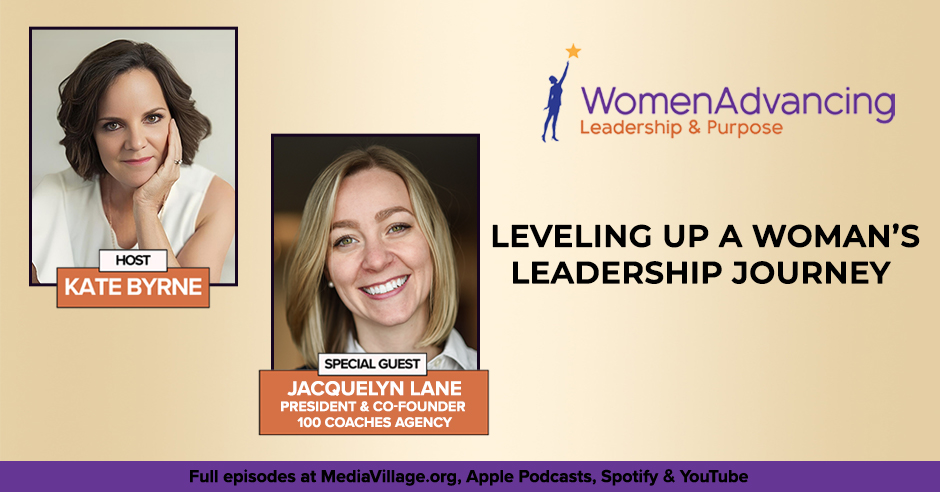
Corporate America makes the leadership journey of every woman quite challenging and frustrating. Their opinions are often disregarded, their talents belittled, and their expertise considered only secondary to men. Jacquelyn Lane, president & co-founder of 100 Coaches Agency, is leading the charge in transforming how women leaders are shaped and trained through executive coaching. Joining Kate Byrne, Jacquelyn, a Forbes 30 Under 30 awardee, explains how they should advocate for themselves and lean on their natural ability to care for people. Jacquelyn also discusses the right way to accept feedback, her process for writing a book, and how to disagree with your leaders respectfully.
—
Watch the episode here
Listen to the podcast here
Leveling Up A Woman’s Leadership Journey With Jacquelyn Lane
Our guest is Jacquelyn Lane, President and Cofounder of 100 Coaches Agency. She’s the co-author of the Wall Street Journal bestseller Becoming Coachable. She is doing all of this shy of her 30th birthday and making it on the Forbes 30 Under 30 list. She shares extraordinary insights with regards to some of the challenges that women are facing, some of the aspects of being a leader, shortfalls and practices that we women need to work on, namely learning how to manage up versus managing down and overcoming this notion of, “My good work is going to speak for itself,” because sadly, that isn’t enough. She also shares some of her special insights on who gets her excited, how she moves forward, and what fuels her next ideas. She’s going to be writing a second book, so there’s more to come. Tune in. You’ll learn a lot.
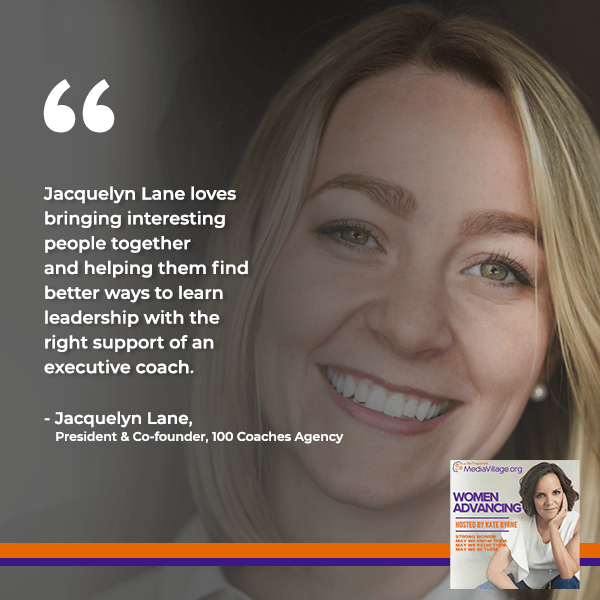
Welcome, Jacquelyn Lane. Jacquelyn is the President and Cofounder of 100 Coaches Agency as well as the co-author of a Wall Street Journal bestseller Becoming Coachable, and was named to Forbes 30 Under 30 list. I’ve got to say you’ve been a busy bee. Thank you so much for taking the time to squeeze us in.
I’m so happy to be here. Thank you so much for having me.
Jacquelyn’s Origin Story And Leadership Journey
It is my pleasure. One of the things that you and I have been talking a bit about, and it comes up so often, I’m sure, when you’re talking with clients and when I’m talking with others, is this whole notion of our leadership journey and our career. Some think it’s such a straight path. Others of us have had more of a winding path. Share a little bit about your journey and how you got to where you are.
I love these stories. Our origin stories are so powerful. For me, my leadership journey began in Corporate America. Like many people, I experienced what I would describe as poor leadership. It was some of those example that showed me maybe not what I wanted to be but what I didn’t want to be. I worked with some great leaders as well but more often than not, I saw the challenges of not having a clear strategy, poor communication, or an unhealthy culture. I knew that and believed that there could be better.
What set me off on my journey to ultimately found the 100 Coaches Agency with my business partner, Scott Osman, is that we believed that there could be a better way and that leadership can be learned and taught. One of the best ways to do that is with the support of an executive coach. In a business that promotes learning, growth, development, and leadership, we also have to live that, too. That was the thing that we learned and started to lean into and say, “How can we build a healthy, flourishing culture even within our organization?”
It’s no surprise. I’m in 30 under 30. I am relatively young, but I have never had experience working for a woman before. In many ways, I was charting my own path and trying to decide how I could show up authentically and genuinely as a young person and a woman with that care and concern that I naturally have for people while also having a vision and clear communication. Fortunately, I’ve had some wonderful mentors, friends, and coaches along the way who’ve supported me and whom I owe being here.
Thank you for sharing that. We’ll get into a little bit deeper on that piece about never having worked for a woman. I’ve worked for some great ones and I’ve worked similarly for some that have some growth to do. It’ll be fun to dive into that a little bit. What were some of the skills that you relied on early on in your career while you were managing and navigating through Corporate America? I’d love to also know when and how you got the courage to say, “This is it. I’m going out on my own.”
I’m an engineer by training. Let’s be clear. They don’t give a lot of leadership training in engineering school, so a lot of the skills that I relied heavily upon early in my career are ultimately not the skills that I have had to learn and use in the leadership role. I was very analytical at the time. It was interesting. I learned quickly in Corporate America that being an individual contributor to my own work was not going to be enough to accomplish the things that we needed to accomplish. Much of education, including engineering school, teaches you to be a strong individual and that there’s not a lot of teamwork. Those were some of the skills I had to learn quickly because education and the working world are not aligned in this way.
In Corporate America, I quickly became the person known to aggregate interesting people together. I was the person who probably had one coffee meeting a day with someone at a different part of the company or part of the business. I’d learn about all these interesting projects and solutions that people had and would bring some of those different people together to solve some of the challenges we were having in my business unit. I learned that that’s one of the things I love doing. I love bringing interesting people together. That’s a type of leadership. That’s what started me on this journey. From our dear friend Marshall Goldsmith, what got us here won’t get us there. New skills had to be learned along the way.
What got us where we are right now will not get us to where we want to be. That’s why we need new skills. Share on XAsking For Help And Never Giving Up
Do you know what’s interesting? One skill that I can think of that would transfer over from being an engineer is this notion of a critical path where you understand, “For me to get there, I need this,” and then realizing, which you have this gift of, “I’m missing these three ingredients, these skillsets, these pieces, and/or these departments have to come in.”
Having the humility to have curiosity and realizing, “I can’t go it alone,” beautifully positions you for the future. The way the future is flatter, less hierarchical organizations are moving in, especially since we’ve got 5 or 6 different generations at any given time and how they respond to power and communication. Are those some of the topics that you cover and the core principles of 100 Coaches?
You are so spot on. Those are some of the things that many executives struggle with. One of the things I hear is that everyone is struggling with something or another. There are all areas where we have blind spots and missing pieces to the puzzle. In general, people feel tired or burned out. Many leaders feel like they’re communicating sufficiently, but their teams feel that they’re not communicating sufficiently.
Some people don’t make peace with power dynamics and the fact that the decision-maker makes the decision. These are some of the things where you have to shine a light and help people come to accept reality, commit to the humility to play the long game and recognize that we all have growth areas. A great leader is often someone who says, “I need help,” rather than saying they need to have all the answers.
A dear friend gave me this lovely, for lack of a better term, parable. It’s a book called The Boy, the Mole, the Fox, and the Horse. There’s a line in there that talks about how asking for help is not quitting. It’s refusing to give up. I thought if we all looked at things that way, there would be no self-judgment, and one would be encouraged to ask whatever they needed. With this new chapter of leadership, what kinds of opportunities does that hold for women? I know we all are yin and yang, and everyone is masculine and feminine, but what are some of the things that you’re seeing and excited about for the future of women in this realm?
At the 100 Coaches Agency, around half or over half of the leaders that we coach are women, which, to me, is exciting. Companies are significantly investing in the growth and advancement of their women. They recognize that there has been inequity historically in women being represented in leadership roles. Many companies are committed to closing that gap.
Companies are significantly investing in the growth and advancement of women. They recognize that there has been inequity historically in women's representation in leadership roles. Share on XBeing A Leader And A Woman
What does it mean to be a leader and a woman?
It’s a balancing act to be both a woman and a leader. I find that many women feel that tension of wanting to be kind and caring but also be known as being firm and assertive. Many of them want to be mothers in addition to working. There’s a balancing act that happens there naturally. In general, I find that a lot of women have some fear because they’re writing this new story. They don’t have nearly the examples and generational experience to walk this path. It’s easy to pull from old playbooks of what we saw from many of our moms or grandmothers. That’s a known path, so it feels very safe in many ways, but charting a new course is scary. They need great support along the way.
I find that many women are excellent at managing down and caring for their teams and people well. They consistently, from what I hear within companies, get top marks regarding their management skills and people enjoy working for them. I am speaking in relatively broad strokes. This is not true for everyone, but it seems to be a big trend. I observe them to not be so good at managing up. They don’t often advocate for themselves in the same way that many of their male counterparts feel comfortable advocating for themselves. It is something to be aware of and to focus on.
Women are excellent at managing down and caring for their teams. They consistently get top marks regarding their management skills, and people enjoy working for them. Share on XWhy is that? I’m one of those people, or historically, I was. I’m finding I’m getting a little bit more into it. Is it old habits or old beliefs that are coming from our family that automatically, those tapes start clicking into us so that we start listening to them instead of our heart?
There are some habits that we pick up early in our lives. One of those is, “My good work will be recognized and rewarded.” It’s that same myth. If a tree falls in the woods and no one hears about it, did it fall? Unfortunately, in a lot of Corporate America, people are very busy and distracted. Unless a manager is paying very close attention, they will probably not spontaneously observe your good work and recognize you for it. Unfortunately, advocating for oneself is an essential skill.
One of my favorite books is from Sally Helgesen, who is also a member of the 100 Coaches community. Her book, How Women Rise, which she wrote with our friend Marshall Goldsmith, is a fantastic guide to some of the habits that women often exhibit without even recognizing that they’re doing it because it’s such an ingrained pattern at this point in our lives. One of the ways around it is to have incredibly aware male leaders who can start to recognize some of those habits as well. I feel very fortunate that my business partner, Scott, is one of those and has helped me learn, grow, and be better in this area.
Getting Past Women Stereotypes In Corporate
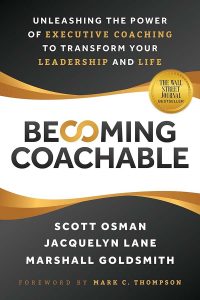
Becoming Coachable: Unleashing the Power of Executive Coaching to Transform Your Leadership and Life
That’s a great point to get a male counterpart partner in crime. A coach, if you will, but an advocate to help you advocate with yourself, let alone with other people and help you balance and counter some of those demon conversations that take place. One of the things that we’ve been talking a bit about, too, is our fear or our past beliefs that women are more the poets. They’re more the communicators, the marketing, the feel-good, and, to your point, HR. God forbid I get involved with anything that a quant would do. I’m like, “I can’t do math.” They’re like, “You can. You wouldn’t get to where you are if you couldn’t.” Talk a little bit about that because that’s a key piece, it seems to me. If you could move that rock aside, your little ascension would begin to flow.
One of the things that I hear so clearly is in order to make it to the very top of an organization, the C-Suite or CEO position, you have to have managed a P&L before. It’s the rules of the road. I remember speaking at a women’s conference and one of the questions submitted was, “How can we change the game to advance to the coveted CEO position?” I laughed and said, “The game is the game. I don’t think we’re going to be changing the game. It’s about learning to play the game. Once you know the rules and understand how to get there, then you have to take the bold moves, play the game, and see what happens.”
I would encourage women to not be afraid to take on those roles. Do something in the field of sales, finance, or engineering, and manage a business unit or manage a plant. I know that there are fewer women who’ve held those roles historically but representation matters. This is not just about ourselves but about the generation that follows us as well.
How To Disagree Respectfully To (Women) Leaders
It’s getting the road set up for them and the path set up for them by all means. This is going to touch upon the comment that you brought in earlier. You’ve never been led by a woman. One person told me that in order to be a good leader, you have to be a good follower. You get used to following, and that doesn’t mean one learns the hard way. It doesn’t mean saying yes all the time. It’s that whole notion that the decision-maker makes a decision. How can people bite their tongue when they want to speak out against, “That is the stupidest decision I’ve ever heard,” because that can be career ugh, especially when it’s a woman who is making the decision. You want to be supportive and at the same time, you disagree. How can one disagree respectfully?
I like to use Jeff Bezos’ framework here to quickly delineate between the types of decisions that can be made. He talks about reversible decisions and irreversible decisions. As it makes sense, reversible decisions are the ones that you can change. You’re, in many ways, incentivized to make a decision quickly, pursue that path, and know that you can always change your mind or backtrack if needed. There are irreversible decisions, ones that are quite consequential. If you’re signing a contract for 5 years or 10 years to do something, that would be very hard to back off. You want to be thoughtful and take the time to do the analysis before you commit to that decision.
I find that in situations of reversible decisions, sometimes saying, “Here’s my opinion but I’m happy to disagree and commit,” is a great perspective because then, you’re telling people what you think but in a respectful way and saying, “I can be a team player here.” On the irreversible decisions, that’s where I find having the courage to speak up and say, “My instinct is this. Even better, I can back it up with this analysis or this data.” That becomes a powerful thing. If worse comes to worse, my experience is to find a male counterpart who shares the same opinion and has them voice it.
That’s frustrating, but you’re right. If you’re fortunate enough, that male counterpart may be willing to say, “I was speaking with Jacquelyn and she brought up a good point,” and step away. That’s a big ask, I know. There aren’t a lot of women necessarily, sadly, that would do that either. If we can start exhibiting that kind of behavior, it would make room for others to take the mic and pass it on down the road.
I couldn’t agree more. I do find it’s their strength in numbers. Whether that person is another man within the organization or another woman, finding someone else who shares your view, winning them over, and together speaking up is much more powerful than and less scary than having to stand there and say it alone.
Encouraging Feedback And The Right Way To Accept It
There’s nothing worse than when you are that voice and someone says, “I’ll stand up beside you,” and they don’t. It’s crickets. That is always going to be a potential situation. What are some of the trickiest pieces that you discuss with some of your clients, the women? Is it around feedback or imposter syndrome? What are some of the biggest challenges that people seem to be coming to you with?
Every person’s a little different. For some women, it’s having a work-life balance. It’s the pressures of home combined with the pressures of work and letting go of some of the guilt that they feel both as a parent and as an employee. That tension is a tough one. Coaching can be great for finding some peace and resolution there.
Communication is always one of those challenges. How do I communicate with strength without being perceived as bossy or pushy? That’s a tough line to walk. In general, courage and boldness to take those big career moves is often a challenge. You don’t want to make that career-ending move. Many women don’t have a safe space or a sounding board that they can meet with.
Feedback is another one of those challenges. Some people, in general, feel very defensive about hearing feedback. It’s a bit of a process to work through that. How do you hear when someone tells you something, see it as a gift, and say, “Thank you,” recognizing that they are telling you something valuable even if you don’t think it’s warranted? Imposter syndrome is the theme that goes through all of those different topics. It’s that, “I’m not sure. I don’t know how to take the next step alone.”
Since one doesn’t know how to take the next step alone, all the more reason for the feedback because feedback is directional guidance, you’re heading North but you wanted to go South so I’m telling you, “You’re heading North. You want to take a left turn at the next spot.”
It’s one of those essential leadership skills. The truth is that as we rise through an organization, we often hear feedback less because of real and perceived power dynamics. The openness to hear it is essential. We all know so many leaders that behind their backs, their employees and teams are saying one thing about them but they’re too afraid to say it to this person’s face and they end up wondering why they’re not progressing in their career. Everyone else in the organization knows it but they don’t.
This is such an important point. Especially in the beginning, to your comment, you may not want to know, but the fact that you have an inkling that there’s something that you need to know, you do know. One looks to others for verification of it. The truth hurts sometimes but it’s going to hurt a heck of a lot more, to your point, about not rising up through the channels. We talk about a personal board of directors. How do you coach people who surround themselves with those who are proponents of “Everything you’re doing is puppy, dogs, unicorns, and cupcakes?”
I had to get to the point where I was more afraid of not knowing where I stood than of knowing the truth. I was more afraid of not hearing than of hearing because hearing is scary. There is no doubt about it. You’re right. It’s kicking the can down the road. Especially if you have the perception of being someone who receives feedback poorly, gets defensive, etc., it is a long road to unwind some of those perceptions.
You’re right. You need to have the people around you who will shoot you straight. The truth is, you have to ask over and over again. I find that a trusted peer is one of the best people because there’s often not that same power dynamic at play. A great manager is also someone who should tell you the truth, but it’s often very difficult to get the people you lead to tell you the hard feedback and the truth. That takes a lot more time. I would start with peers and your manager. You have to start somewhere. Get that feedback muscle exercising again.
That’s an interesting point, too. The key piece is being defensive. What is a non-defensive response? Sometimes, there are people who talk about a blind spot. They’re saying, “I want to hear the feedback,” and then you say it and then they say, “That’s not true. I don’t think that’s right.” They say, “Don’t be defensive.” One says, “This is me I’m referring to. It’s very glass house but it’s like, “I’m not being defensive.” What does that sound like? How do we language that?
This is an insight from Marshall that the only appropriate response to any feedback is, “Thank you.” That’s it. It’s not even, “Thank you. That’s great,” because if the first piece of feedback someone gives you, you say, “Thank you. That’s great,” the next piece, you say, “Thanks. I’ll think about it.” On the third piece of feedback, you say, “Thanks,” or, “I’m not sure,” or anything.
The only appropriate response to any feedback is thank you. Share on XAll of a sudden, you’ve graded the feedback. You said, “I loved what the first thing you said, I was okay with the second thing, and I was uncomfortable with the third thing.” If you grade that feedback again, even something that subtle, especially if it comes from someone that you lead, that is going to deter them from telling you what you don’t want to hear. Ultimately, feedback, whether it’s what you want to hear or don’t want to hear, is for our benefit. Say, “Thank you.” It might feel a little awkward because we always feel some need to interject. This is one of those things I have had to learn to bite my tongue over and over again.
Through all this, what are some of the things that you do personally to continue to grow and develop as a leader? Are there practices, philosophies, or habits that you’ve found are the most helpful for yourself?
I love being in the field of leadership development and executive coaching because it’s the industry of learning. As someone who works in this space, I feel so fortunate. One of the perks of the job is so much learning and growth. I might be the candidate for the most free coaching ever received because I have worked with so many coaches. They never quite turned off the coaching, so I ended up receiving a lot of great input from them. I love reading business books in general. I feel very fortunate in our community to know a lot of authors who are coming out with groundbreaking research and getting to discuss those ideas live with them further. I love podcasts in general. I feel like it’s the water I’m swimming in.
Myth Of The Nice Girl And Other Exciting Research Pieces
I learned of some work that UVA is doing, and I’m sure others are doing it as well. That’s THE University of Virginia. It’s around Alpha Gal Syndrome. I’m going to be having them join us on the show a little bit later. What are some of the research pieces that you find the most intriguing or have you going, “Hmm.”
I love Sally Helgesen’s book, How Women Rise. It is a fantastic and well-researched book. I also loved The Myth of The Nice Girl. I can’t remember the author’s name. It’s escaping me. I found that to be a very powerful story about how you can be kind and a good leader. I also watched the Frances Hesselbein documentary Defining Moments.
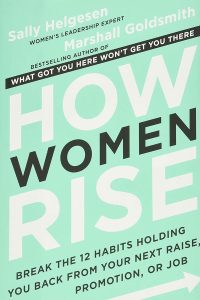
How Women Rise: Break the 12 Habits Holding You Back from Your Next Raise, Promotion, or Job
If you know Frances Hesselbein, she is one of the great leaders. One of her famous quotes is, “I’m not a woman leader. I’m a leader. There’s no need to qualify that.” She was the CEO of the Girl Scouts in the late ‘70s and the ‘80s, and she transformed that organization from being largely housekeeping skills and homemaking to being the entrepreneurial STEM-focused and leadership-focused organization that is for women. She had a huge emphasis on diversity and inclusion in the ‘80s when that was not nearly as popular a subject as it is now. I love the example of Francis.
That’s a terrific one.
Who was it that wrote about growth mindset versus fixed mindset? Remind me.
I’m trying to think of who that is.
Is it Carol Dweck?
Yes.
That’s the other one that I love. It says our growth is up to us and that we can choose to have this growth mindset of, “I can learn, grow, do better,” versus, “I’m fixed. All my traits are inborn in me. People will have to work around the person I am.” I combine that idea with Dorie Clark’s The Long Game. We’re not playing the short game. We’re not playing for the quarter. We’re playing for years, decades, and if we take that even further, for centuries. How can we make decisions with our children and our children’s children in mind? If I combine a growth mindset with a long game, that, to me, feels like my philosophy at the moment.
That’s fantastic. I wish that more people in the financial realm would think that way when they’re investing, too. That’s another episode for another time. One of the biggest issues is short-term results versus long-term and if we had that whole notion. It speaks to Frances’ acumen as a business person. She understood the people, planet and profit. With those people, do you want the broadest swath involved? It’s nice and it’s smart business. That’s what fuels your sustainability. You keep having generations and generations of next-gen.
How Jacquelyn Wrote Her Book
Speaking of all these fabulous researchers and these people who have written a book, how did you know, and how did you get the courage to write a book? That’s no small undertaking. Many people say, “I’m going to write a book,” as if it’s the easiest thing and it is not. It’s certainly not to write a good one. How’d you get there? Congratulations.
Thank you so much. Like for many people, writing a book was always a dream. Like many people, I also didn’t know when it was going to happen until I found the right collaborators. Scott and I had an idea for a book for a long time. We discussed it in a few different places. We were pretty open about wanting to pursue this but didn’t know how to get started. We then met our publisher, Naren, at Amplify Publishing. He said, “Definitively, this is a book and I think this can be a bestseller.” He caught the vision from the title Becoming Coachable. He caught the vision and said, “We are going to make this happen.” That partnership was the wind in our sails that got us started on this process.
We also learned from Marshall Goldsmith, who became our third co-author. He has written many books, so he has a lot of experience in this space. That was also very valuable. One of the most important pieces that goes somewhat hidden is our friend and coach, Nilofer Merchant. Nilofer wrote a fantastic book called The Power of Onlyness, which talks about the unique place that each person stands in the world to make a difference. It’s a fabulous book. I love her writing style.

Leadership Journey: We learned from Marshall Goldsmith, who became our third co-author and has written many books.
We hired Nilofer to be our coach for Scott and me at the agency. She had the right input at the right time and said, “This is a great book but you need a good outline.” She helped us build the scaffolding for the book. What are the chapters or the sections of the book going to be? What are some of the subheadings that will come in each of those chapters?
Once it was outlined well and we had talked through it, I knew at that moment that we were going to write this book. Scott, me, and Marshall were able to fill in all that scaffolding. Once we knew the direction, this very unified voice and collaborative writing effort poured out of us and we wrote the book quickly. It was the right partnership. Also, if you’re a first-time author, it’s intimidating to look at a blank Word document and see a book out of a blank page. Sometimes, building the structure is enough to get started on filling it in.
That makes sense. That’s amazing. Congratulations on that. Do you think you’ll end up writing another?
We are beginning our work on the second book. It’ll probably be a few years. It’s going to be a more research-intensive book. We’re very excited about it.
Creating A Better World Through Leadership
That’s terrific. I won’t press. I will wait until later. You can be back on the show once that comes, which will be terrific. With you and Scott, moving forward, what’s the vision for 100 Coaches? Do you plan to expand or evolve the organization’s overall impact? What are your dreams there?
Our ambition is to create human flourishing in the world through leadership. There are a few people in the world who have a disproportionate impact. We call those people leaders. Those are the people that we want to work with. The most impactful leaders who are at moments of inflection in their work and in their lives, we want to pair them with the right coaching support at the right time so that they can make an outsized impact.
They can create human flourishing for themselves, their teams, their employees, their suppliers, their customers, and the environment. Leadership is the vehicle to do that. It’s amazing. We’ve already impacted millions of people through our work at the agency because we’re working with these incredibly influential leaders. It might sound a little audacious but the hope is to reach a billion people through improved leadership.
Jacquelyn’s Advice To Her Younger Self
Be audacious. We need audacious things. There’s going to be a lot of hubbub in the coming years. That kind of audacity is very welcome with open arms. Knowing what you know now, what advice would you give your younger self? You’re not that old but still, there’s always stuff. You know what I mean.
This goes back to the idea of playing the long game. I would encourage people to take that long-term perspective and be patient. Good things take time. It also takes a community of people. At the end of the day, anything meaningful that we accomplish is with and for other people, so don’t forget to cultivate those relationships. Stepping on someone to get ahead is not a great long-term strategy. That will likely come back to bite you. Collect the right people and play the long game.
Stepping on someone to get ahead is not a great long-term strategy. Share on XI was going to ask if you could distill everything you’ve learned into one essential lesson for leaders and what would it be. You pretty much stated it. I could talk with you for hours. I’d love to dig into some of that research and some of those things and maybe even have a conversation around Frances because she’s so spectacular. This will be the first of our many conversations. I want to thank you so much on behalf of the show and all the readers for doing all the work that you’re doing. Continue to do so. Thank the Lord you’re playing the long game because you’ll be around for a long time.
It’s such an honor to be with you and to get to chat about all these important topics. I’m looking forward to more conversations. Thank you for this important message. I’m so happy to be here and happy to call you a friend.
Thank you. Same here. If people want to get in touch with you, what’s the best way?
The best way to find me is on LinkedIn. Jacquelyn Lane is my profile. You can go to the 100 Coaches Agency page and find me there. You can also go to our website, 100Coaches.com, to learn more. Don’t hesitate to reach out. I hope to hear from people.
Thanks again.
Thank you. It’s such an honor to be here.
Important Links
- 100 Coaches Agency
- Becoming Coachable
- Jacquelyn Lane on LinkedIn
- Marshall Goldsmith
- The Boy, the Mole, the Fox, and the Horse
- How Women Rise
- The Myth of The Nice Girl
- The Long Game
- The Power of Onlyness
- 100 Coaches Agency on LinkedIn
About Jacquelyn Lane
 Jacquelyn Lane is the President of 100 Coaches Agency, an organization designed to amplify the collective impact of the world’s most iconic leadership thinkers and executive coaches. She is the co-designer of 100 Coaches Agency proprietary curation process and the company’s relationship-first philosophy. In her role as President, she oversees the growth and development of the Agency, serves as a critical pillar of the 100 Coaches community, and is a member of the editorial team that selects the authors and titles published in their new book imprint, 100 Coaches Publishing. Her leadership and impact in the coaching industry have been widely recognized, including being named to Forbes 30 Under 30 and receiving the prestigious Coaches50 Award from Thinkers50.
Jacquelyn comes to the world of executive coaching naturally through her lifelong commitment to improving the lives of all people by elevating the quality of leadership. Previously, she held various roles in the energy industry during which time she developed deep insights into the perils and privileges of leadership. Throughout her experience in corporate America, academia, and the international humanitarian space, she observed a common thread – people issues were consistently the most complex and most overlooked. She knew that these problems were the ones she wanted to spend her life solving.
Jacquelyn received her Master’s in Engineering for Sustainable Development from the University of Cambridge, and presented her Master’s Thesis on needs assessments and new solutions to support refugees in Greece. Through her work with vulnerable populations in Greece, Uganda, and South Africa, Jacquelyn has observed the impact of business on global development and human flourishing. She is a passionate advocate for conscious capitalism and entrepreneurship as a means to create sustainable solutions globally. As both a natural people person and systems thinker, Jacquelyn is committed to bringing the right people together to solve some of the world’s most complex challenges.
She is defined by three key qualities:
Relationships First “Regardless of the person on the other side of the dialogue, Jacquelyn’s relationship-first approach is always evident. In a world that too often wants to build walls, she is exceptional at breaking them down, and building other people up. Her ability to be bold and vulnerable makes her a superb partner, friend and a stellar human being.” – Peter Bregman, #1 Executive Coach, author of Leading with Emotional Courage
Highest Quality “My partnership with 100 Coaches and Jacquelyn has been exceptional in large part to her commitment to the highest quality in everything she undertakes and delivers. There are few people I have worked with that combine diligence, dependability and creativity as she does. There is no doubt that my life is better because of Jacquelyn. I appreciate her work, her commitment, and knowing that I can trust that everything she touches will be of the highest quality.” – Marshall Goldsmith, Hall of Fame Executive Coach, NY Times Best Selling Author of What Got You Here Won’t Get You There and The Earned Life.
Leading with Heart “Jacquelyn is one of those rare human beings that make each person she connects with feel like they are the most important person in the world at that moment. And that is because they are. Her heart and agenda are pure and she leads with clarity and intuition. Her ability to see people is peerless. She is comfortable with and belongs in the room with everyone from refugees to world leaders. I have known many amazing people in my life, and working with Jacquelyn, who I now call my friend, has been a great privilege.” – Scott Osman, CEO and co-founder of 100 Coaches
Together with Marshall Goldsmith, a 4-time New York Times Bestselling Author, and Scott Osman, CEO of 100 Coaches, Jacquelyn is a co-author of Becoming Coachable: 4 Proven Methods to Maximize Your Leadership Growth and Potential. It is a guidebook to get the most from executive coaching and chronicles their findings from observing hundreds of coaching engagements and why some flourish while others fizzle.
Jacquelyn graduated magna cum laude in chemical engineering from Oklahoma State University and received her MPhil from University of Cambridge and has an MBA from Quantic School of Business and Technology. She developed a passion for rowing while at University and aspires to climb Kilimanjaro someday soon. She is a voracious reader and welcomes anyone who would like to discuss the classics.