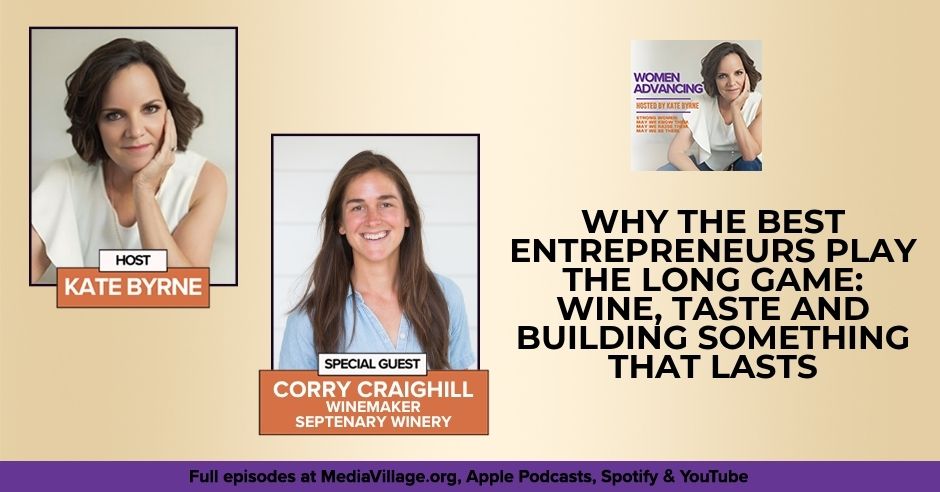
Adopting an authentic Entrepreneurial Mindset means learning to trust your gut over rigid playbooks. Host Kate Byrne sits down with Corry Craighill, the acclaimed winemaker at Septenary and creator of her experimental venture, Wound Tight. They break down what happens when you’re shifting from traditional practices to making up your own rules in an industry governed by nature. You’ll learn why real discernment comes from deep technical training rather than quick shortcuts. Success doesn’t happen overnight, and building something meaningful demands patience with slow cycles. Tune in to discover how balancing institutional mastery with personal passion lets you build on your own terms.
—
Watch the episode here
Listen to the podcast here
Why The Best Entrepreneurs Play The Long Game: Corry Craighill On Wine, Taste & Building Something That Lasts
The entrepreneurial mindset, definitely not a phrase that I in the past would have put together with winemaking. Why? Let’s face it. There are industries where you can move fast and fix it later. Winemaking sure as heck isn’t one of those. However, I’ve come to see how it is so. My guest is Corry Craighill. She’s the winemaker of Septenary Winery and of her own passion project, Wound Tight vineyards.
Corry is such a fascinating mix. She’s part artist, part biologist, part chemist, part technologist, and I would say one solid winemaker and a solid business person. She works in a world where time isn’t the constraint, it’s the medium. A lot of it’s out of her hands because she’s dealing with none other than Mother Nature herself. Big surprise to her is just how much she’s come to know and understand and learn, but also how solid her intuition is.
We’re going to talk a lot about what it means to leave and shift away from a traditional production system and to build something of your own, making your own calls, and kind of the quieter question behind all of that. How do you build a business and a life without defaulting to someone else’s blueprint? Stay to the end for the KB Takeaways. I look forward to what you think. Sit back. Go ahead. Pour yourself a little wine. See what you think, and let’s dig in.
I’m so excited to welcome our guest. We are fortunate enough to sit down with Corry Craighill, who is the winemaker of Septenary, a well-known winery here in Virginia. I believe it was voted like number one wine region to watch in the world, as well as Wound Tight, which we’ll talk a little bit more about as we continue the conversation. Corry, welcome to the show.
Thank you for having me.
My pleasure. Some of you might be thinking, “Great. She makes wine. That’s wonderful but what does any of that have to do with entrepreneurialism? What does even being a founder of that kind of a situation look like?” Those are some of the things we’re going to be talking about. It’s also getting schooled in a traditional manner, and that’s the case with wine. Also, having some ideas and thinking, “I’d love to try something on my own. Maybe on the side as a side passion, and see if some of my little chemistry and biology tastes good.” I want to start there. I want to start with, how did you get to here?
I started back in 2011. Even before that, I started in 2010, working in the tasting room. I’m pouring wine on the weekends. This was in my fourth year of college. I fell in love with the people that came in, and the people I worked with. I felt like I was learning a lot from everybody. When I graduated, my goal was don’t sit at a desk. I applied and got a job at Blenheim.
Traveling To Master The Craft
Again, the same thing, I loved the people and loved what I was doing. I quickly realized I could travel with winemaking. I’ve been all over the world. I’ve been to New Zealand, Australia, South Africa, and France. I’ve been to the West Coast twice and I’ve worked for several winemakers in Virginia. In 2020, when I got offered the job at Septenary, I said, “Let’s go back to where I started,” and here I am.
What I want also everyone to know is that, I mean what I say when I say Septenary is a wonderful place but the other thing, Corry, is. Not only have you gotten to travel the world but some of the most beautiful regions of the world.
Some of the most beautiful regions of the world just happened to make wine.
Dumb luck. Lucky you. I want to talk a little bit about the fact that you got schooled and trained in more traditional manners. Do you see yourself building upon the traditional winemaking path or is this where there’s a little budding entrepreneur going, “Hello, let me out?”
Can both be true?
Real expertise isn't built behind a desk. Traveling and learning from mentors gives you the skills to trust your gut. Share on XGood on you. Both and. The answer is yes.
For Septenary, the goal is to make classic wines. When I was being interviewed, the owners were very clear about their business plan, which was to make wines that age 16 to 18 months in barrel. We age them before they even get released to the public. That’s a challenge. I was a little bit nervous because I’d never had that put in front of me like that before. Making those classic wines, even though it sounds like repetition, it’s not because we’re in Virginia. It’s farming. Those two things combined make winemaking challenging. With the crazy ideas pushing me to do something else, yes.
I don’t want to say I’m not creative with Septenary. I do try to be creative, but I can’t be wacky. Whereas, with Wound Tight, I can be as crazy as I want. How I usually look at it is with Septenary, I know what the goal is. More or less, I know how to get there because I know exactly where I want to get to now. Does it always work out perfectly? No, but with Wound Tight, a lot of times I have a weird idea or I have access to more interesting fruit. I have no idea what the end result is going to be, and that’s fun for me. Maybe to start a business on that is a little bit not the norm in normal business. With winemaking, there’s that opportunity.
It’s fantastic because I think of your grapes almost like the paints on a palette. You literally get to smash them up and make all sorts of different combinations. I would think on the one hand, you need to be respectful and more the classic Septenary, “This is our way. This is how we do it.” Great. Respect it. You have this great outlet on the side where like many people, you can play a little bit, it sounds like.
Protecting The Brand Versus Being The Brand
The challenge of Septenary is delivering a consistent product and interacting with a whole staff of people and customers that are expecting that product. With Wound Tight, I don’t have a staff. With Septenary, I’m part of the brand, but with Wound Tight, I am the brand. Those are ever so slightly different. I’m still the same person.
That’s an interesting way. Build up on that because that’s an interesting point. It goes back to our both end piece.
With Septenary, the owners, they’re here every weekend. They are very customer facing. If you walk into a tasting room on a Saturday, you have a high likelihood of meeting the owners, but you’re not going to meet me because I work Monday through Friday. You’re going to meet them. You’re going to meet Andrew, who’s the general manager, and you’re going to meet Marty and/or the whole, however many staff are working that day. It’s a team. It’s a team effort.
Again, you don’t see Travis, the farm manager, but he is what makes the place beautiful. You don’t see me, the winemaker, but I’m the one that makes the product. You have these other people representing us. It’s a team. Whereas, with Wound Tight, I’m the winemaker, the negotiant, the salesperson, the delivery driver, and the accountant. That’s all that you’re going to see. You might see my husband who would design the labels, but other than that, it’s me.
Which is a lot right there, in addition to family, which we’ll get into in a little bit. I sit here and I think about it because it is a craft, but then also kind of this weird friction point. It’s kind of craft versus control. Where have you had to let go of process and of perfection, dare I say even of ego, to make something better?
Replacing Control With Endless Patience
I would say the word patience brings all of those together. I mentioned that the Zimmermans put the challenge of creating red wines that age. Making a wine specifically to be age worthy is like a human. They have its infancy as grapes and through fermentation, then it goes through this awkward stage in like November, December, and sometimes that can last until spring. You have this young, beautiful wine that’s still a little bit awkward. By the time it’s in bottle and then released, it’s a mature person or it’s a mature wine. It’s grown.
Having a process to always come back to and keep me in line was never more glaring than when I was on leave. I was on maternity leave. I had to write down in extreme detail how to make wine. I felt I handed them the binder. We went through it and all that, but handing them “my recipe” felt very black and white of, “This is how you make wine. If you do this, you’ll be fine.”
It will all work out. You always hit a perfect ten.
Nailed it. The amount of communication that I got from Andrew, who was making the wine that year, was eye-opening of how many decisions I make on the fly. How many are intuition-based and how many require some skill set but knowing that I always had this protocol to back me up. Have I done like weird things where I went way off protocol.
Forcing immediate results ruins quality. When you replace control with patience, better decisions and superior products emerge. Share on XThat’s what I was going to ask next. What was that like?
That’s Wound Tight.
Ironically.
Bouncing Back After An Experimental Failure
I know. For example, I use this process called carbonic maceration. There’s a clear protocol for it for red wine, and I decided to do the same process on white wine. With red wine, you kind of know what you’re going to get at the end of it because I’ve tried lots of Beaujolais Nouveau wines or just Beaujolais in general. Other people who are doing carbonic maceration, whether that’s in Virginia or West Coast or wherever. I don’t know anyone that’s done it on white. I had no idea what to expect. t was nerve-wracking. Taking a risk on something like that, the first time I did, I failed. The wine wasn’t great and I had to pivot. When you’re a small producer like that, you don’t have much room to pivot.
That’s interesting because it made me think so often that’s a perfect example of saying, “Here’s this gap. They don’t do this with white. I’m going to do it. I’ll be the one.” Going through as you did, you then quickly realized, “Maybe this is why they don’t do it.” I cannot tell you how many times I’ve had fabulous ideas that no one has heard about.
I did it again with a different type of white fruit and it worked beautifully. I failed the first time, but I was not willing to give up on the idea.
Good for you. Good on that. With the whole, working with time, I love that idea because you’re right, wine requires so much patience and provides a longer view. Everyone is now obsessed with speed and with scale. You talked a little bit about it. What has it taught you about decision-making? You made reference to intuition earlier in the case that you just brought up as an example. You realized when you were writing down so intricately how you make wine, did it surprise you that you use your intuition so much? I think of it as like an artist, they often do. It’s much more of a visceral kind of thing. I’m sure there’s some chemistry involved as well.
Not to like toot my own horn, but I didn’t realize how much I know or knew. I’m able to use intuition. I’m able to make decisions on the fly because I’ve gained all of this experience and I’ve learned the traditional way to do things. if I had only learned, if I had only ever made wine the way I make Wound Tight wine, I wouldn’t be as knowledgeable of a winemaker. Knowing the classic way to make wine is just a good building block so that I can make Wound Tight successful.
It’s such a foundation. I think of it as akin to way back when early days in advertising when you had to calculate everything by hand before there were computers. Anyway, I won’t bore you. It was that same kind of thing. Now, I have a clear understanding of where to look, where there might be issues, where there could be problems, and where I could tweak something and have an understanding of, “If I do this, if I tweak this lever, it will change this and this,” which is great. What’s been the biggest surprise you’ve had?
With Wound Tight or with Septenary?
I’d say yes, since we’re going that route with both.
It’s not maybe a surprise, but I thought I would learn the vineyard a lot faster. Farming is so slow. I even think about my own garden. I’ve been going out looking for hornworms, which are like wrecking-havoc on my tomato plants. I can only go a certain time of day because that’s when they’re out. You’ll get one chance during the day because either I’m busy or doing something. Maybe there’s two chances, but I’m busy doing something else in the morning. My chance is at night and I can’t find them, so I have to keep going back out there and it’s slow. It’s a slow process.
Respecting The Slow Cycles Of Nature
The vineyard, maybe a better example. It’s understanding the life cycle of a vine is a multi-year process. If you have a frost or a freeze that like we did in 2026, that doesn’t just mess up 2026, it messes up 2027. Now, I have two years. I have to wait to learn something new. Not learn something new about the vineyard, but it’s so slow. Wine making is not fast but it’s not snap your fingers but sometimes, it is. Let’s say I have a problem with reduction, which smells a little like burnt rubber. I know to move that wine out from barrel to tank or from tank to tank. I can do that tomorrow and you can’t do that with a vineyard. Some things you can, but mostly you can’t.
It’s out of your hands, too.
I’ve been surprised at how slow that is. I already knew I was not patient, but it’s hard.
I bet. What is some advice that you wish someone had told you? The second part of that question is, what’s been the worst advice someone has given you, if any?
It’s not the worst advice, but I remember someone challenging why I got a job because of the lack of perceived education that they thought I didn’t have. There’s certainly a lot of negatives in that sentence. It wasn’t necessarily advice, but it was a like, “You shouldn’t be here kind of moment.” I luckily was able to prove him wrong, and he did apologize. The best piece of advice I got was, “Go travel. Go explore. Go learn from other people.”
That sounds crazy that someone needed to tell me to go see the world. I’m shy and an introvert. Having my mentor lay it out of like, “You can do this or you can do this. Those are your two options.” I took I took it and ran with it. It was some of the best years of learning about myself and learning about wine and how I wanted to make wine. It impacted Wound Tight with my travels.
I bet. I would bet that it also would encourage you to ask a ton of questions. Stay perpetually curious. Even though being shy, not feeling like a dope because you’re asking the questions because you’re also from a different country. That’s awesome. How did it particularly impact Wound Tight?
My time in New Zealand directly impacted the creation of one of my wines. Where I was working in New Zealand, it was in Central Otago where they have a lot of pinot noir. With pinot noir, it’s very common to use stem inclusion or use whole clusters. Instead of separating the berries from the stems, like we do often in Virginia. They keep a portion of those whole clusters in the tank. That’s supposed to help with tannin, texture and all of that. In order to decide, should it be 20%, should it be 50 or 100% whole cluster, the winemaker would chew on the stems.
I thought that was weird, then I did it. There’s a huge variation in what the stems taste like and feel like when you chew them. Fast forward ten years, I now make a wine called Little Light. Where I take a small portion of the stems, I dry them, I wrap them in a cheesecloth, and I steep them in the wine like a tea for usually ten days.
I’ve worked with stems in other ways with Septenary wines and with Wound Tight wines. My fascination with stems started in New Zealand. In an area where whole cluster is the norm and working with stems is the norm. Whereas in Virginia, you don’t see that very often. You certainly don’t see winemakers chewing on them.
What is interesting about that is just having grown up in Bay area right next to the California wine country. I know there’s a lot about the terret noir. Often, people think of that as impacting the grape itself but it would impact even more so the delivery mechanism AKA the stem. That makes a ton of sense.
I know. We forget about stems because they typically go to the compost pile.
Who wants to chew on wood in your wine? I want to shift now a little bit into just combining life. I’ll put it that way. Personal life, family and personal cost of doing all of this, especially in something as immersive as winemaking. I can imagine it bleeds over to other parts of your worlds. What if you had to choose not to do or not to be in order to build this? How do you make peace with that?
Honestly, I feel like the only thing I give up is exercise. I’m very active at work but I feel like I feel very lucky to have found someone who supports me in my passion. My husband’s part of his vows were how much I love winemaking and how much I’m so driven with that. He respects that. I don’t think I give up time like I give up time with my family but honestly, Jake comes with me to events. Sometimes Reese comes with us to events.
Speed and scale won't solve every obstacle. Some ventures demand respecting multi-year cycles that you simply can't rush. Share on XI feel like I’m living the dream. I’ve found someone who loves that I am Wound Tight. He doesn’t love that I’m Wound Tight. Jake is very supportive of Septenary and of the long hours that harvest entails. He gets it because he’s also equally as passionate about what he does. I don’t think I’d be able to be successful with Wound Tight if Jake wasn’t always saying, “Yes. Go.”
I have such a lovely visual in my head of the three of you walking around and your two dogs. Walking on the earth. There’s something lovely in this day and age of AI, screens and digital. There’s a place for all of that, but to be able to spend time and connect on the earth itself and just be surrounded in it and be of it and realize you’re a part of it and how connected it all is. I would think that’s going to be extraordinarily grounding for little Reese. I would think for his nervous system must be relaxed.
We try to limit this or we don’t do screens or whatever. We try to take him outside as much as possible and smell. I feel like I’m the one that’s like, “Smell this.”
Which is great because so often, scent is one of the least tapped, I believe, senses in the workplace and during the day. Listen, speak, maybe touch, but not even touch to the same amount. That’s fabulous. What advice would you give to folks who are looking? They’ve got a little passionate side and they’ve got a budding side gig. I’m even thinking of some of the folks who are accelerators or programs like maybe, UVA has the iLab program for young founders who’ve got budding ideas. What advice would you give them with regards to sticking with it and if you have an idea and you love it, go for it kind of thing?
You nailed it with, if you have an idea and you love it. I can’t tell you how many people tell me how passionate I am about it. Again, I’m an introvert. I don’t feel like I come across as emotional. For people to call that out is always interesting to me. I feel like as far as passing on advice. We’ve touched on passion. We’ve touched on staying curious. To take honestly from my husband, who’s a graphic designer, artist, and muralist.
Seeking Tough Feedback From Honest Mentors
He’s very big on shopping his ideas around to friends and family, but giving them an out to say that they don’t like it. Negative feedback is important too to build. It’s hard to tell someone that they don’t like it. I take my wine to Mathieu, who’s my mentor, because I know he will tell me he doesn’t like it. He won’t tell me how to improve it, but he’ll say, “It’s lacking X, Y, and Z.” Positive feedback is awesome, but having that negative feedback can be equally as helpful, even if it’s hard to hear.
Bring on the truth sayers.
That’s where hopefully your passion will build yourself back up.
I think, too, that someone is giving you very real feedback and accurate. Sometimes, it’s, as you said, harder than others. They’re not trying to be mean. If anything, it’s the opposite it’s because they care so much and they want you to be successful. They’re saying, “You’re saying you want to go do North, but you’re heading Southeast. Here’s some thoughts of maybe some ways to course correct.”
Being open to criticism is hard, but it’s wild.
Knowing what you know now, what advice would you give your younger self?
Don’t be afraid to ask questions. Again, I know I’ve said I was so shy. There were so many times where I didn’t speak up and I wish that I had. I discovered not too late, but I discovered late that like my passion will come across in questions and keep asking because that’s how you learn.
You don't have to pick between your day job and your passion project. Thriving leaders choose the world of both/and over either/or. Share on XAlso, usually I’ve discovered more often than not, other people in the room have the same question but they’re too afraid to ask.
Confidence when you’re young, at least for me, was hard to come by.
What I started doing is, for some reason, and this is a female thing, it’s easier for us to do things for other people than ourselves. I started telling myself, “Other people have this question, too, so I’m going to take it for the team,” and I’m going to ask it. After a while, I said, “I have the question, so I’m going to ask it.” I didn’t need that whole preamble to give myself permission to ask a question. Also, if you’re worried about looking dumb, you look even dumber if that piece information is critical. That is dumb to sabotage yourself from getting that. Corry, thank you so much. Are there distribution? Septenary is available at Septenary Winery, but also in all sorts of ABC stores and grocery stores, correct?
No. With Septenary, you got to come out here. You got to meet the owners. You got to sit down.
You got to see the land. It’s beautiful.
With the exception of. We do events. I’m doing a wine dinner. Septenary is just at Septenary. Whereas Wound Tight is the opposite because I don’t have a tasting room. I’m in several stores, smaller wine shops in Charlottesville, and a couple of restaurants.
Which restaurants?
I’m at Ethos and Maude and the Bear.
I was just at Maude and the Bear.
I never thought I would get a wine at such an awesome restaurant. Those are the only two restaurants, but then Greenwood Grocery, which is the Woollen Mills Wine shop and Market Street Wine shop, is also where I sell my wine.
Everyone, be on the lookout for it.
I think they did my wine called Root Chatter for the wine pairing. I don’t know how recent it was. It was weeks ago that I delivered it.
I’m going to go back and look.
Will you send me a picture of it?
I absolutely will. Thank you so much readers. It’s just the beginning. Find that wine. It’s terrific, but also when you have a passion, it just goes to show you can still do your traditional giddy up but making room for that passionate outlet makes all the difference for both worlds and live in a world of both and. Not either or. Until our paths cross again, Corry.
Thank you so much.
My pleasure.
—
Interesting, right? I don’t think I’d ever apply the notion of an entrepreneurial mindset towards winemaking and making a wine. For someone to work at such an esteemed traditional entity like Septenary, and then go breathe life into your own passionate project. I think that was relevant for a lot of us. My KB Takeaways, leaving that system, but she hasn’t left it momentarily. She does when she goes to work on her winery at Wound Tight.
While there’s comfort in established paths and proven methods, there’s clearly inherited credibility. The moment you step out of that, you don’t just take on risk. You take on responsibility for your own decisions. One of the things that Corry was surprised about was how much she knew already, and how she had her own set of discernment in making choices.
Number two, control is overrated, attention isn’t. To me, a sector like winemaking makes this very clear very quickly. You can’t control everything, but you can pay attention to everything. That shift from control to awareness is where better decisions, and honestly, as a result, better products start to emerge. Time can be a pressure or it can be a partner.
In this time when we are so focused on getting everything so fast, the discipline is staying with something long enough for the appropriate outcome to reveal itself rather than forcing it too soon. I can’t think of any industry better than as she described working with nature and knowing that you can’t force it. Finally, the fact that you don’t balance at all. You choose. Having a great partner is a huge piece of this. Entrepreneurship doesn’t always neatly coexist with the rest of your life. It requires trade-offs.
The question to me is whether you’re honest about what you’re choosing and what you’re not and you do have free will to do that. Lastly, the and is real. We said that quite a bit to each other during the conversation, but it’s not always effortless. There’s science and art, craft and staying within the lines, structure and intuition, business and life, holding both is the work. Collapsing into one is the shortcut and usually the miss and you miss out on so much. With that, thank you so much as always. I appreciate you joining and look forward to continuing the conversation on the next episode.
Important Links
- Corry Craighill on LinkedIn
- Septenary Winery
- Wound Tight
- Blenheim
- Ethos
- Maude and the Bear
- Greenwood Grocery
- Woollen Mills Wine
- Market Street Wine
About Corry Craighill
 Corry brings many years of winemaking experience from a variety of regions, including South Africa, France, Australia, New Zealand, California and Oregon in addition to her native Virginia.
She has been the winemaker of Septenary Winery since 2020, and she started her own experimental wine side project, Wound Tight, in 2023.