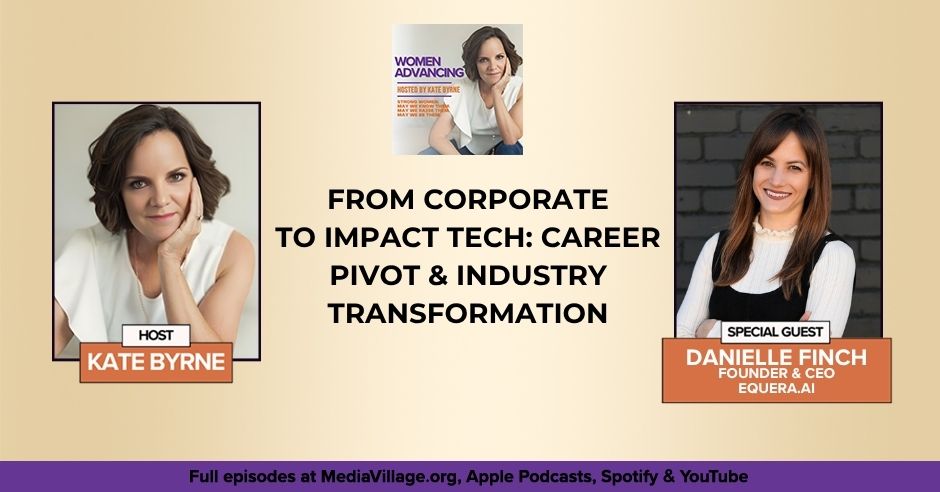
Are you successful on paper, but feel like something is missing inside? In this episode, we sit down with Danielle Finch, Founder and CEO of Equera.ai. Danielle made the bold career pivot from twenty years of corporate success—including roles at GE, Michelin, and as Director of Customer Experience at HomeToGo—to become a social entrepreneur in the impact tech space.
Her story isn’t one of impulsive reinvention, but a thoughtful reorientation from chasing profit to pursuing equity as the ultimate outcome. Danielle recognized that ‘staying is also a choice’ and realized she ‘had to get off her path’ to follow a greater purpose.
We dive into how Danielle is leveraging systems thinking to disrupt the extractive tourism industry, turning it into a powerful lever for addressing wealth inequality by redirecting capital back into local communities. Discover how she built a practical runway for her leap and how she redefined success by shifting her focus from the what to the why.
If you’re contemplating a big move or want to learn how to find real leverage inside broken systems, tune in to understand what it truly takes to build something that shifts, not just scales.
—
Watch the episode here
Listen to the podcast here
From Corporate To Impact Tech: Equera.ai Founder Danielle Finch On Career Pivot & Industry Transformation
The Career Pivot From Corporate Success To Community-Based Tourism
We know success looks good on paper until it doesn’t feel enough inside. In this episode, I got to sit down with Danielle Finch, who’s the Founder and CEO of Equera. She’s a systems builder turned founder who made the pivot so many of us quietly contemplate, but we don’t always act on. She didn’t set out to leave this stable global career path. She had a twenty-year plan. She had the 401(k). She was very responsible and true to her Midwestern roots plan, and then slowly, all at once, something else started calling.
What unfolds in our conversation, which I think is cool, is not a story of impulsive reinvention at all, but a thoughtful reorientation from corporate success to community-based tourism. It’s social entrepreneurism at its finest, from profit as the goal to equity as the outcome, from asking, “Should I do this?” To recognizing, “Staying is also a choice. There’s no way I can stay.”
We’re going to talk about courage, systems thinking, and what it means to build something that shifts, not just scales. We’re also going to talk about how, finally, success is defined as moving away from the hows and the whats to the whys. If you focus on that, success comes and flows to you. Be sure to say to the end. There are so many KB Takeaways. I look forward to hearing your feedback, as always. Thanks so much for tuning in and for your support.
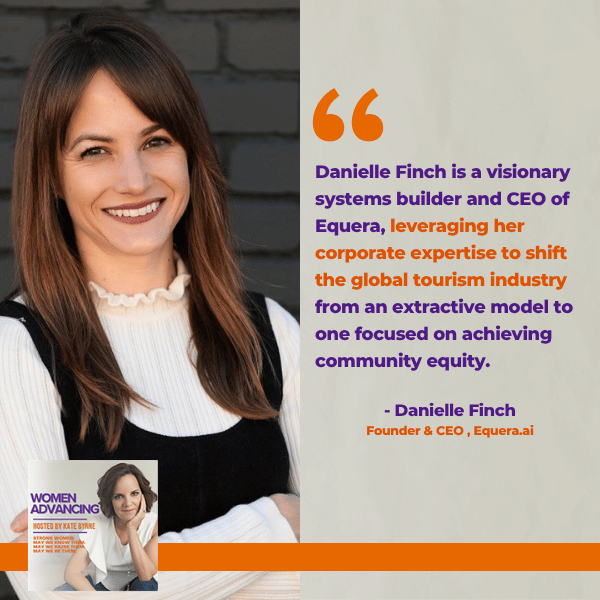
Welcome. Please join me in welcoming our guest, Danielle Finch, who is the Founder and CEO of Equera. I cannot wait for you to hear her story and how she got to where she is. The lady is in fuego. She and Equera are in this delicious moment where they’re starting to enjoy some momentum. Danielle, welcome to the show.
Thank you so much for having me. I’m excited to be here.
My pleasure. We’re going to jump right in because it is a very cool story and one that many of us have dreamt of, and, in some ways, possibly feared. I want you to share with everybody. It’s often been said that you left a good job at a good company, and you wanted to pursue something that was more purposeful. I want you to share with everyone what that good job at that good company was and that moment when you realized, “This success is not enough. It’s not giving me enough impact,” and you decided to take that big, courageous jump. Take it away.
Thanks for that intro. I’m super happy to be here again. That starts in 2024. In 2024, I was working as the Director of Customer Experience at HomeToGo, which is the world’s largest vacation rental marketplace. I had been in travel tech for about five years at this point. Before that, I had a successful career, mostly leading digital transformation at major brands like GE and Michelin. I was happy with my career, to be honest. It was fulfilling. I had kept growing.
You were good at it.
I had gotten some great opportunities that fueled my career. I’d gotten exposed to working abroad at this time. I was living in Berlin. I’m from the US originally, but I moved to Berlin for HomeToGo. It was a lifelong dream to live abroad. At the same time, I came to a crossroads that I had come to a couple of times before.
In Charlottesville, which is where I used to live, still love, and where we got connected, I heard the story of the Salesforce company, Salesforce.com, using their platform for good. They were tracking school attendance in a community in Kenya, and anybody who came to school got given water, because a lot of times, kids dropped out of school to go get water. It was a very simple idea. It was in 2012 that I had heard that.
Ever since then, every couple of years, I said, “Am I doing enough?” I had come out of a background where I believed in equity. I’m a middle-class American. That gave me a lot of opportunities, to be honest, that I took advantage of. I had a lot of opportunities. Using something like tech to provide more equity was always something that was on my heart. So far, every time I had this crossroads feeling, I invested myself more in this mission by way of volunteering or financially supporting organizations. I was doing that a lot on the side, working in mentoring programs, in emerging markets, or with women.
Every couple of years, I’d ask myself, ‘Am I doing enough?’ I was shaped by a belief in equity and a middle-class upbringing that gave me many opportunities I was fortunate to use. That experience stayed with me—using tech to create more equity has… Share on XI came to this crossroads again, and this time, it was a little bit different. To be honest, I said, “Do I keep going in my career, or do I work in impact tech?” Right when I started asking that question, I got approached and was recruited by a company that would have been the next step on this career ladder. It would have been the next round with more responsibility. I thought, “Easy. Answered. I’m going to take this and keep doing what I’m doing.” That was my plan.
Discovering Community-Based Tourism In Malaysian Borneo
In between the 1st and 2nd interviews, I stayed at a community-based tourism organization in Malaysian Borneo. I was traveling. It was my 50th country. I wanted to go off the beaten path. In planning this trip, I had been frustrated. Everything I saw on the booking platforms was generic. It was the same. Here, I was in the middle of the Malaysian rainforest, and I wanted to find something unique.
I had been scrolling on Google maps, going along the river that I wanted to stay by, and randomly found this listing for Tungog Eco Camp. It had 65 reviews, almost all 5 stars. Everybody said it was the best time of their life. I booked it, and I went. When I got there, they told me it was community-based tourism. For those of you who didn’t know that model like me at the time, it’s locally-led and socially sustainable. A percentage of revenue from that tourism goes into a community fund that helps develop the community. I was like, “This is cool.”
The story of Tungong is that they had been damaged by the palm oil industry. To start making money again, they started homestays, pooled their money in the fund to buy a boat, added boat safaris to their offering, and then pooled enough money to build these amazing A-frame huts in the middle of the forest that we stayed in. Google was right. It was the best time of my life. I met amazing people, and I realized that I could only access this part of the world through this community and the products they offered.
I asked my guide as I was leaving, “Why aren’t you guys full all the time?” She said, “It’s difficult to get gas and get connected to global demand.” Working it for HomeToGo, I immediately got it. I’ve been working in travel tech. I was like, “True.” All of our professional customers, not the people themselves, but all of our small companies, have no problem. These guys operate in a rainforest, so how are they supposed to connect through the connectivity that exists? That was when this journey of questioning started.
I ended up not going forward in the interview process, but I still stayed in my job. I said, “This is an idea. I come from the Midwest. Stability and growing my 401(k) are my priorities in life. That wouldn’t go away.” Long story short, over the next several months, I started digging into this more and being like, “What is this problem? Is there a global use case? Can I solve it?” What I did was, at that time, there was a contest. It was called the Social Entrepreneurs in Tourism Contest. I worked on a business case during nights and weekends to submit for this contest.
My idea was that I submit the case in June, I see the feedback in September, and then I decide if I quit or not. To make a very long story short, which we can still dive into more, throughout the course of the business case, I became convinced. I saw how big the problem was. I saw how big the opportunity was. There are 250,000 of these organizations in 85 countries around the world. By the time I submitted my application, a few days later, I decided to quit and take the leap. That was what happened.
I have to ask. When you did that, what fear showed up? It seems like a basic question, but I’m curious.
A lot that I would be lying if I said they don’t sometimes resurface. That was a long time ago, and they still surface. A couple. Maybe I can talk a bit more about that process. There are a couple of months between getting back from Borneo and deciding to quit. Here’s what happened. There are three things. One, I decided to dig more into the topic. I did something cool. I was in Barcelona for something.
The Decision To Quit And The Light Bulb Moments
I went to a bookstore, and I said, “I’m going to buy a book on wealth gaps, on the travel industry, and on founding.” I bought Originals by Malcolm Gladwell, and I can’t remember the other two. I said, “I’m going to read these topics and see how I feel.” There was one light bulb moment while reading the book about wealth inequality. I was on the subway back in Berlin one night, and I started crying because of the gap.
It’s another deep story for another time, but if you own more than $4,000, you own more than half of what the world owns. That’s crazy. When I started understanding how the world works, especially in an industry like tourism that’s crazy extractive, that doesn’t get better over time. That gets worse because of the K factor, wealth gaps, and all this stuff. That was a light-bulb moment number one. I was like, “Maybe there’s something here. Maybe I’m starting to find my red thread a bit.”
Light bulb moment number two is that I was working with a coach. He was amazing. I had come to him and said, “I’m at a crossroads in my career again. This happens every couple of years. This feels a little bit different. How would I approach it?” He said, “Let’s do this together.” He had me do an exercise. To be honest, I thought it was super stupid. I’m a very thinking person, not a feeling person.
He said, “To start this part of the journey, I want you to write down how you want to feel every day.” I was like, “This is so dumb. Can we write down the decisions that I need to make?” I put it off, and then I did it. At the end of that exercise, I was like, “I get what he’s doing. I’m starting to have this feeling about the wealth gap. I’m passionate about it.” He’s saying, “How do you want to feel? Is that how you’re feeling every day?” That was light bulb number two. I started looking at myself doing that.
Not a light bulb moment, but because I’m Type A and coming from the Midwest, I did all the practical stuff I needed to do. I started looking at, “Could I do this financially? Could I do this logistically? Could I do this in good mental and physical health to take this risk? Could I do this?” All of those answers were yes. I submitted the application on the weekend, but what I didn’t say a second ago is that I submitted the application on a Saturday. At the time, I was going to a church that meets on Saturday night. Everything felt like it was lined up, but it wasn’t clear yet. I’m a Christian. I walked away, and I came back.
You needed signs and confirmation.
For every big move, I’ve always felt something very spiritual. I hadn’t felt that yet. It’s going to sound like a long story, but I promise it’s not. The weekend before, I was running an ultramarathon in North Macedonia, which is very random. I had gotten lost. I finished the race. Technically, I did the 50K, but I got off-course and ended up having to go to this random hut in the middle of nowhere.
At first, I was very scared, but by the end of the night, I ended up making friends, fishing, and watching the Euro Cup. I honestly had a much better time than had I finished the race. My friend finished the race and said, “The finish line’s very boring.” I was paranoid on the side of a mountain by myself, but it ended up being the time of my life.
Long story short, I’m at church, saying, “God, I need Your guidance.” A couple of things happened. The sermon that day was on how living out of your purpose builds resilience. Resilience is my key word of my life. My friends got me a bracelet a couple of years ago that says resilience. I was like, “This is fitting.” He said, “Pray about what’s keeping you from loving your purpose,” and I did that.
Quickly, I got this very clear guidance from God. I kept saying, “I don’t want to leave my path. I went to business school. I’m on a career ladder and doing well. It’s safe. I don’t want to leave my path. I like it.” God showed up audibly and said, “Remember how last week, you were in North Macedonia, and you were off your path? You were lost, but I helped you get somewhere, and where you ended was even better than had you stayed in your path.”
It gives me chills. I heard that audibly. He said, “This is what you’re supposed to do. You need to get off your path. It’s going to be scary. You’re not going to know the way, but I promise that what you get as a result is going to be better than if you were to stay in your path.” Even now, saying it makes me a bit emotional. That was light bulb number three. I’m not exaggerating. The next week, I quit my job.
As soon as you started sharing the story of the Macedonia race, I’m like, “Hello?” It’s funny how those little angelic messengers come up when you least expect them, and frankly, when you often are at your surrendered point, and, in your case, on bended knee, and you’re able to hear it. There is that resonance, at least for me. It sounds corny to say, but it lands. I also always get chills.
This is true. If I even try not to do it, it keeps coming back until I hear Him going, “Hello? Do this.” I love that. Thank you so much for sharing that. Shifting this whole notion of inequality and inequity, and focusing on community-based tourism, share a little bit about how you see tourism as such a powerful, especially when it’s done differently, lever for addressing this kind of wealth inequality.
Tourism As A Lever For Addressing Wealth Inequality
Tourism is one of the world’s largest industries. There are trillions of dollars flowing through the tourism industry every year. Unfortunately, it’s also one of the most extractive. There’s this famous stat out there that in emerging markets, up to 95% of tourism revenue that enters communities leaves. I started my research and my hypotheses on this, but I’ve got to tell you, it is way worse than I thought.
Tourism is one of the world’s largest industries, with trillions of dollars flowing through it every year. Unfortunately, it is also one of the most extractive. Share on XThere are a couple of reasons why. The way that tourism in emerging markets works, and I’m generalizing, but to explain the problem we’re focused on. You’ve got traffic coming from outbound markets, which would be where I am in Europe or where you are in the US, going to inbound markets. Let’s say, Uganda, which is our first place where we launched.
You also, a lot of times, have strong currencies coming to what’s more considered a risky currency. The problem is that you can already start seeing that here’s a bit of a power dynamic. The demand is coming, and the money is coming. It’s top down. That’s okay. Maybe. I don’t know. Maybe not. What starts to become a problem is how the value chain works.
Local ownership in these places is very limited. I couldn’t believe this. We met somebody who has an amazing story. I’m sure it’s fine saying this. He’s quite well-known. Amos Wekesa is a huge entrepreneur and an amazing, prominent leader and figure in Uganda tourism. He was the first Ugandan to open a lodge in Uganda in 2006. I had no idea. Before that, all the lodges that were there were foreign-owned, which means that the revenue is then foreign-owned, if you catch my drift.
We focus a lot on experiences because that’s where this gets wonky and tricky. There’s also a lot of margins in the supply chain. If you pay a tour operator in the US $4,000, they likely pay somebody on the ground $1,500 to $3,000, let’s say. It’s rather lower than higher. Everybody works in this setup with tour operators. They also charge a margin and a markup between their local ground suppliers and themselves.
You have to do this. You have to charge the margin for the services, but because there’s a lot of margins and there’s no transparency on this part of the sourcing, it gets wild quickly. This is why when I quit, I moved into a backpack. For the first 5 months of 2025, I spent time across Asia, Africa, and Latin America to understand what’s going on. Is this a global problem? Can there be a global solution? In that time is when I realized, “This is bad.”
Two stories that are real on the field. One, in that organization, there is a community that gets traffic through a tour operator, but said, “We’re a bit underpaid. Can you pay us more?” That tour operator said, “We’re not going to pay you more. What you get is what you get. We’re your only traffic source. If you don’t like it, we’re going to stop bringing people to you. We’re going to tell everybody that your community has an Ebola outbreak, so nobody will come to you anymore.” Imagine. What can the community do? Business is better than no business.
We hear that a lot. The other story, I’ll make it more general. We hear that happening a lot also with commission rates. The guys on the ground will get paid almost nothing, and the guys in the middle understand how much margin there is. I’m not exaggerating. These are true stories I’ve heard. They turn around and sell something for $100, $200, or $300. What can the community do? It’s a tough problem to solve, I’m not going to lie.
I didn’t know it was complicated when we started, but that’s the problem. We will make an impact for two reasons. One, it’s a big industry. There’s a lot of money flowing through this industry. If we can reroute a bit of it to local players, then we’ve won. The second thing is, if we can help the leadership of the industry look a lot less like the 1% and a lot more like the beautiful parts of the world, which is what we always say. We then can start getting people not only to where they get paid what they’re worth, which should be happening anyway.
They can start getting into leadership positions and start accumulating real equity, which comes in the form of leadership, real estate ownership, and asset ownership. Our long-term vision is that’s what we would do. We would enable this whole generation of social entrepreneurs to step into leadership and ownership roles in this industry because those are mostly filled by, unfortunately, not locals on the ground.
You may be familiar with the work of Christine Mahoney of WayFlowering.com. She’s the Chief Innovation Officer for the Batten Institute out here in public policy. Her husband, John Kluge, has a completely sustainable, amazing metery. Those are two folks that I would love to make an introduction to. Especially in Christine’s case, she’s got a great business model that I think will resonate a lot with you.
That sounds great.
With regards to systems thinking, because we’ve talked about that a lot, there’s a lot of it, especially in this day and age. I know women are systems thinkers. You’ve gone from being a system builder to a turned founder. How does thinking in those systems and not just the businesses change the way you approach solving challenges, but global challenges? It seemed like a good idea at the time. I signed up for this.
Applying Systems Thinking To Global Challenges
Sometimes, when I tell people in the industry what we’re doing, they’ll get these big eyes, and they’ll be like, “What you’re trying to do is big.” Somebody told me, “You’re like a bull in a China shop.” I’m like, “I know.” I first became a bull in a China shop. Let me tell you where I learned that. I’m super grateful. As I said earlier, I’m grateful for the opportunities.
Why I left Charlottesville back in 2017, which was very sad but exciting, was because I got recruited to join Michelin. I got recruited to lead their digital customer service transformation across all B2B and B2C product lines with this startup initiative within the company. It was amazing. It was cool. I led several global teams. I was on the customer service side, but also with peers, sales, marketing, and B2B partnerships. We all digitally transformed the company. It was huge. It was super stressful and big. We were flying around the world.
Michelin was a product company. I’m in Germany, and I’m on the continental land. Fighting words, but you could say that they make the best tires in the world. People here would say conti. They had a product mindset, but that didn’t work anymore in an experience age that we live in. Our return process was very bad. It was blaming the customer. It took a long time. It costs a lot of money. It made nobody want to buy Michelin tires again, so we needed to transform this.
That was hard to convince a product company, where the average tenure was twenty years. When I started at Michelin, I was 27. I had been alive for less time than some people that I would meet with and ask to change who had worked at Michelin. It was not an easy job. There, we had to design a global platform to change customer service that would work for the world.
Imagine if we had done one country at a time. We’ve gone to Germany and said, “What do you guys need?” We built this thing that looks like A. We go to Thailand, and then we build something that looks like 5. You have an A system and a 5 system. It was difficult, to be honest. We had to spend a little bit more time upfront, digging deep into the different product lines and the different business models in the different countries, to then come to the top and say, “We’ve got something that’s going to work 80%. We implement that and then iterate.”
To be honest, it was a weird approach the first time I did it because it took more time. It would have been faster to build something, launch it in Germany, and then go to Thailand, but then, we would have started over in Thailand. It was a bit counterintuitive. What we saw is that once we did that, the time from 0 to 1 was long, the time from 1 to 5 was very short, and the time from 5 to 25 was even shorter.
This may be an erroneous assumption on my part, but it also makes me think that the different employees in the different countries would then be familiar with that kind of thinking. They would be trained in it. Perhaps if they ever wanted to transfer to another country, the system might be different, but they would be able to catch on more quickly and give potential greater opportunity, too.
It creates this commonality. If you connect that to what I mentioned about growing a global talent pool that takes on these different opportunities and then gets the equity and that type of thing, then that’s also how we want to approach this because we want to transform the industry. There are enough people out there building good CBTO products and launching good CBTO initiatives. We want to create a system that unites us around the world. That’s also what stands out.
Having employees across different countries creates a sense of commonality. When you connect that to building a global talent pool—where people take on opportunities and gain equity—that’s how we approach it. That’s how we transform an industry. Share on XThat’s why I spent five months in a backpack. I needed to validate it, as we did at Michelin, to make sure that this could work, that it was global, and that type of thing. Ultimately, tying this back to your previous question, that’s why we do believe that we can use the money flowing through this industry to make a long-lasting concrete change to wealth gaps.
Listening to all of this, I would think that where you started in your career, climbing that very vertical ladder, there’s one definition of success. I’m curious. As you’ve gotten more into this purpose-driven area, how has your definition of success evolved from earlier to now?
Shifting The Definition Of Success From The What To The Why
I’ve always been goal-oriented. In every assessment you take, I’m the Achiever. On DISC, I’m the D and all that stuff. I’ve always had different definitions of success in my life for different phases, but they’ve always been similar compared to now, in the sense that when I was younger, it was to keep growing and advancing in my career. It was around opportunity. I had this big vision and goal of moving abroad and working abroad. I have that.
The thing that I would say now, which sounds crazy, but is a bit simpler, is to close wealth gaps around the world. It’s simpler but ten million times more motivating than before. My intrinsic motivation to do something like this is insane. That’s been one of the most surprising things about taking this step because it has felt so much of who I am and what I was put in this world to do.
I’m taking care of myself. I never work on Sundays. I try to watch my hours and work what I need to. I keep it in check, but I sometimes want to keep working for no reason other than this intrinsic motivation. Now, it has gotten a lot simpler and more flexible. This is going to sound cheesy, but I was focused more on the what, but I am now focused on the why. If that looks like Equera five years from now, that’s great. If that looks like something that started as Equera but evolved into something different, then that’s also great. If that looks like Equera ten times faster and bigger than I ever thought, also great.
That’s how it has changed a bit. I’m less focused on what I achieve, but the why. That’s been one good thing. I’m on a path where the career ladder I knew, the next rung. I knew that I could always reach up in this path that’s unknown. I don’t know. I can’t say, “In five years from now, I’d like to X, Y, and Z.” I believe in goals, aspirations, and stuff, but it’s different before.
I love that whole idea of shifting from the what to the why. The question becomes, “How best do I serve?” The rest then happens. A lot of women tuning in may be exactly where you were, where they’re looking at, “I’m successful on paper, but I still feel like I’m missing something.” What would you say to someone standing at that crossroads?
I would say two things. From my experience, figure out practically what you would need to do to take that leap, whether that’s you need to get to a certain place physically, mentally, or health-wise, or you need to get to a certain goal financially from a savings perspective, or you need to get to a certain goal from a knowledge or credential perspective.
Be careful with this because I feel like, as women, we can also set a bar that’s impossibly high, were not to stereotype, but maybe our male colleagues would jump a little bit further, faster. I know how I work, and I know I needed a baseline of stuff. Make sure it’s one of these SMART goals, like Specific, Measurable, Achievable, Relevant, and Time-bound. Make sure it’s specific and not something that says, “When I get to a net worth of $15 million, then I’ll take this risk,” because you won’t. Make it achievable in a relatively short amount of time, and then start working against that practically.
The next thing I would do is to do something that scares you every day in this area. The hardest part about this is asking the questions. It was easy the last time I came to the crossroads. The answer was, “Always stay on your path. Keep volunteering.” It was like, “Easy. I know how to do this.” Last time, I started asking the question, and then it said, “That’s not enough anymore.”
I have this deep passion for wealth and equality. That’s scary because I don’t know how to solve wealth gaps around the world. Now, I have a better idea, but imagine a few years ago, when I started asking myself that question, I didn’t know. The reason a lot of people don’t ask the question is that the answer might be something different than what you’re doing. I relate to that. I would be lying if I said, “I made the jump, and I never have those concerns.”
For the third thing, something you said in the last question made me think of it. I’m chasing the why now, but that means that the what is unpredictable. That’s something I still struggle getting used to, to be honest. I’m nomadic. I’m living out of a suitcase, and I’m comfortable with it, but not long ago, I had to have a conversation with myself and say, “You signed up for this. Are you ready? Done. Fine.” That’s also one thing. Get ready for your what to shift a lot, but if you’re anchored on your why, it’s pretty cool and fun.
Other sides of yourself start to bloom that you never knew. Speaking of that, knowing what you know now, what advice would you give your younger self?
Advice: How To Be Both Nice And Formidable
I always used to say, “Make a plan, but be ready to break it.” That’s my old advice. What I would say now is I wish that I had learned at a younger age, like younger in a career phase, to play big and play nice at the same time. This is a theme that’s been coming up a lot. I have an amazing therapist. I’ve talked to her about it. I’ve read a book she recommended. I’ve even talked to a mentor about this as well.
I came out of uni super ambitious. I was doing well in my career and whatnot. I started seeing what some women see. When you’re big, you may intimidate other people. It gets a bit awkward. Something that women mostly used to say to me in my career a lot is, “You’re only this good and ambitious because you’re young. Wait until you get older.” Sorry to say, I’m in my late 30s. I think I have more energy than I did at 22, so that’s not true.
When I was younger, it was hard to be big, successful, and nice at the same time. What started happening is that when people would say these things, I would be like, “It’s okay.” I sensed that maybe it was off-putting to come in with this ambition stuff, so I started taming that a little bit and started making myself smaller to be liked. I liked being liked.
It’s this human thing.
There’s this classic book, Nice Girls Don’t Get the Corner Office. I also read that. I feel like you have to choose. I think it’s a lie, but I didn’t navigate that lie early on in my career. Unfortunately, I started to choose to be small and light rather than big and threatening. Honestly, I spent a lot of my time in my career like that. I feel like that has hurt me as I stepped into a founder role. On the outside, you probably couldn’t tell, but on the inside, that’s been the biggest thing that’s come up. It was like, “In order to do this, I have to take big swings. I have to realize that I’ll get in that situation again.”
I’ve also grown a lot. I’ve lived for the last couple of years in Germany. The culture is a bit more direct. I’ve learned how to be assertive, which is not a negative word, also value relationships a lot. I like the balance I have now. I do feel like that’s the biggest piece of baggage I carried into doing my own thing. The self-doubt that came with that, I didn’t like that.
If you’re at a point where you do have these big ambitions and you feel this tension between that, there’s a good book called Playing Big by Tara Mohr. It’s a good one. That’s what I would tell myself younger, like, “Your ambition is not going to go away, so figure out how to keep it and keep growing while also navigating the relational side.” That’s what I would tell my younger self.
Thank you so much. Those are wise words for everybody of all ages and stages.
My friends often say that I’m the most reflective person they know. The downside of that is I’m a big overthinker. My mom can attest to that. It’s something I like to do and also like to share. I made a commitment when I started this journey that I would be super open and vulnerable and share the highs and the lows to make founding or chasing after your why a lot more approachable. It’s pretty hard to do. Hopefully, those lessons and insights help others who are considering something similar.
That’s incredibly generous of you, too, because a lot of people still freak out, saying, “This is hard or I can’t do it alone or here’s where I made a mistake.” The truth is, the more open we are about that, the more quickly all the ships rise. Knowledge is power, but only when it’s shared, so everyone, start sharing.
Thank you so much for taking the time and coming on the show. I know, readers, you will agree with me that that was chock-a-block full. I don’t even want to do KB Takeaways because I will repeat the entire conversation we had. With that, I look forward to continuing the conversation, hearing about this momentum that you’re experiencing, and watching you grow. Everyone, we should be taking a trip and utilizing Equera. Stay tuned.
Thank you so much for having me. It’s been a pleasure.
Until next time.
‐‐‐
Was I right or was I right? Fascinating story. Danielle was so incredibly generous, sharing all the reels, all the feels, and all the truth of being a founder, of going from a hotshot in a corporate environment to going out and building a company that is purpose-driven, and seriously becoming a social entrepreneur who will shift the lives of generations to come across many geographies.
KB Takeaways. Reorientation frankly rarely arrives as a lightning bolt. It builds up over time. Danielle’s pivot wasn’t impulsive. She had that burning urge and desire in her gut. Remember, that signal is often quiet, until she wasn’t listening, and there was no way she could say no. Staying is a decision. It’s not a default. To me, one of Danielle’s most powerful reframes is, “The choice isn’t whether I leap or not. It’s whether I am choosing to move or choosing to stay.” Both are active decisions. Own whichever one you make. Not making a decision is a decision, too. There’s no getting away from that.
If you’re going for a purpose, it doesn’t mean abandoning structure. It means redefining it. Danielle built her own runway. I love how she chose the three books in the three different areas. She built financial, emotional, and practical runways. Courage isn’t reckless. It’s always resourced. Systems thinking is how you move from impact to scale. She’s redesigning flows of capital and disrupting a long system.
When done right, tourism, as she explained to us, can redirect wealth into communities instead of being so extractive. Sometimes, what shows is that the most scalable industries are often the most inequitable. Those are the ones right for change. Take a look. See what you could do. Real leverage lives inside broken systems. That’s exactly what Danielle saw and has run with it.
Achievement is an end versus achievement as it means. Early success was all about, “How do I get to the next ladder?” It was all about the what. Now, it’s all about the why. It’s tied to outcome and impact. It’s exciting to see how that is. Honestly, Danielle’s advice to herself is true. You can be nice, formidable, and big. She learned that earlier than most of us do.
It’s one of those things where you don’t serve anyone by shrinking your ambitions to maintain relationships. That’s a heck of an expensive trade-off. The real work is how you figure out how to be both warm and authoritative to others. The work you’re meant to do often sits at the intersection of curiosity and discomfort. Don’t shy away from doing new things because, frankly, that’s where you’ll often find some of the greatest opportunities. With that, thank you so much for joining me. I look forward to crossing paths again at the next episode.
Important Links
- Danielle Finch on LinkedIn
- Equera
- Originals
- Playing Big
- Nice Girls Don’t Get the Corner Office
- Salesforce
- WayFlowering Flower Farm
- HomeToGo
About Danielle Finch
 Danielle Finch was 50 countries in when she found herself scrolling Google Maps in the middle of Malaysian Borneo, desperate to find something that wasn’t on every other booking platform. What she found was Tungog – a community-run ecocamp with 65 five-star reviews and a story that would change everything. Four days in a rainforest with crocodiles, leech-proof socks, and a guide named Nur later, she left with a full heart and one burning question: how had she spent her entire career in travel tech without ever hearing about community-based tourism?
She went back to her job – and couldn’t stop thinking about it. So she quit.
Danielle spent the next five months living out of a backpack across Africa, Asia, and Latin America, staying with the communities she wanted to serve, understanding their world before building for it. What she found was an industry hiding in plain sight: 250,000+ locally-led tourism operators across 85 countries, running extraordinary experiences powered by WhatsApp and spreadsheets, completely invisible to the global market.
She founded Equera to fix that – a distribution and technology platform that brings community-based tourism online for the first time. Before Equera, Danielle spent 14 years leading global digital transformation at GE, Michelin, and HomeToGo, living in both the US and Germany, and scaling technology across 170 countries. Today she’s building the infrastructure that makes the travel industry more equitable – one community at a time.