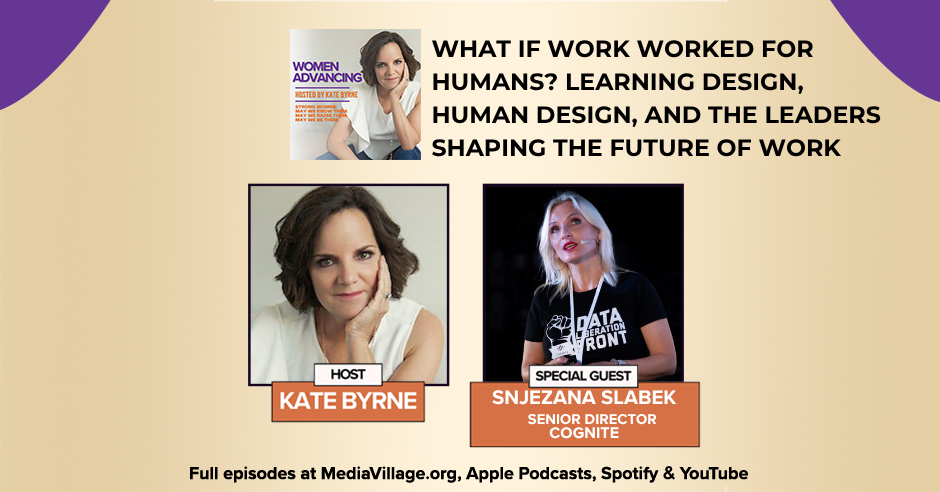
In a world rapidly reshaped by Artificial Intelligence, the conversation often centers on the tools. But what if we shifted the focus to the people?
Join host Kate Byrne on Women Advancing as she dives deep with global thought leader Snjezana Slabek into the timely intersection of AI, human-centered learning, and organizational effectiveness. Snjezana—an expert in human-centered AI learning, gamification, and design thinking—reveals why traditional learning and leadership models are failing in the AI era, and how we can adapt, unlearn, and relearn alongside technology.
Discover:
- Why the biggest challenge in the AI era is not technology, but creating organizations capable of continuous adaptation.
- How gamification and human-centered design turn “consequences” into safe “trade-offs,” encouraging the experimentation vital for innovation.
- Why the “power of the query” is the new essential skill, shifting our focus from getting answers to asking the right questions.
- How communities like She STEAMS are empowering women to embrace playfulness, collaboration, and bolder leadership in an AI-driven future.
Stop focusing on keeping up with AI and start focusing on leading the loop. Read on to explore how we can build a future where work truly works for humans.
—
Watch the episode here
Listen to the podcast here
What If Work Worked For Humans? Learning Design, Human Design, And The Leaders Shaping The Future Of Work With Snjezana Slabek
Introduction Of AI And Learning In Business Schools
Hey, everyone. Your host, Kate Byrne here with Women Advancing. Most conversations about AI focus on tools. In today’s conversation, we’re going to focus on people and how we actually learn and lead in an AI-shaped world. I’m joined by Snjezana Slabek, who’s an expert and global thought leader in human-centered AI learning, gamification, design thinking, and its overall organizational effectiveness.
Snjezana has been working at the intersection of AI, human-centered learning, and organizational strategy for years, using approaches like gamification and design thinking to help leaders and teams adapt, not just keep up. She understands what AI actually holds and opens up for women. Good news, it’s a lot. As well as how communities like She STEAMS and the Professional Women’s Network are helping women make the future of work work for humans. Stay to the end, KB’s takeaways. Let me know what you think. Let’s learn.
Women Advancing readers, prepare to have your mind expanded. Yes, I’m going to dare to say even potentially blown. As we talk with today’s guest, Snjezana Slabek, who’s an expert and global thought leader in human-centered AI learning, gamification, and design thinking. All of this is put towards organizational effectiveness. Snjezana is joining us from Oslo. Welcome, Snjezana.
Hi, Kate. Thank you so much for having me here.
My pleasure. I’ve had the treat of getting to know Snjezana through some other projects. I look forward to doing more together. I would love for you to just start briefly and talk a little bit about how you’ve built this career at an incredibly timely intersection of learning leadership and design. More and more these days, all those three things are getting more activated with people. What first drew you into this world of shaping experiences?
The Starting Point Of Snjezana’s Career
Quite honestly, it all started with a failure. I would say, with frustration, but a positive kind of frustration, which I’m very grateful for. My background in Computer Science and Educational Technology. With this background, around 2006, I worked on implementing a digital learning and knowledge sharing solution in one big organization. From a technical perspective, the solution was, I would say, almost perfect, scalable, secure, and greatly designed. After it was launched, no one used it. This was, for me, the moment. My wake up call, I would say. I realized learning is never actually a technology problem. It’s always a human problem, an organizational problem.
Learning As A Continuous, Human, And Organizational Process
The technical solution was working but the organization and its people actually were not ready to learn. They say, “When the flower doesn’t bloom, you don’t blame the flower,” right? There is always something in the system that prevents flowers from blooming. I would say that the same goes for learning because I believe learning is a basic human need. We all want to learn. We like to solve our challenges, just like playing, creating, eating, moving, whatever. We are fired so we want to understand the world and to make sense of it. That desire to move forward, I believe, is deeply human.
Again, the organization wants their people to learn, to innovate, and to move forward. But I think if you want to understand this, this curiosity pulled me out from pure tech to more into behavioral science, motivation, learning psychology, and system thinking. It was always somewhat related to digital transformation and the role of learning and innovation in it. This is what I already told you. I realized that learning is only one part of the ecosystem. We want to call it a learning organization. We build organizations that can actually adapt, reflect. They can evolve continuously. They really learn from their mistakes and people naturally learn from them.
Just having a digital learning platform, training, this is just one part. People also want to share knowledge. You learn in the flow of work. You’ll share your ideas. You learn from your failures. There are so many ways that we learn when we work. I believe this is the challenge for organization, how to capture all these lessons learned and knowledge.
There are so many ways that we learn when we work. This is the challenge for organizations: how to capture all these lessons learned and this knowledge. Share on XWith AI, I think we have even more challenges because AI learns fast, relentlessly. I would say at scale which means that the real question for organizations is no longer how can we adopt AI but it’s can we learn alongside it? Can we follow that speed as persons, as organizations? There is a saying that I love about change. “When the wind of change blows, some build walls and others build windmills.”
It’s in the learning organization. AI becomes a partner. We are not sure yet which kind of partner. Some organizations may feel it’s a threat. People are curious but at the same time, defensive. It’s a lot of different things going on in that area. I believe that we should, in the organization, encourage more experimentation. To allow ourselves to play with AI, to learn through it, to learn through our failures, to play with it because no one truly understands what’s going on. There is also a threat that our learnings could be very shallow about possibilities.
I see that because I think a lot of the shallow bit. It’s because we want to learn so fast. We need the answer so quickly. We need to get it. “We need it. Boom. Okay, I know enough.” The issue with that becomes for that moment for that context, right? That’s something that really has changed. In your mind, what are some of the biggest challenges of learning and innovating with AI? Why are some companies more comfortable with it? To your point, more expansive, more open to playing with it. I know other things you work with, gamification and human-centered design. How do those all three come together and aid in learning AI, if at all?
AI, Continuous Adaptation, And The Need To Unlearn And Rethink Organizational Structures
I would say everything that you mentioned is super interconnected. When you talk about learning, this is not training. It’s the overall ability to adapt and reflect. In the AI era, we have these challenges. The skills expire very quickly. We upskill all the time. Every month, there is something new. Our answers to our questions also, they change fast. I would say that leadership is super important here when we talk about organization because it’s not that the leaders are in the loop. They should lead the loop. I’m still confused about this.
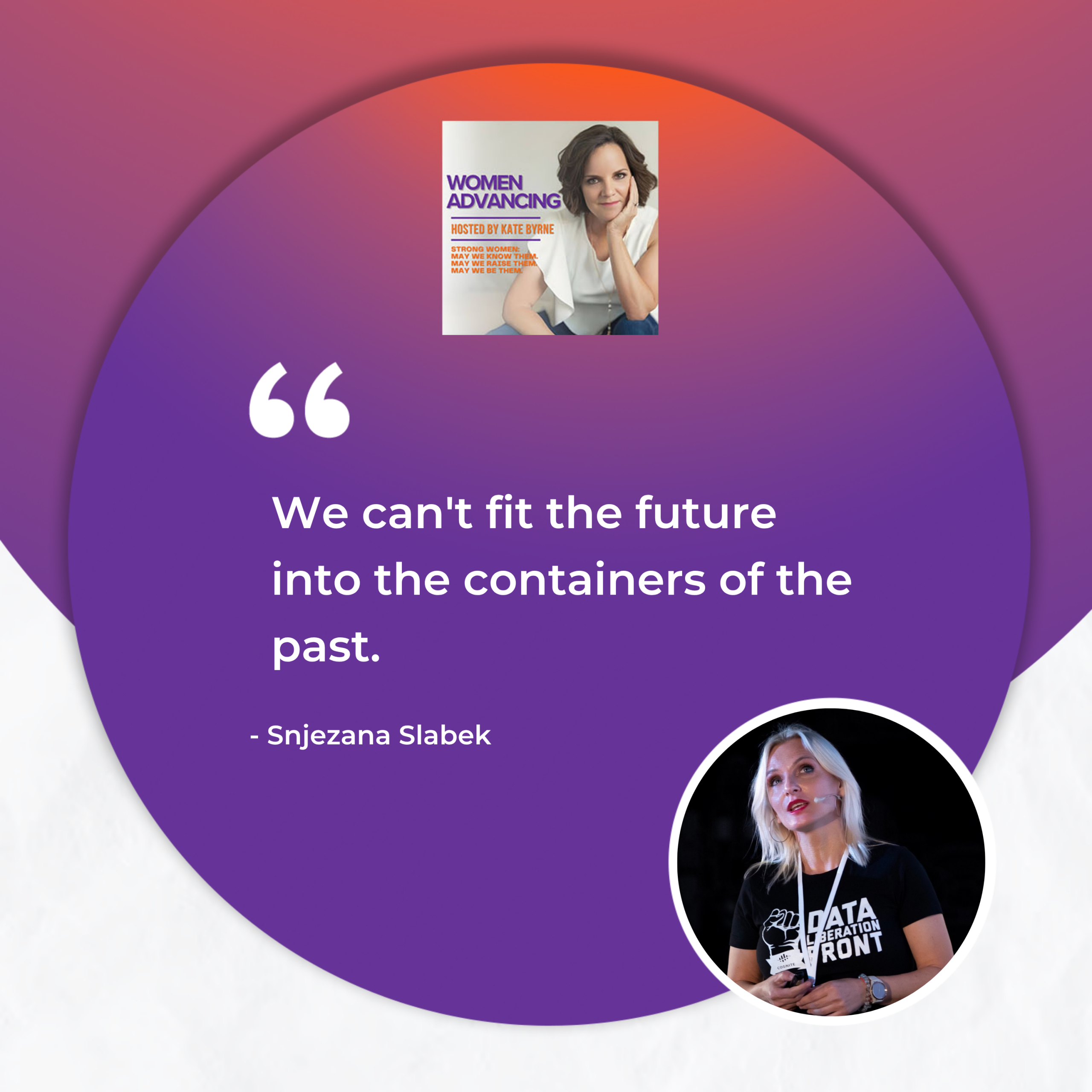
The ways that we have built our organizations, we should also question this as well. Our organizational structure, the way we operate in-house, because obviously we can’t fit the future in the containers of the past. Traditional structures, static content, and one-off programs simply can’t keep up. You can hear it many times. People are more and more talking about our capability, not only to learn, but to unlearn and relearn. We say in the 21st century, illiterate people will not be those who cannot read and write, but those who cannot unlearn and learn and be able to learn new things in a different way. The question is, are we building organizations that are capable of learning now?
I think that’s really interesting. One thing that came to my mind when I heard you talk about how leaders need to lead the loop. One of the challenges I know, we have so many different generations in the workplace. Part of the issue, a lot of people are saying, is because the folks at the top, the Boomers and even the silent generation. Those who are still there aren’t giving up their jobs.
They’re holding onto dear life for a lot of different reasons, right? Everyone is living longer, has to work longer because everything’s so expensive. This might cause or force an issue where those leaders will be passing that baton more often. They’ll have to because they won’t be the right folks. There’s a different skill set that needs to lead the helm. With that, do you think they’ll become this situation where there’ll be senior, older leaders who will be more like, for lack of a better term, Yoda? You know what I mean?
That wise one who will really be the, not the keeper, but leading the intellectual or the humanistic side. The younger crowd will be the ones who are really understanding, connecting the dots, and seeing how the new systems should be built with this technology. You have less friction, more collaboration, and less threats for the older set.
Very good point, Kate. Mentioning Yoda, I really often think of Yoda as a teacher of this wisdom, “Do or do not.” No, there is no try. It’s not pressure, but presence. A good reminder that transformation really asks for our commitment. When he says that, “Failure is the greatest teacher.” He named something, I believe, deeply human. Growth comes really from our experience, our reflection, and actually to our willingness to begin again. Even the Jedi Order fell, not because it lacked knowledge, but because it clung too tightly to what once worked. This is exactly the situation that we are in. We know what worked up to now. Sometimes, we are not willing to change. This is actually very much a discussion about change management, how we navigate that change, and how we catch up to speed and evolve.
Are there a few easy to do motions that folks could put into play that both encourage themselves to get more comfortable with change, letting go, and learning, opening up a curiosity, and then thereby helping their organizations?
Integrating Gamification And Human-Centered Design (Design Thinking) For Learning
Absolutely. I’ve been using many different tools and approaches in different companies where I’ve worked. Personally, I very much love the appreciative inquiry, change management approach when you introduce change. You start with appreciation of what already works. People are not afraid of change, I would say. They are afraid to change themselves. When you include them, they are like ambassadors of change. They’re the ones that will create the new change. I love that approach.
Mentioning all these tools, I especially appreciate gamification, adding the touch of playfulness into serious things. Also, human-centered design. These are the two tools I discovered many years ago. They stayed in my toolbox because they are deeply interconnected. Both will help you make systems or products or learning experiences much more playful and human.
Plays actually create safety. Safety creates experimentation. When you feel safe, you’re not afraid to fail. You will experiment. You will just go beyond borders. You will go out of your comfort zone. Experimentation is actually the engine of innovation. We love to be more innovative and to learn. Gamification is not just to make work fun. To add all these cool points by just leaderboards, you think this is gamified. It’s too much.
Experimentation is the engine of innovation. Share on XThe essence is we like to play with systems. We like to see consequences in the play, trade-offs and behaviors, not just some concepts on the slide and take some training courses. We like to learn through play. We have as-if experience. Sometimes in 30 minutes, 45 minutes of playing a well-designed serious game, I would say, you learn much more than months of learning. At the same time, I would say human-centered design.
Share a bit about that.
I don’t know how to call it a methodology approach because you can use it in so many different ways. I think that this approach keeps us honest in a way. It forces us to start with what are the real human needs, not some assumptions. Then, you combine this with gamification. You can create experiences. People are engaged in those experiences. I think that’s the real power of play.
When the term gamification was first coined back around 2006, we used to think of gamification like, “We will gamify some applications, learning materials and stuff.” As time went by, we learned we can also gamify our processing as companies, serious things, some scientific experiments. We can add this touch of playfulness to many different things, just not to make it more playful. To touch deep human drivers like, “I like to experiment. I’m interested and curious. I’m excited.” Kate, let me ask you about one game you really wanted to play or you still want to play in your life.
There are a couple things. There are new ones like Quick Quick Quick, which is really quick. This isn’t necessarily a game, I guess, but I love dominoes. My husband loves Monopoly. Those are old school games, but that kind of thing.
When you think about it, we all have different games. If you, for example, had to single out one emotion. Why do you love to play this game? What would be the essence? Curiosity Stimulation?
Yeah. For me, I feel alive.
You feel alive. You see. People give you different answers. I like curiosity. I like to solve challenges. I like a sense of freedom, having choices, being in control of my progress. You have autonomy.
I’m curious of seeing where it goes. Like, how’s the game going to play out?
This is so natural. I believe that, as human beings, we just love to play. When you take a look at gamers and players in some statistics, they pay a monthly fee to play with other players. World of Warcraft, for example. They’re willing to pay money to be able to solve challenges, to innovate solutions, to be exposed. On the other side, we have an organization where we also have people, like multiplayer online games for example. We want them to collaborate, to be loyal, to trust. When you compare this to systems, we are dealing with the same elements, I would say. The games show us that they’re much more successful when it comes to engagement and motivation.
I think I love the notion. Words matter. I have a big thing about words. To me, you just said something, I think is just such an example of this. Maybe it’s a euphemism. Rather than consequences, through gamification, you see trade-offs. That’s really scenario playing. That’s what a consequence is. But, it doesn’t have life or death consequences, right? That severity of feeling. It’s literally, “Okay, these are the trade-offs. You can have this or you can have this.” It’s almost like when you’re talking with a little one. Giving them choices and trying to figure out what they want to do.
To me it’s a gentler, more palatable way of experiencing evolution. That’s another one. People don’t like to change but if you ask them, “Would you like to evolve” “Yes, of course. I’d love to evolve.” Same thing because of evolution, that changes. It seems to me the beauty of human design added to this is it provides relevance to you. It gives you the, “So what?”
Human-Centered Design Principles And Balancing Technology With Humanity
Exactly. I think, with human-centered design, with this approach to whatever we do, especially when we design new products or new services, we don’t optimize for efficiency at the cost of humanity. We keep this community a very important element. Who is this really for? What behavior are we shaping? What emotions does the system create? Because AI can give us all of the answers. We still need to keep this human element when we are innovating and creating. Without this, AI will just scale biases, fear, and disengagement. With human touch, we will have more trust in the system as well and more clarity. We will see more purpose in this.
With a human-centered design approach, especially when designing new products or services, we don’t optimize for efficiency at the cost of humanity. Share on XWhat is human-centered design? Maybe we explain a little bit for those who are not familiar with it. Often known also as a design thinking methodology that was very popularized by Stanford in the 90s, I would say. At its core, it’s methodology that is framed as Five Steps that helps you create and innovate in a very human way. It always starts with defining a problem like, “Okay, what is the problem?” With building empathy towards the people that we are solving the problem for and often redefining the problem once you truly understand it.
I think maybe you have this problem. After having a human conversation with you, I may realize that something else entirely is your problem. And then, you move to ideation, prototyping, testing, and so on. Very important, you don’t do this alone. You always do this with a team of people. Collaboration is just built in the process.
I would say the real power of this methodology is not in finding answers. It’s about asking the right questions. Is it really the problem that the bridge is broken? Maybe we don’t need to go to the other side of the river. What is really the problem? Because with AI, we suddenly have all the answers of the world here. Very confident answers and very convincing ones backed with all the data. I believe that the real skill now is, what do we ask?
It’s the query. The power of the query.
What do we do with the answer once we get it? Is it inclusive? Is it sustainable? Is it for humans really this answer? With human-centered design, you actually train different muscles. You ask a lot of why. Why not? So what? You train. You have this divergence. You go wide and you scope. You just train different muscles. If we just forget to train those muscles, I think, then we will just use the answers that AI will give us.
This is also something that we should think about together with developing AI skills. What are the core human skills that we should develop alongside? Not only to be able to better use AI, but also to continue developing these core human skills like critical thinking, creativity, sustainability, creating for the good. All these things that really matter to us.
A lot of things are possible, but not everything is inclusive, and not everything is human-centered. Share on XThis reminds me of The Hitchhiker’s Guide to the Galaxy when the supercomputer calculates the answer to life, to the universe, and to everything. It calculates something for many years and it gives the answer like 42. Everyone is disappointed. No one agreed. “What was the question?” They forget the question. I think we have all the answers. Just ask AI, you hear everything. But, what are our questions? I believe this is super important. Human-centered design and approach can really help us just to keep developing those muscles, I would say.
It is definitely, clearly the ultimate collaborator. This is definitely potentially provocative. Given that women, in particular, just our brains work, we’re more systems thinkers. We’re definitely more collaborative in nature. Does this technology perhaps, more than others, open a window for women to take more of a leadership role?
Absolutely. I think it is super connected. Women, oftentimes, will come out with a question by proposal or they will apply for a job when they’re super confident. When they know that they have done it before, they can perform it. I think that’s why it’s very important with this approach, they play. You give them permission. Just play with it, learn with it. You don’t have to be perfect. Just start away. Everything else will appear as you walk the way. I think this might be very helpful in that context. Experience-based learning. Just encourage and build confidence through it.
It really just made me think about how it is so true. This is maybe a dumb thing to say, but so often, we do base everything just on the past. We know at least, “This is what happened.” I think in this time and space, AI is able to take that which is more linear and make it actually quantum. We do have all the answers. It would give us access to information and insights and research and thoughts and thinking patterns that we otherwise would never have even had. Because we are so focused on, “I did this in the past. It’s safe for me.” It means then I have the ability to move forward because I’ve done this before. I know what I’m doing.
This brings us also to the topic of responsibility and I would say responsible use of AI. Like the Spiderman quote, “With great power comes great responsibility.” I think leaders and all of us actually are in that situation. We have a great power in our hands. Hence, a lot of things are possible. But, not everything is inclusive, not everything is human.
Everyone does have that responsibility. That’s the thing. I can remember early days asking some folks over at Microsoft about AI. “Is it inclusive? Does it lower the playing field? Does it equal the playing field?” To a T, each one of them said, “Absolutely.” It completely does because everyone has access to that. You have a responsibility to use it wisely. One quick, semi, before the last question. You’ve done a lot with fit women organizations in Scandinavia and beyond. One of the key things is She STEAMS. Talk a little bit about what She STEAMS is and the role it plays in not only creating opportunities, but in a community for women leaders.
The Role Of Women’s Networks (She STEMs) In AI Leadership And Experimentation
This was last year, actually inspired and driven by everything that’s going on in the AI world. I initiated the She STEAMS Program within the Professional Women’s Network in Norway. Professional Women’s Network is a global community of women leaders with a branch in Norway. The main idea was to create a six-month program and some boot camps that will allow women to experiment, just give them permission. “Here is this beast AI, go play with it. Learn how to create prompts. Learn how to make it in a playful way. Use what human-centered design is, how you can use it when you innovate together with AI.” At the end of this six-month journey, we also had final hackathons. Women had challenges. They had to source out and innovate solutions together with AI.
I think this is the first time since I’m in that job. You have five women around the table plus AI. You need to collaborate with AI, but you need to also come up with your idea. I think these kinds of programs are super important to create space for women, to give them permission to play with something that’s going on out there. Because there is always the possibility that they will stay behind. Only men will step into AI, shape the future, because they don’t feel like we are ready yet.
No one is ready. It’s more about building confidence to understand what’s going on. Breaking through all these invisible limits that actually stop many women to be bolder. When you come into such a community, you ask questions. You take space. You don’t care if you’re wrong. You don’t have this problem like, “I don’t know something.” Maybe if you are a leader in a traditional organization, you don’t want to admit it. I think it’s super important that women support each other, mentor each other, connect, and play with technology. They are much braver out there.
That’s the thing. You just said a key phrase, “Permission to play.” Because still, there is such a classic linear male-dominated severity. “You’ve got to be tough. You’ve got to be competitive.” We may be all those things, but we may express it differently. The whole notion of it’s okay for us to actually be us, be a little softer, be a little more playful, be a little bit more experimental. Without a consequence of “We’ll never get ahead because no one will take us seriously. If I play, I won’t be taken seriously.”
I know for myself, I have a very playful nature. I infuse humor in a lot of things because for me, that makes me comfortable, makes everybody else comfortable. However, in certain careers, places, that was taken as, “You’re too lighthearted. You’re not a real mind.” It’s misinterpreted sometimes. I think this is a really important point. Don’t go away from that kind of interaction because it’s exactly, frankly, what workplaces and really the world in general needs. That’s how we’re going to get ahead. To your point, nobody knows. Nobody’s ready to be the brave one.
You watch different demos on the internet. You learn here and there. To connect all the dots and to have a deep understanding of what’s really going on, what are my possibilities, how this can impact our future, we all need to learn it. One interesting thing about the She STEAMS project, it’s She STEAMS, which stands for Science, Technology, Math, Engineering. We added A for Art.
I love it.
I really love it because it sends a clear message. The challenges of today and tomorrow also require art. It’s not everything goal-oriented. In that, we need this multidisciplinary approach. Technology alone is not enough anymore. I love this shift in the conversation we have when you’re talking about technology. AI is not only for women in STEM, right? It’s for every woman, just every profession.
The challenges of today and tomorrow also require art; not everything is goal-oriented. We need a multidisciplinary approach, as technology alone is no longer enough. Share on XThe thing about art is it’s this notion too of, which empowers all of this, art is just art. It’s either, you may like a picture, you may not. There’s no right. There’s no wrong. It is. I think that’s going to be a really important skill for people to not be so fear-based, having greater equanimity. Good thing.
Art just motivates you to be brave. You need to be brave to push.
Vulnerable, yes.
Vulnerable to expose yourself. We are back to human-centered design. Before we come up with solutions, usually we have a challenge. We have a problem, and then we come up with ideas. Oftentimes we jump too quickly on solutions without allowing us to really think, go deep. Not just fast learning. Learning fast and learning slow. Allow ourselves to be creative and to be friends with our own creativity. Art can help us a lot. After we are relaxed in that way, then the ideas in the brainstorming session will come up. You might be totally surprised with the quality of those ideas when you just warm up your brain a little bit.
Everyone, think about a meal or meat or wine. If it marinates, it gets all the flavors. It takes on nuances and it’s so much more satisfying. It’s so expansive. This kind of practice with human-centered design and the gamification allows for ideas to marinate a little bit. Frankly, most likely, probably a better lifelong, longer term solution for the context at hand.
At least we know that we did our best. We didn’t take it on the surface. Just jumping because we don’t have time. There are quick solutions, quick fixes here and there. We need to also train our brain to be able to make us increasingly happy.
It’s a solution. It’s not just a checklist.
Yeah.
Thank you so much. I can go on and on with you and I may. In future subsequent offerings that I’m thinking of doing, everyone. Some LinkedIn Live, some YouTube videos and then also Women Advancing Summit later on this year. Stay tuned for that. I can’t thank you enough for this. So many nuggets. I’m so glad our paths have crossed. I look forward to continuing the conversation.
Thank you so much, Kate. It was a pleasure talking to you. Thank you for having me.
Until next time.
—
I told you your mind would be somewhat blown and expanded if nothing else for sure. For KB Takeaways, some things that we knew. But also, some other ways of looking at this world of life that is including so much more technology in each and every day. Query is queen. We had a very deep conversation about AI increasing accessibility. I think there’s a huge opportunity for women here. Snjezana completely agreed. Mainly one of the reasons is we’re so much more systems thinkers and we’re much more oriented towards collaboration.
A bit more patient. Far too often in the past, the world has been wanting to quickly solve. Quick solve is already inherent, sometimes a quick fail because it works for just one little solution. Sometimes, by letting ideas marinate just a bit, you get longer lasting solutions that actually answer additional problems that you may not at first glance even realize you had. I think illiteracy, the thought that that’s going to come to mean you can’t necessarily read, but you also don’t understand or are not as tech savvy. I think definitely. That’s been a generational issue for centuries. Maybe this is an opportunity with so many different generations in the workplace. We can uncover and fix that.
You can’t solve for the future by sticking everything in the book of the past. It’s just too expansive and it won’t work. We’re already seeing that so many of our systems are coming off. Lastly, I really loved the thought of gamification, which is literally just making creativity, new solutions and putting them into place. A safe haven really. It’s a playing field that’s much safer. The thought of instead of looking at everything so heavily, so severely as a consequence. It is coming to realize everything as it’s a trade-off. Maybe it gives us a pause. We’re able to take more of a hawk’s eye view so we can better see short-term and long-term implications simultaneously.
I will also say organizations like She STEAMS and the Professional Women’s Network are incredibly important communities that we should each turn to if we’re so inclined. There’s a lot of learning we can do from each other. So, join the circle. Let’s see how we can make the world a better place. With that, thanks so much for reading. I really appreciate it. Please reach out. Let me know who else you’d like to learn from. Until the next time, in the next conversation.
Important Links
- Snjezana Slabek on LinkedIn
- She STEAMS
- Professional Women’s Network in Norway
- Professional Women’s Network Global
- The Hitchhiker’s Guide to the Galaxy
- Cognite
About Snjezana Slabek
 Snjezana is a global learning and transformation architect with more than 20 years of experience building scalable learning ecosystems worldwide. She believes real innovation happens when strategy, technology, and human potential move in sync — and that learning and innovation must go hand in hand. In the AI era, she advocates for a simple principle: humans should lead the AI loop, not merely operate within it.
Today, she leads global learning experiences at Cognite in Oslo — a leading industrial AI company accelerating digital transformation — and is part of the Cognite Academy team reshaping how industries learn and innovate in the industrial AI space, unlocking human creativity to build a more innovative and sustainable future. With roots in computer science and deep grounding in behavioral science, she designs learning ecosystems where digital transformation fuels engagement, innovation, and lasting change.
Twice recognized among the Top 100 Movers and Shakers globally for shaping learning cultures through structured change leadership, Snjezana is passionate about advancing women’s leadership in STEM and beyond. Her toolbox blends gamification, human-centered design, Appreciative Inquiry, and innovation strategy to help organizations learn in the flow of work. A philosophy enthusiast and music lover, she approaches transformation with both analytical precision and creative curiosity.