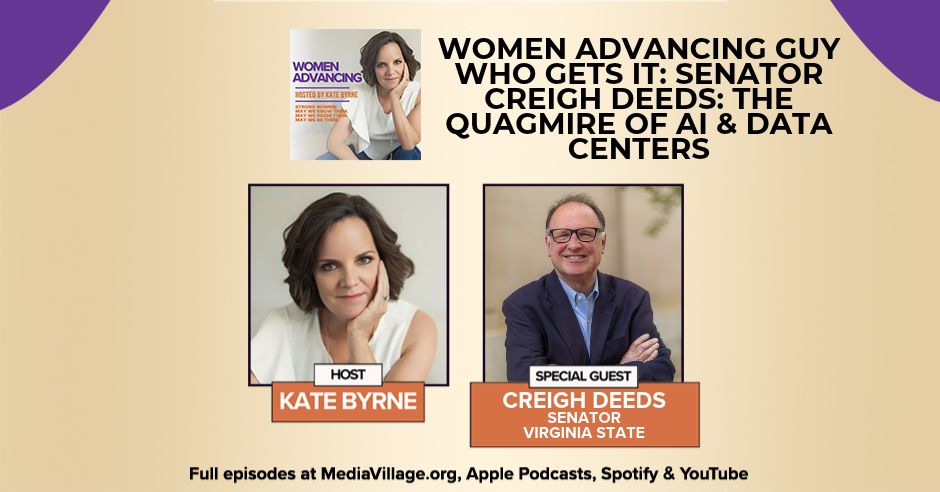
Virginia stands as the data center capital of the world, and rapid AI growth puts the state’s infrastructure and economy at a major crossroads. Host Kate Byrne welcomes Virginia State Senator Creigh Deeds to launch her new series, Guy Who Gets It, unpacking the complex realities behind massive tech expansion. While data centers bring billions in local tax revenue, they also strain power grids, consume millions of gallons of water, and spark intense debates over transparency. Senator Deeds shares an insider view on how public servants balance short-term financial wins against long-term community impact. You’ll discover why local governments are signing non-disclosure agreements and what it takes to demand real accountability from corporate developers. Tune in to learn how citizens and leaders can stay agile, question the status quo, and shape a sustainable economic future.
—
Watch the episode here
Listen to the podcast here
Women Advancing Guy Who Gets It: Senator Creigh Deeds: The Quagmire Of AI & Data Centers
I’m excited that you’re joining me for a new series that I’m going to be doing throughout 2027, which is called Guys Who Get It. Each month, I’m going to be having a guy who gets it, and I’m so excited to have my first guy, which is Virginia’s State Senator, Creigh Deeds. Why? Everyone’s been talking a lot about data centers and AI. In my state, Virginia finds itself at a crossroads because as AI has reshaped our economy and our lives, we here in Virginia find ourselves as the data center capital of the world.
While it brings enormous opportunity, you can only imagine huge consequential questions. Who’s going to benefit from the growth? Who pays for it? Is there real growth? Is there real job growth? What happens to energy costs, the environment, communities, water? Creigh Deeds has spent decades in public service, and now he chairs the Senate’s Commerce and Labor Committee. I thought he would be the best one for the job to answer a lot of those questions as he’s been at the center of some of the State’s most important conversations about economic development, energy, and the future of Virginia.
We’re going to dive in, but this is part one of a continuing conversation. On December 1st, here in Charlottesville, Virginia, through the Tom Tom Foundation, Creigh and myself and Representative Gallison and Martin Wiener, former CTO of Pinterest and Reddit, will be sitting down for what we call Tomorrow Talk from 6.30 to 8:00. We hope that you’ll join us there as well but for now, let’s tune in and stay to the end for KB Takeaways. There are a few of them.
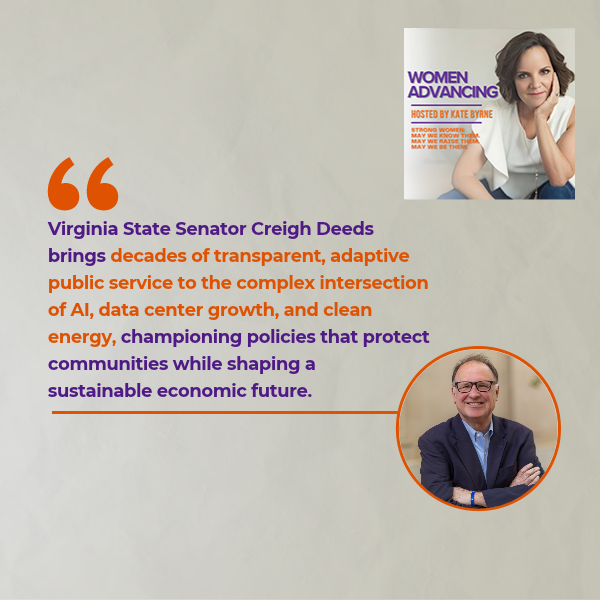
Women Advancing, thank you for joining. I am so privileged and humbled to have a terrific public servant. We are joined by Senator Creigh Deeds, who serves us here in Virginia and plays a big role in the growing data center. Promise, yes, but dilemma. We’ll get into that in a little bit but welcome.
Thanks for having me.
It’s my pleasure. Believe me, I know you have a very busy dance card. Thanks for fitting us in. This is also in preparation for an exciting Tomorrow Talk that we will be having here in Charlottesville on December 1st. You can find out more information about that at TomTomFoundation.org. Now, I would love for you to talk a little bit about how you get your start as a public servant? There are people that say, “I want to do my part.” I know it started in Bath and now you’re representing Charlottesville.
At one time, I represented Bath and Charlottesville for a lot of years. The district was connected. In 2022, those districts were changed. The Bath was put in one district Rockbridge, another in Albemarle, in Charlottesville in a third. Seventy percent of the people I represented live in Charlottesville, Albemarle, and Nelson. They were in one district. It just made sense for me to move to Charlottesville.
I’m glad you made it.
I wanted to continue to serve anyway.
I moved here. My family moved here in 2021 from the Bay Area. We were a COVID move. We’re lucky to have you. Clearly, our timing was good.
I appreciate that.
What drew you into the public service? Has your understanding of leadership changed?
Leadership isn't about stubborn consistency. Senator Creigh Deeds shares why you must reserve the right to be smarter tomorrow than you are today. Share on XIt changes all the time. I’ve always been interested in politics and interested in government. My grandfather was chair of the Democratic committee in Bath County during the depression. I was born significantly after the depression, but my grandfather was alive for the first fourteen years I was on this earth. He instilled in me a sense of public responsibility that kept me involved and kept me interested. When I was 29 years old, I had the opportunity to run for a local prosecutor. I did that, then when I was 33, I went to the House of Delegates. Ten years later, the Senate. I’ve run for Statewide Office a couple of times. I’ve been involved at a pretty high level.
Reserving The Right To Get Smarter
The issue of leadership does change. I’ve learned over the years, at least in my view of leadership, you have to retain the ability to have a new set of eyes to look at issues. The way I phrase it is I say, I reserve the right to be smarter tomorrow than I am. Some people that are elected are afraid to change their minds but I am not afraid to change my mind. I am not afraid to say that I was wrong about something or my views have changed.
When people have elected me in the past, I’ll ask them to reelect me next year. When they have voted for me in the past, they’ve expected me to try to get smarter about issues and try to learn as much as I can about things. HL Mannequin wrote that a foolish consistency is the hobgoblin of small minds. While I’ve always, and certainly when I came into the legislature, I tried to be more consistent as I’ve aged and had a hand in raising children and being married. I’ve learned a lot. I think people expect that each one of us grows as we age.
Lord knows the contexts surround us. I feel that’s part of the beauty of just intergenerational work in general and being, frankly, a lifelong learner. Always curious.
You have to be.
What makes sense may not tomorrow.
As I age, honestly, I read more. I don’t like to watch television. I don’t find that there’s a lot that’s interesting there. A lot of good news either. I would rather read a book, read a novel, or read some history. I’d continue to try to develop my way of looking at things.
I am right there with you. Historical fiction, I adore it. It does sometimes make me queasy, but I will stay away from that. It is fascinating. Speaking of, I won’t say queasy, but crossroads. Shifting into this whole notion of just data centers and AI. As we said, there’s going to be something else tomorrow and the year after. We both were here when the internet was the thing. We went through so many things. There’s always going to be another thing.
There is.
A massive data center uses a million gallons of water a day while employing fewer than 70 people. Who actually pays for this AI infrastructure boom? Share on XWhether we like it or not. Maybe that’s what keeps us flexible and agile. I’m not quite sure but specifically as it pertains to Virginia. I know it has become this data center capital of the world. There’s certainly a leading one, something crazy like 13%. I know that AI is accelerating that demand. Before we get into good things or bad things. What do you think most people misunderstand about data?
There was an article in this online news service called the Virginia Cardinal by this guy named Dwayne Yancey. Whether you agree with him on everything or not, he is a smart guy who thinks a lot about these issues. He said, “It’s clear that people don’t like data centers, but it’s also clear they haven’t figured out how to stop the need for data centers. We still have all this data, whether it’s on our phone or our laptops, it has to be managed somewhere.” AI certainly changes the game and accelerates the data center business. It’s a very complicated issue.
I know. There is no one easy because that’s what I’ve been trying to figure out. It’s an economic opportunity or is it an infrastructure challenge?
It’s all those things.
I was going to say yes.
Weighing The Data Center Tax Windfall
Yes to everything. Data centers are more than 90% of the current economic investment in Virginia. It’s huge. Data centers in this past year produced $1.2 billion in taxes, personal property and real estate, personal property machinery and tools and real estate to Loudoun County. It produced about $455 million to Prince William County and about $110 million to Fairfax County. Those are the big three in terms of data centers in Virginia. They’re all in Northern Virginia.
It’s a huge opportunity. It’s one that the State pays for because the state doesn’t collect. That’s been the issue that we’ve been trying to look at. It raises issues about what do we want Virginia to look like? What kind of jobs should we be seeking? What economic development should we be seeking? The last governor focused on data centers in large part because they were somewhat easy. There’s a lot of internet access in Virginia. The infrastructure is already here. The data centers want to come and localities in general.
I think if you took a poll, Democratic voters and Republican voters, large numbers would be against the placement of data centers in their neighborhoods. A lot of the local governments are starved for them. Distressed and doubly distressed localities in Virginia. We’re not all Albemarle County, or we’re certainly not all Fairfax, Prince William, or Loudoun. There are localities in the State where there’s high unemployment. There’s a constant need for revenue in schools, and their localities. They are looking for opportunities, and they see data centers as something that has the opportunity of producing a lot of local taxation.
A lot of local governments think it’s worth the risk. Now, the chair of the finance committee in the Senate, Louise Lucas, says, “Let the localities incentivize data centers if they want them. The State shouldn’t be in the business. We shouldn’t be giving up this tax revenue.” JLARC or the Joint Legislative Audit and Review Commission, took a look at all the economic incentives we offer. The reality is, we offer incentives to an awful lot of businesses.
Confronting The Hidden Costs Of AI Infrastructure
A lot of businesses that come to Virginia. About 60% of the incentives we offer are the data centers. The return on investment is pretty good. Still, you have to recognize that data centers have created huge demand for electricity In Virginia. They’ve overwhelmed our infrastructure. You could argue that they are the reason why a purchase of Dominion by the next era is being advanced. You could argue that’s what made Dominion attractive to the next era.
Some people would disagree because I’ve raised that point. There have been people that have called me back down on that. It’s clear that Dominion and the other utilities in Virginia have the demand. The next era has energy. Dominion and the other utilities in Virginia, the co-ops, I don’t know where the energy is going to come from. That presents a real challenge. We have to figure out how to incentivize utilities to build power in Virginia. Clean energy in Virginia.
It’s not that ambitious in the big picture, but when you think that other states haven’t done it, this Clean Economy Act, where we’re going to decarbonize our electric production by 2050, is something a lot of other states have not done. We want to incentivize the growth of clean energy in Virginia, but we still want reliable and cost-efficient energy. We’ve got a huge challenge on our hands. Data centers complicate that. Data centers use a lot of water.
They complicate our natural resource issues. They’re huge issues. They make noise. Some localities have allowed data centers to be built right next to neighborhoods. It just doesn’t make sense. People don’t want that noise and that activity in their backyard. That’s what we’ve got in several situations I can take you to.
One of the things I think is, oftentimes, it’s like a corporation making a decision where you’ve got a short-term fix. It’s going to ease the pain quickly, but long-term setting yourself up. I won’t say for disaster, but who knows?
It could be. What we’ve tried to pass legislation and also the State Corporation Commission has made it pretty clear that data centers have to pay for their own electric infrastructure. The question remains, are they paying for the whole thing? Are they paying for everything? The demand has increased and bills have increased. I will tell you that the Dominion bill per 1,000 or 100,000 kilowatts is still lower than the national average but it’s risen dramatically in the last few years.
How do we make sure that this growth happens? That there is growth but it’s balanced to a degree where individuals don’t end up carrying the majority of the weight of it all.
It’s troubling. We’ve got to figure out how to make damn sure that the data centers are paying the total infrastructure costs, the cost for transmission, and the cost for building the power plants. In the past, I’ve tried to build incentives into the tax exemption to require data centers to be as energy efficient as possible, to clean up their act. We’ve talked about things requiring data centers to produce their own power, but it has to be non-carbon producing power.
Building A Balanced Economic Footprint
We’ve talked about a lot of things. Can we get there? I don’t know. In the long run, I’d hope the State would focus more on manufacturing jobs. They’re going to manufacture activity that will produce more jobs and be more evenly distributed than a huge data center that has maybe 50 employees at most that uses a million gallons of water a day and all this electricity.
It’s so funny you mentioned manufacturing. I’ll get to a point on that in a second. I would also imagine that some of those jobs within those data centers could very potentially be replaced by some form of AI or robotics.
When local governments sign NDAs with corporate developers, they shut out the very people they represent. Transparency in leadership isn't optional. Share on XThat is a concern but here’s what I worry about. AI could replace a lot of jobs. It could replace a lot of jobs in a lot of industries. The construction of data centers is going to require people. The jobs that are in data centers themselves. Somewhere between 30 and 70 people in general can be replaced with the AI. Now, there’s a project in Pennsylvania County, down next to Danville. They promised 2,500 permanent jobs. That’s going to entail more than 40 data centers.
More than 40 data centers. That’s an area of the state where there’s a need for investment. There’s a need for economic development. You recall the last governor shut down a battery plant that was going to be built there. A combination between Ford and the Chinese. He just didn’t think that we ought to be involved with the Chinese. There are other people that share that idea, but it’s a global economy. We know that there are investments from foreign actors and foreign countries in a lot of these businesses.
In States around. That is definitely short sighted to say the least. The piece about manufacturing, I can remember a couple of years ago sitting in an ecosystem conversation and what do we want the economic footprint to look like. Having just come from the Bay, so many people said, “We need technology. We need entrepreneurs.” I said, “What are some of your favorite things that you love about the area?” They said, “We like affordable prices. We like lots of open land. We like good schools, public schools.”
In my heart, I thought, “What?” No offense to entrepreneurs. I work a lot with them. However, tech entrepreneurs in particular, go look. Every single place, it had a huge boom. You can kiss a lot of that goodbye. However, if you did have manufacturing and there is so much natural land, that along, in my mind, with regenerative agriculture, those are two areas that make a lot more sense.
I was just thinking, you said you’d come from the Bay area. When you’re talking about affordable prices, how many people can afford to live there?
That’s why we came here.
That’s your point. Exactly. We build on what we have in Virginia. The data centers are, if you look at the governor’s energy plan and her response to data centers, they basically assume that there will be more data centers. We just have to make them clean up their act. If we’re going to have more data centers, that’s the approach we have to take. Most people that I talk to don’t want more data centers. Again, we get back to Dwayne Yancey’s article. They’re not saying we’re going to find ways to stop while we need data centers. It’s just a very complex issue.
It definitely is. For Governor Spanberger, that is a good point. It’s, how can we learn quickly and then do it all day to what all tech entrepreneurs iterate. How do we change? That was what I was curious about, is we’re building, and this is perhaps my own ignorance or my learning about data centers, because I thought, “We’re building for a certain need now, but they’ve got to become eventually down the line more efficient, or they’re going to be working in different ways. We’ve got these huge footprints, then what?”
They’ve got these huge footprints. In 2024, Jay Lark, maybe they did a study on water usage. Basically, they came out to say data centers use about the same amount of water per day as a similarly sized building does. They didn’t say that similarly sized buildings have hundreds of employees involved in the buildings every day. Data centers, as I said, have 30 to 70 people at the most. What do we do with these? That’s a very good question.
It's not a sin to change your mind or admit a mistake. Stay on the balls of your feet and stay ready to adapt as the world shifts. Share on XHonestly, it is one of the things that I sit there and I think about because coming from the Bay. I think about mainframe computing and now it’s in our phones. At the chips, whole buildings, tiny, teeny. As we started the conversation, everything’s cyclical. There’s going to be another something, something. With quantum computing, I don’t even know enough to go there, but to see what ends up happening with that for sure. What I’m curious about is, how do we ensure that these residents and locals are informed so that everyone isn’t necessarily running around feeling, “Honey penny, the sky is falling?”
What drove the debate at the state level in 2025 was the need for revenue. With the big, beautiful bill at the federal level, we’ve lost 94,000 people from the rolls of insurance in 2026. We’ll lose $150,000 to $300,000 from Medicaid in 2027. We’ve had to spend more than $200 million on SNAP in 2026 that we didn’t before. They’re just huge needs. Trying to find revenue that tax exemption looked like at the right place. How do you make sure that the locals know what’s going on in their locality?
Banning Non-Disclosure Agreements In Public Deals
The governing body has signed these non-disclosure agreements with economic development prospects. From my view, that’s political malpractice. You have fiduciary responsibility to the people you represent. When you sign a nondisclosure agreement, you put a barrier between yourself and the people you’re responsible to. I can’t believe that local governments have allowed that to take place. What the governor announced and what a lot of other people have talked about is banning that process of allowing local governments to have nondisclosure agreements.
The governors already signed an executive order that says people in her administration cannot sign them with any economic development prospect. We shouldn’t have to pass something to say a member of the board of supervisors can’t sign them but they should know that but they don’t. We ought to tell them because people in local governments, there’s an exemption under the Freedom of Information Act. When you are in a public meeting, you can exclude the public from the conversation if you are talking about an economic development prospect.
If you make a decision, that decision has to be made in public. There are lots of reasons why you might want to keep the specifics of situations quiet until you are ready to make a decision. You don’t want to drive up prices. For example, if people know you are looking for 40 acres and you’ve got a million dollars to spend, then you might not find anybody willing to sell 40 acres for less than a million dollars. There are lots of reasons why you keep things quiet for a long time but decisions have to be made in public.
That’s unbelievable. Lack of transparency. I won’t get too political on this, but I’m looking forward to things evolving to a more transparent and, dare I say, reasonable. Anything will seem more reasonable than the shifts that have taken place thus far so that more folks can help. I know you’re coming and joining me on December 1st. I am excited. What do you hope people walk away with?
Whatever information we can share about how decisions get made. That’s important. People need to feel like they’re part of the process. After all, the government belongs to people. Our government has to be responsive to the needs of the people and the wants. There might be reasons why. I firmly believe there’s a section in Plato’s Republic called the Simile of the Cave. You’re in the cave as a representative.
Stepping Out Of The Political Cave
When you go out and see the light, you have a responsibility to run out in the light or to take it back to the people and say, “There’s light out there.” You have a responsibility as a legislator to educate. Educate, but also be open to being educated because a guy like me doesn’t know everything. I learn things every day. I have to continue to learn things.
I have a feeling all of our learning curves are about to be completely vertical. I look forward to that conversation. Again, that’ll be from 6:30 to 8:00 on December 1st. Do come and join us. I want to ask you, Creigh, and I always ask this of everyone. You are my first guy who gets an interview.
I usually only have interviewed women in the past and raised voices, but the work that you’ve done across so many things, like this, mental health, and your years of dedicated public service with such transparency and integrity are to be plotted. I thought yes. Creigh, you’re my first guy who gets it. To that end, I would love to know. Knowing what you know now, what advice would you give your younger self?
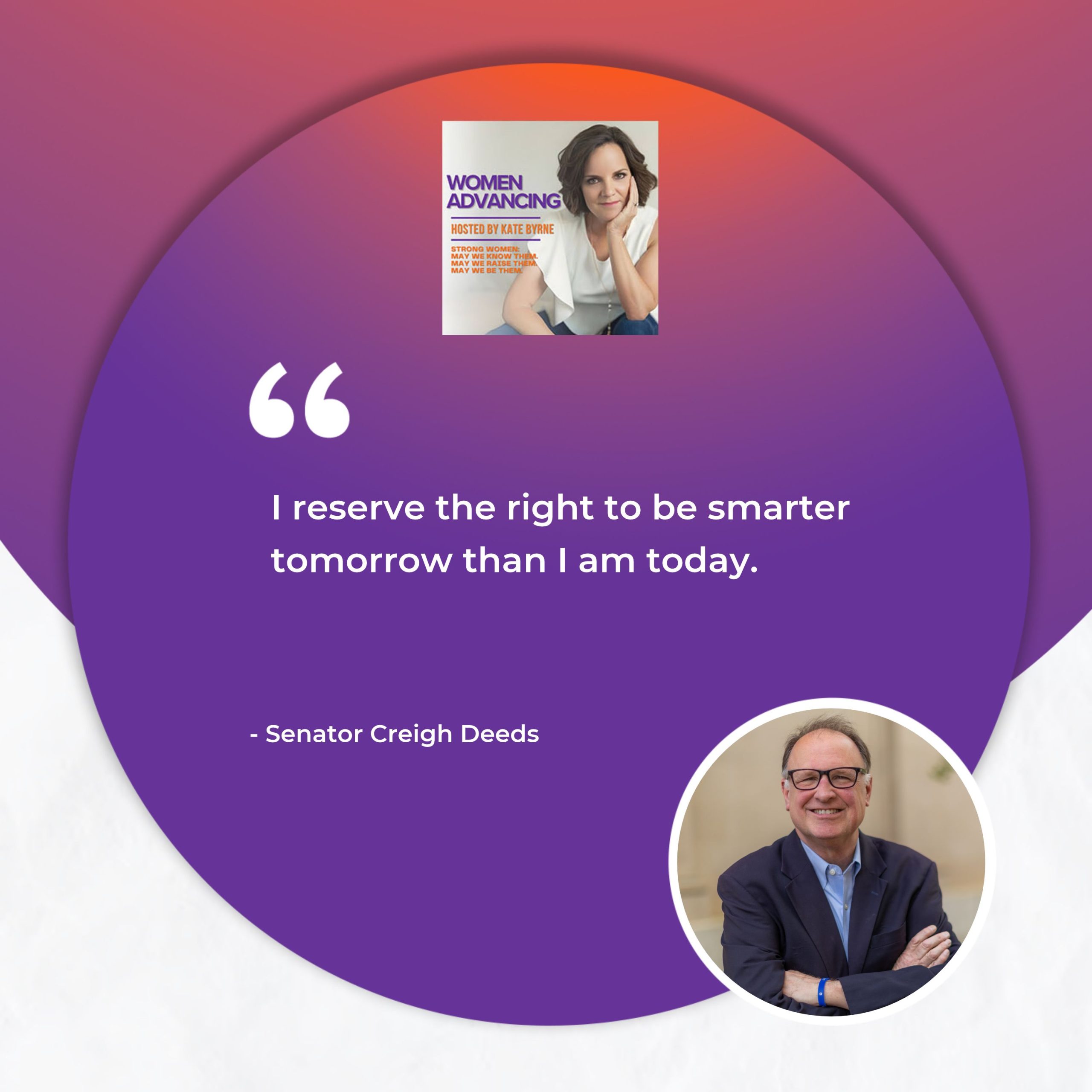
I would have advised my younger self to be more open early on to change and to other ideas because for a long time, I felt like I had to be stuck in one position. Even though I certainly had questions, I felt I needed to be dogmatic about issues. Probably, the smartest thing I did was realize that it’s not a sin to change your mind. It’s not a sin to admit mistakes. It’s human. We learn every day. You have to be open to that.
Words to the wise, I will tell you. The truth is you don’t know what you don’t know and you know what you know based on today’s situation. It never fails. I’m going to say this, how many times people say, “I would never do that?” That to me is surely far away for you to begin to have to face that exact thing you would never do probably the next day only to realize, “It’s not as clear cut as I thought. It is more complicated. I get why I’m tempted to do what that other person did.”
Adapting With An Open Mind
You have to stay open and flexible. It’s like you’re an athlete. You have to stay on the balls of your feet and be prepared for change. I remember a movie from many years ago. I went to see a movie called Adaptation. It was about how plants and people adapt to their situations and evolve. You have to be prepared to adapt.
We’ve got a lot of adaptation coming our way, which is all good. I also find when I find myself hesitant about doing something. That once I surrender and allow and go with the open heart and mind, it often leads me to an amazing thing that I never would have dreamed up for myself. Creigh, thank you so much for taking the time. I appreciate it. I look forward to continuing the conversation on December 1st.
Thank you so much.
Women Advancing readers, please join me in thanking Creigh. I look forward to you joining me on my next episode.
—
Wasn’t that a terrific conversation? The thing I love about Creigh is he reinstates and re-instills my faith in what I thought was a long gone journey. Facets of politics, and that is there are still good people who have good values, who are transparent, live and lead with integrity. I have three key KB takeaways. I kept it tight. To me, they are, progress comes with trade-offs. Economic growth, yay. Energy affordability, environmental responsibility, and community wellbeing all have to be taken into consideration and a key part of that equation.
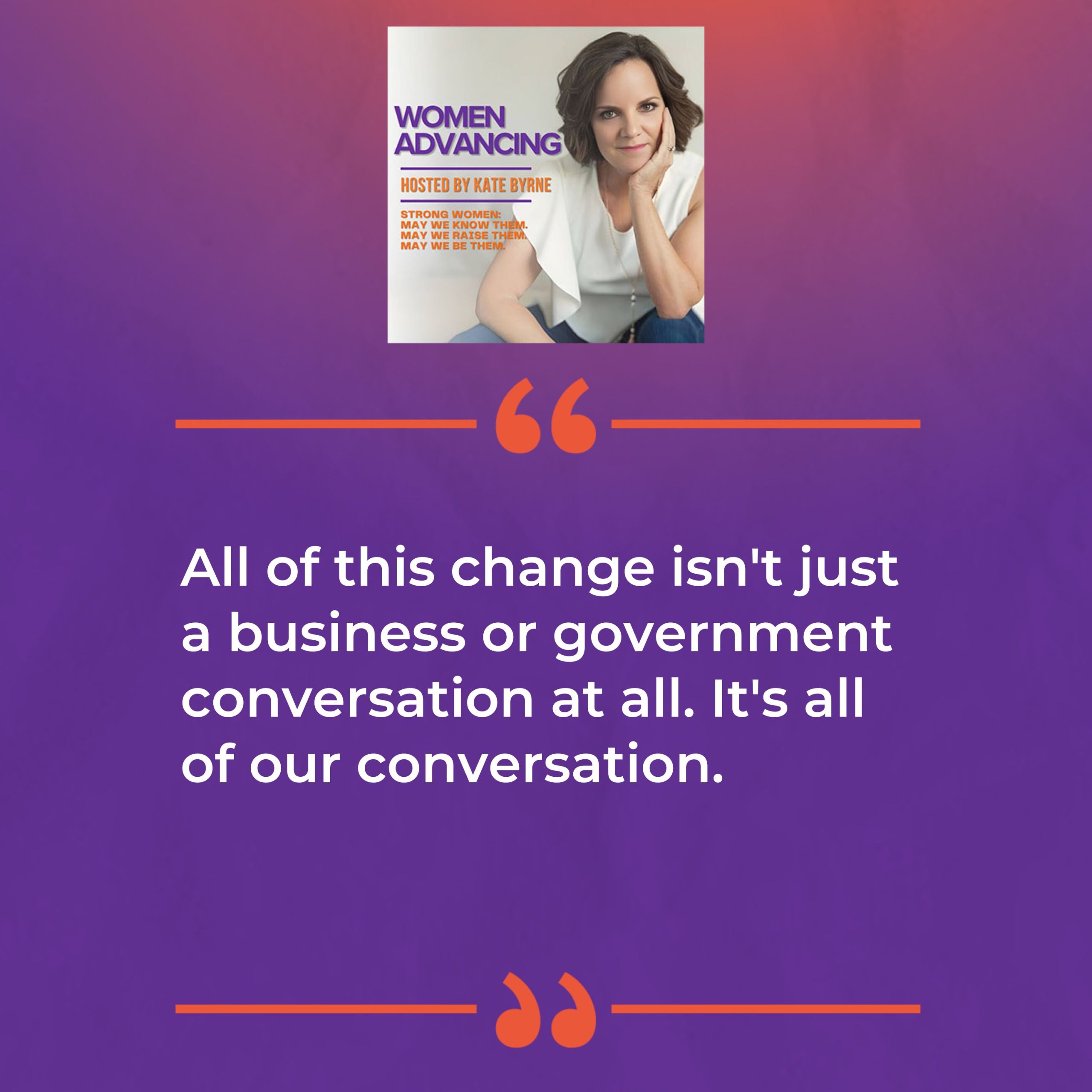
What does that mean? It means that, second takeaway, the future isn’t inevitable. It’s shaped by decisions. The policies and investments we make will influence our lives for decades to come. To ensure that all are informed, we need to remain transparent and informative and educate. Lastly, who participates matters. All of this change isn’t just a business or government conversation at all. It’s all of our conversation, such as citizens, communities, everybody. That also requires that we ourselves stay in the game and we exercise our voting, our judgment, our critical thinking, and we question when we have questions.
Frankly, we all have a stake in what comes next. With that, I will say thank you for joining me. I know you have so many other places you could be. I’m excited that I am one of them. Be you walking, running, driving, or simply hanging out. I appreciate your tuning in. Until the next time, Kate Byrne, Women Advancing.
Important Links
About Senator Creigh Deeds
 Senator Creigh Deeds has served in the Senate of Virginia since 2001 and represents the 11th District, which includes the Counties of Albemarle, Amherst, Louisa (part), and Nelson and the City of Charlottesville.
Senator Deeds serves on five standing committees and chairs the Senate Commerce and Labor Committee and the Health and Human Resources Subcommittee of the Senate Finance and Appropriations Committee. He sits on the Privileges and Elections, Rules, and Courts of Justice committees. He also chairs the Behavioral Health Commission and the Center for Rural Virginia Board of Trustees.
He is a member of the Joint Subcommittee on Tax Policy, the Energy Commission, the Joint Legislative Audit and Review Commission, and the Indigent Defense Committee. He is a lawyer in private practice.