
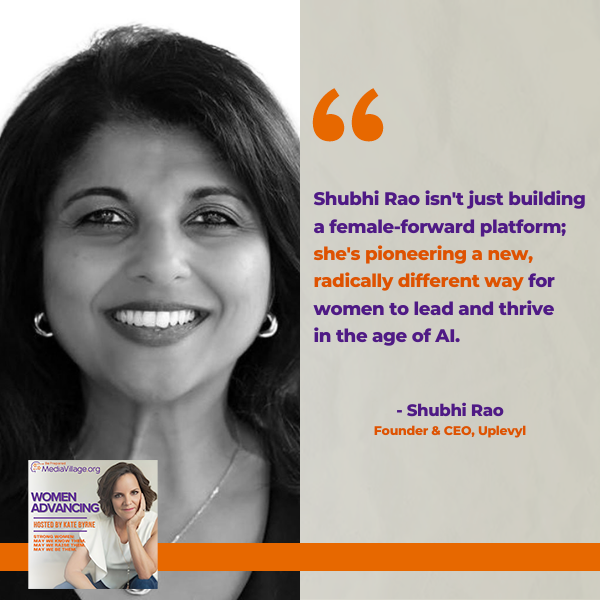
The convergence of women and Artificial Intelligence is not just a trend, it’s a revolution, and Shubhi Rao, Founder and CEO of Uplevyl, is leading the charge to close the AI gap with a platform built for women, by women. In this episode, host Kate Byrne sits down with Shubhi to unpack the game-changing work of Uplevyl, diving deep into how a “female forward lens” can transform the tech landscape and empower women across industries. Discover the realities of building with limited resources and high stakes, the nuances of leading in the AI age with both bots and humans in the mix, and why listening is just as crucial as serving when creating innovative platforms. We’ll also uncover practical advice for staying relevant in an AI-driven world, explore the importance of ethical AI, and get a sneak peek at the emerging jobs that will shape the future of work. This is an essential conversation for anyone passionate about seeing women thrive in the age of AI and shaping a more inclusive tech future. We close the gap here, we begin to close it everywhere.
—
Watch the episode here
Listen to the podcast here
Rewriting The Code: Female-Forward Innovation With Shubhi Rao, CEO And Founder Of Uplevyl
It’s your host, Kate Byrne, with Women Advancing. What happens when you mix AI, plus purpose, and the audacity to build something radically different, never been seen before, that presents female forward, that’s for women by women, and informed with data all about women? You get a platform like Uplevyl, and you get a leader like Shubhi Rao. On this episode of Women Advancing, I get to sit down with Shubhi, who’s a brilliant force behind Uplevyl, to talk about what it means to create a technology that centers around women across industries, life stages, and experiences, all with data that is specifically about them.
We dive into everything from ethical AI and conscious leadership to what women are asking for now, which is a huge lens into where we’re headed. We also explore the messy truths behind building with limited resources and high stakes, what it means to lead with both data and gut, and why the best platforms don’t just serve, they listen. We also talk about a few big future jobs coming down the road, mainly not necessarily the sexiest, but cyber cleaning, anyone? This one is for anyone who has ever looked at the status quo and thought, “We could do better than this.” We can, and Shubhi is. Jump on in and let me know what you think.
Shubhi Rao’s Journey: From Tech Expert To Founder Visionary
Shubhi Rao, founder and CEO of Uplevyl. Thank you so much for joining Women Advancing. We’re so excited to have you.
Thank you for having me. It’s a pleasure. I’m looking forward to this.
Shubhi, Jacki Zehner, and a whole host of characters in Uplevyl are doing amazing things that you’re going to be so excited to read about. Before we go there, I wanted to start with you. Especially, with something like Uplevyl, that comes after deep lived experience, a clear understanding, and an overview of what exists, what has been, what should be, and what’s missing in between. I’d love for you to share a bit about your journey and how you got to where you are right now.
You captured it perfectly in the sense that you don’t roll out of bed one day and show up here and just go, “I’m going to be a founder.” I always tell people that I’m one of those folks who did not become a founder or entrepreneur by design, but it’s the byproduct of what I wanted to do. There are two elements to it, at least for me. One is a combination of the attributes you have. In my case, I’m a problem solver, I’m a builder, and I like numbers. When you start to think about the pieces that are within you, that’s one set of data.
There are all those experiences that you’ve had along. As humans, we all tend to look at the world through the lens that we’re most familiar with or that we have the strongest bias for. The third piece is, “What did I do from an academic perspective? What was my training all about?” I trained to be a technologist, practiced as a technologist, combined that with finance, and ended up working for very large organizations from Ford to PwC to Tesco to Google Alphabet in the US and London for ten years.
There are lots of different experiences across different sectors, but at the same time, lots of different common denominators. One of the biggest common denominators, personally, was that I always straddled finance and technology projects. I had my day job being pure finance, but I also did a lot of fintech-related projects.
Some of them were small, and some of them were large. Some of them were internal. Some of them ended up being external projects. It was when I was in California, working for Google Alphabet, that I was working on some pretty good-sized fintech projects. I also had the responsibility to manage a $120 billion portfolio, where we were making the investments. Back then, around 2016 or 2017, you’re beginning to see so much investment going into AI. Now, AI has become such a common part of our vocabulary.
It’s been in our lives, but people were less aware of it.
The Gender Data Gap: AI’s Missing Piece
Spotify, Netflix, and Amazon, but we were not interacting directly. Generative AI has been a big game changer in that sense, but it got me thinking, “If AI is going to be such a big part of humanity, then where is gender data?” In the end, AI and the algorithms are only as good as their raw material. It has one single raw material, which is data. Long story short, here we are. Since you cannot go buy gender data, and I have the ability to go away and build both gender datasets and a technology platform as an application layer, and I wanted to fix this problem before it becomes a problem, I decided to go away and start to build this gender dataset.
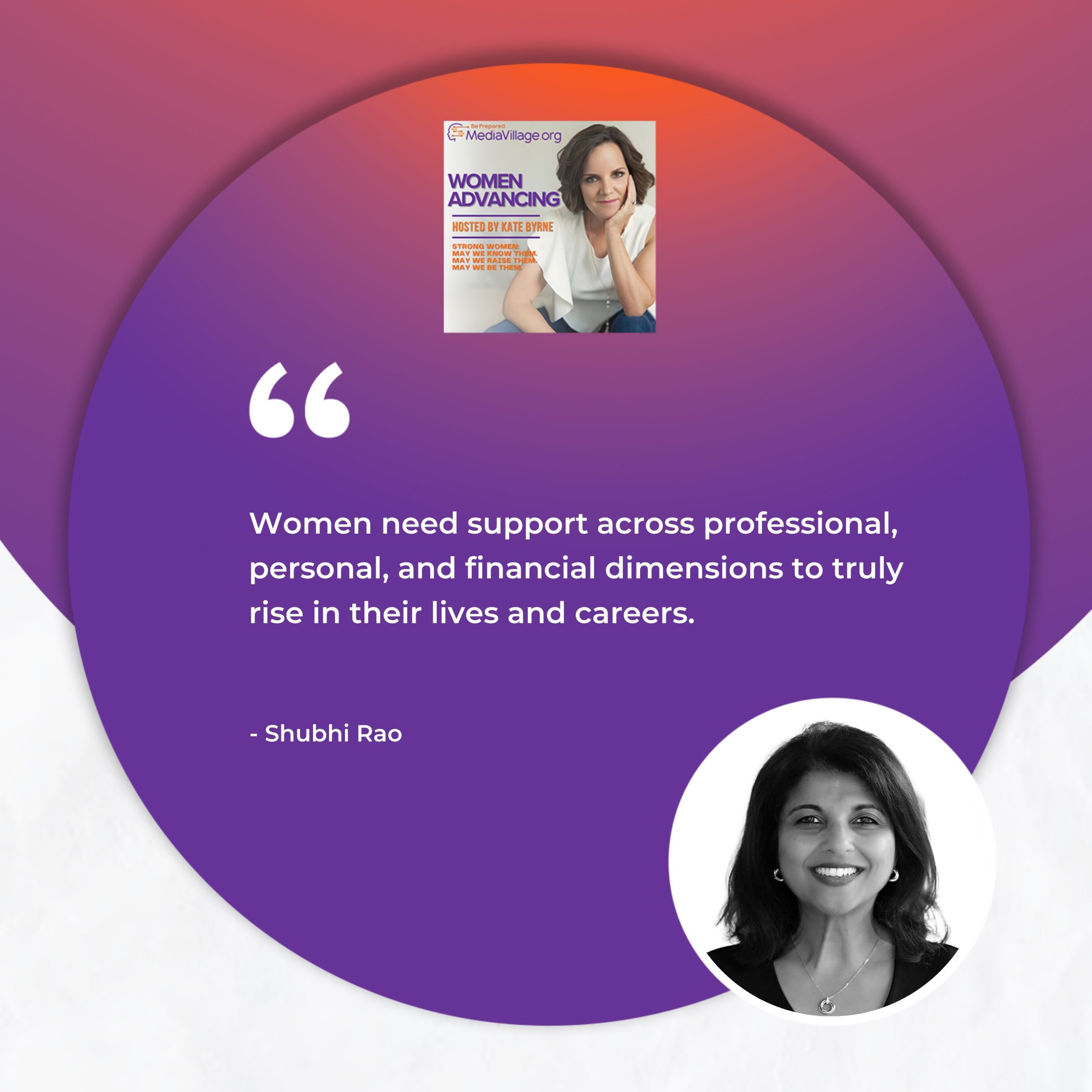
That’s one element of it, the gender dataset and the application. For me, the first application was, how do we support women professionally, personally, and financially? This comes back from my personal experiences. I don’t live in this little silo. It’s not like I go to work, and I can just pitch all my personal and financial responsibilities somewhere else. It’s all this whole baggage I carry with me, and I take that baggage all the way back home.
We need to be supported across all three dimensions if we’re going to rise in our lives, our careers, our wealth, etc. The first gender dataset that we built, our first party, came from working with hundreds of women like yourself, including physicians, lawyers, psychologists, and corporate board members. These are women who have deep domain expertise to help us across those various topics.
I was like, “What are we going to use this data for? What’s the first use case?” The first use case for me was that we need to partner with organizations that convene women. They could be corporates. They bring women together for the ERGs or the women’s employee population. There are women’s organizations that are professional networking organizations. There are nonprofits. In the US alone, there might be 20,000 plus such organizations. If we want to really accelerate, then, in this day and age, technology has to be a partner.
We could be doing it the way we do it, which is to use websites. Let’s use a plethora of tools. Those tools don’t talk to each other. There is a lot of dependency on human labor. That doesn’t work in today’s world. Here we are to power those women’s organizations through technology, but technology that’s powered by gender datasets.
There are two specific directions I want to go in a little bit. One is leadership, and the other is a mashup of tech and gender. I’m going to start with the leadership piece because I think that’s going to inform, especially the way I’m going to ask this next question. It’s informed how you’ve started and how you’re leading yourself. You have an amazing CV, a global CV, that has these extraordinary companies. Having been in leadership roles across all these Fortune 500 companies, what did you learn that you’re intentionally leaving behind when you’re building your own company? What’s the special sizzle that you realized, “That’s such a misconception. It’s wrong. We can end this cycle right here, right now?”
Redefining Leadership: Remote Work and Female Empowerment
Maybe COVID was a big catalyst for this. Being a woman and a mother with my share of unpaid work, it is this whole paradigm that you’ve got to have an office. You’ve got to have humans come in. There’s no perfect answer. I get it that there’s something to be said when you have humans together in a space. In my case, I work for very large organizations. Even though I went to the office every single day, I knew my little unit. I don’t even think I knew who was on the opposite side of the building on my own floor in the building, let alone on a massive Ford campus, a Google campus, a Tesco campus, or the PwC campus. No clue. Did I know my immediate team and my immediate function? Of course. How much time did I spend physically interacting with them?
I also feel like you lose out on the best because the way I build Uplevyl is getting the best talent. One of our data researchers is in Germany, and we have one of our AI colleagues in Canada. We have a pretty good set of folks who are India-based, but they’re not in one office. They’re all across India, and yet, there is a connective tissue through our culture that brings us together across our mission. The other thing that we have learned along the way is that when you build a company like this, it makes it more transparent in a funny way that it’s either going to work or it’s not going to work, versus when you are in an office building.
You can hide.
That’s the part I don’t understand. AI transcends everything, and yet we’re saying, “We can’t transcend a workforce. They all have to come into the office every day.” That feels so counterintuitive to me.
It’s very archaic. Talk about brick and mortar. It feels like it’s so stayed.
AI transcends everything, yet we say a workforce can't transcend the need to come to the office daily. That feels counterintuitive and archaic. Share on XThere are other ways. Once a quarter, everybody will come together for a week. You could do something like that. There are other ways to solve for the human connection, for sure. That is a better model for women as well and a better model for the planet, because I look back at the hours I spent commuting and flying. Maybe I could have used a lot of the time to be with my son, for example, or do other things.
You go from working at these large companies. You’re rolling your sleeves up. You have such a big vision. It is lucky for us that you have this bold vision. How do you lead when you’ve got this big, bold vision, resources are tight, and stakes feel personal because it’s your baby? It’s this idea you want to put to work. How do you lead when you’ve got champagne taste, but a beer budget and a whole lot of heart all intermixed in one recipe?
Human Touch In Tech: Balancing Vision, Resources, And AI Insights
You said something interesting, which is the mission. The mission that we are on has been one where I’ve had so many incredible people wanting to be part of this journey. You mentioned Jacki Zehner, for example. There are so many others. Jacki is important in many ways, but we’ve also had an incredible team that is so driven by the mission. It’s not that what we’re trying to do is so unique, but what is unique is that never have we thought about bringing the gender agenda and technology together. That is what folks find super interesting.
In some ways, you’re right. Life is not always about dollars and cents. Humans are sometimes motivated by the purpose, what they can do for you, and how they can be part of something that perhaps could be a legacy for them. I’ve been very fortunate. In the end, I would have to say that dollars and cents, and my investors, have come in and believe this was a power point. I’m blessed and grateful to them. When you said champagne and beer, that has to do with dollars and cents.
Life isn't always about dollars and cents; sometimes humans are really motivated by purpose and the chance to be part of something that could be a legacy. Share on XIt had the champagne with the champagne people. They can give me ten hours of their life, let’s say, but that’s worth a fortune. They’ve given me their expertise or experience or connected me to people, or opened doors for me. That’s social capital. It’s been so much bigger than any financial capital I could have had in many ways.
The more that I’ve introduced myself to Uplevyl, what I’m also realizing is it’s not only this interesting gender powered data informed AI for good example. Frankly, it’s also a new way of the way you describe your leadership of actually running a company. It’s such a terrific model for both of those things. We’re going to shift a little bit into the tech, and then we’ll get to do a deep dive into Uplevyl. It’s data-driven, which is great. As you talked about, that seems counterintuitive to me to do this. Do you see a tension between data-driven insights and human intuition, or are they more like dance partners that move with each other if you get out of their way?
Think about generative AI. You ask a question, and you get a response. “What is that?” Your query is data that’s going into the system. The response that’s coming out of that, whatever tool you’re using, is also data that’s coming back at you. It is not always numbers. In this case, it’s text, but don’t take it as gospel. This is why human intuition, judgment, critical thinking, logical thinking, and analytical thinking are super important, because you still need to go and look at their response and see if this makes sense. You need to figure out how to validate it.
You use your judgment to go, “That sounds about right,” or “It doesn’t sound right.” Data-informed decisions are only as good as the quality of the data going into the systems. There could be lots of data quality issues, like not enough data, broken data, and not necessarily the most relevant data that you need for the particular application. That’s where the human brain has to assess that.
Uplevyl Unveiled: AI, Community, And Purpose-Driven Tech
Unveil a bit about Uplevyl because I think it’s a terrific thing. It’s built around this whole idea of advancing women through AI and the community. It’s purpose-driven, and it’s this powerful tech platform built together with the community. Talk a little bit about all of that.
In some ways, what we’re trying to do is turbocharge the work of millions of women who are doing this. Women are working across so many different areas to change the discourse around, whether it’s women and climate, reproductive rights, pay gap, leadership gap, or policies. There are so many topics. Millions of women are employed and have given their lives to this. Let’s look at technology. Technology has never been built for us. Nobody is rolling out of bed going, “I wonder how this works out for women.”
We also know that because of where big tech is today, so many women are fleeing many of these platforms because these platforms have become overly sexist, misogynistic, and all of the above. If you want to further the agenda of all these millions of women who are doing all this good work, where is their technology partner? Can you imagine going into any company in corporate America and them not having tech? Tech is part of our toolkit. Technology was never built going, “We should build it through a female-forward lens.” That is what Uplevyl does.
Technology needs algorithms. We are AI first. We started a few years ago. You need the gender datasets that we built, but that gender dataset is only one ring of the entire data stack. Eventually, it will be great to aggregate all the gender data we have in one place so that women can then access that dataset for their different applications that they want to build. There is this truly shared resource. When I say gender dataset, that is the collective brain trust of us women. What is happening is that data is being extracted and exploited by big tech for advertising dollars. That’s one.
Today, big tech extracts and exploits data for advertising dollars. Share on XTwo is the ethos. A big ethos is that safety, privacy, and data minimalism are at the center or the forefront. It’s not something we slap on later. It’s in our DNA. It’s how we build. The first line of code we write is written from that perspective to protect our members. When I say our members, they are the members of those amazing women’s organizations, whether they’re corporations, nonprofits, professional women’s networks, etc.
We have three, or I would say a multi-tenancy architecture. Think of it like a condominium complex. Why? It’s because we women collaborate. When I say we’re female-forward, our tech has to reflect that. How does it reflect that? I wanted a technology platform whereby organizations could have their own condos. They can also connect, share across those condos, share their resources, and be much smarter. Not only do we then have a gender dataset that is reflective of our collective brain trust, but we can also dynamically and actively share our resources. We have one product that we launched, which is called Up. Think of Up like Twitter or X and Bluesky, but for women.
That is now in its first phase, and we’re still building our features as fast as we can. We also have the hubs. These are the hubs to house the various organizations’ communities where they want to convene their women. I’ll come to that particular application here in a second. The third one was born from a place of recognizing, after speaking at many different events. Women were coming after the event and having these conversations with me around trusting AI and the fear of AI. There are many forces out there, but they’re dry and boring. They’re not exactly accessible. This accelerator is an eight-module program to help women gain a holistic understanding of AI. How do I show up as a digital leader? How do I work in a team that is transforming? Our team could be humans and digital colleagues.
It’s shifting. You have to shift your leadership style. Earlier, you asked me if that’s another big shift that has happened. How do I think about redesigning processes? What does AI and ethics mean? What are the risks? I don’t mean like the internal risks and biases, but also cyber risks. When you have data all scattered across a company, it is not a good thing from a cyber perspective. When you imagine you pull all that data together in one place, you’ve created a huge concentration of risk for data.
Understanding that, we have put a curriculum together. It’s not only, “Come in and listen to the webinar. Have a nice day.” It’s all the other modalities, like hands-on use cases, different kinds of prompts, books, movies, and podcasts. It’s an interesting toolkit for each module as well. Each one of us learns differently. It’s being able to deliver the same topic but in different modalities.
I worked with the George Lucas Educational Foundation. The whole thing was opening the world up to this idea that there are at least six different ways that people learn. For those who don’t normally learn one way, it activates your brain to receive the information in different ways. It makes you more of a systemic thinker as opposed to Newtonian. The whole notion of ethical tech and some people say conscious AI is an oxymoron. What are the red flags people need to avoid? As you said, you’ve got to be aware that on the one hand, old school, you want to collect all your data in one place, but that opens you up to such vulnerability. Are there other red flags to avoid?
Ethical AI: Avoiding Red Flags And Uncovering Data Stories
Before you aggregate the data, you need to look at the historical data and understand it. Especially if you’re using data for decision-making, you’re using data for lending purposes. Historically, that dataset is included, even if you changed policies later on down the road. If that historical dataset included was discriminatory or declined certain races or certain genders, and that’s the dataset that’s going to fuel your algorithms, then guess what’s going to happen on the predictive analytics side. When I say ethical AI, a big part of it is the story in the data that’s training those algorithms.
No one talks about it from that angle. It’s more outcome-oriented as opposed to input that’s going to lead to that output because it’s like, “It seems like it’s human,” because it takes it back to the root, the origin issue.
We are talking about the foundational models. ChatGPT, Gemini, and Llama are the big foundational models we have. They were primarily trained on the data on the internet. Maybe in Google’s case, it’s search. Maybe in Llama’s case, it’s all the Facebook expert data. Regardless, that is the data. Having said that, I always say there are two sides to that coin. One is that the algorithm itself has the ability to predict and put one word after another. That is such a massive breakthrough. The application is going to be huge in a good way.
The flip side of that, though, is that it also took all the data off the internet. The internet reflects our society. It’s 500 billion to 700 billion tokens. A token is the smallest unit of data that you could use. Stringing 6 to 8 words is probably a token. Cleaning that is impossible. Where do you begin? There’s all this user-generated content, machine-generated content, and published content that would cost billions of dollars.
When you needed those kinds of datasets to train, it also happened that we were using the dataset for creating content. We need to be aware and be thoughtful about how we’re using those. What’s happening is people are using the computational models from a lot of these large organizations, but pointing them to their dataset, which is great, as long as you make sure that your dataset is cleansed. This is where a lot of new jobs are going to emerge, by the way.
People were thinking, “Be a prompt manager.” That’s going to be nothing. What you’re talking about, sadly, is job security.
It’s not like the data is static. Even you and I talking right now, we are creating data.
I’ve got to ask. We were talking a little bit about, “You might be managing people and bots.” I sit there and think about that because we all have issues with working intergenerationally, everyone going up or going down, there are challenges, whatever. Have you ever managed a bot yet?
We do. This is one of the things people ask us, which is how Uplevyl is so lean in many ways. We are at the forefront of what is happening today in that we only use humans when we need to use humans. We use all kinds of tools and bots where we don’t need a human. For example, doing a lot of our quality work before we publish our code, basically to go through the quality of the code. We use a lot of bots. What’s interesting, too, about these tools is that, while we haven’t implemented this yet, imagine your colleagues are also these digital colleagues. They give you a 360 at the year-end. These colleagues don’t forget anything. They’re not designed. They work 24/7. They have a memory.
It’s evergreen.
It is very different than when I have to do a 360 for somebody. I have to go back and remember all my interactions. I’m not sitting there all day long, writing every single interaction I had with my colleagues. It changes the dynamics, too, in terms of the workplace.
I was talking to a friend with regards to the future of work, about how it actually can flatten an organization and change a lot of those hierarchical challenges. The other thing that struck me when you were talking about “never forgets” is this notion of impact feedback. Throughout the history of work, it has always been such a big issue for people to receive feedback and be able to counter it. With something like this, they’ll have all the data right there.
As software engineers, we get a report right then and there. “This code was great. This was not.” You can see. As opposed to back in the day, your supervisor would take a look at it or somebody else, or you would have peer reviews. That’s what I’m saying. A peer review is done by another digital colleague literally in seconds.
It can impersonalize a lot of it. That piece makes it so much more factual, which I’m completely comfortable with. That makes a lot of sense. Explain to everybody a little bit about how they can participate or get involved, because I think it’s interesting how you’re building out the different hubs.
On the App Store or Play Store, there’s Uplevyl Social. Download Uplevyl Social, and you can join Up. Up is the Twitter for women. When you have a women’s community, there is a lot of time, money, and energy spent on human labor, plus a plethora of tools, which creates a lot of inefficiencies and costs. You’re trying to build out these communities. You want to acquire them. You want to retain them. You want to grow. You need to come up with a business model, whether it’s a subscription model or it’s donor-based. You need the data to show the value proposition of what you’re doing.
What we are working towards is being able to provide technology to women so that they can could be sleeping and their communities are growing. Download the Uplevyl Hub, and you get two digital employees, basically the agents, to be your community manager and your operations analyst. Between the two of them, they figure out everything. Within the hubs, you have the ability for people to discover, connect, and network. You have the ability to get highly personalized resources, either our content or your content that you want to publish in a video format, audio format, or text. We also have our own generative AI tool called Uplevyl Genie.
What we're working towards is providing technology to women. Share on XYou can ask Genie any questions. Genie will provide you with responses. The next release should be able to provide you with video suggestions, book suggestions, and people you can connect with. The whole idea is that Genie is supposed to be this wise woman. It’s no different if I had this conversation with you, Kate, and I’d be like, “Can you help me with this?” You would be, “Here’s my advice. Let me connect you with three other women. Did you read this book? Did you watch the film? That was a great podcast, Shubhi.” That conversation we have is exactly how Genie has been designed. It’s after thousands of these kinds of interactions that Genie has been trained on so that Genie can be that wise woman to help women.
What Women Want Now: Relevance, Inclusion, And AI Literacy
Along those lines, in terms of asking Genie or asking someone for help, what are women asking for that they weren’t five years ago? What does that tell you about where we’re headed? I think it’ll be really interesting with regards to Uplevyl, too, because it stands the opportunity for me to shine a light and a beacon for what’s coming up.
I can give you a few data points. As we built up the accelerator and we reached out to women, maybe a few hundred women responded to this dataset. The number one thing that was on there was, “How do I stay relevant in this AI age?” It is a big question, top of mind for a lot of women. I wonder if that is because we have a lot of data that says 300 million or so women will lose jobs, but at the same time, there are going to be new jobs that are going to be emerging that we haven’t even thought of. It is a very valid question. With the jobs, the low-hanging fruit that are perfect for automation happen to be a lot of operations roles or administrative roles. Those tend to be dominated by women. I can understand that concern and worry around, “How do I stay relevant?” That is one thing.
Second is they also recognize they do need the technology, but the present platforms are not serving their needs. If you go to the Uplevyl website, you will see that there was a survey that was done. There’s been a big exodus of women off a lot of these different platforms because they can’t be themselves or you’re on this platform, but it can’t be active. You’re scrolling passively. Your voices are automatically silenced and muted.
That’s where AI can make that difference. You were sharing that stat. Would you share it with everyone else about it, and is it only 30% or 34% of women who are using AI?
I’m only talking about the generative AI piece of it. That gap is widening because there are only about 37% or so of women who are using generative AI. There are about 50% or more men. If you unpack the data, and I want to do more of this work, men appear to be using it more from a work perspective and professional perspective, whereas we might be using it more from a personal perspective, like, “Help me figure out whatever it might be.” Using it in those applications in the workplace is going to be even stronger if we can. That’s the generative AI piece of that equation. I always say that generative AI does not equal AI. AI is a much broader field than that.
Another big field is robotics. Let’s use robotics for a second, because we are an aging population, and we don’t have enough people. Logistics is a good example. I saw something super interesting on tiles. To get people to come in and lay tile is becoming expensive and very difficult. There are these incredible robots that, first of all, lay tile beautifully, far more productively. They can work 24/7 if you want to. It’s perfection. A tile maker may lose their job, but a whole new set of jobs is coming up, which will be repairing those robots and maintaining those robots. We women start to think about, “What’s happening in the broader AI world? Where could I insert myself in this big shift that’s happening?”
How can I embrace, pioneer, direct, and guide it? I also believe in women getting a bit more involved. I feel the same way about media, too. With women’s voices guiding it, it stands a better shot out of the gate to be a little bit more even-handed. At least I’d like to think about that and maybe celebrate not only drive and ambition, but also empathy and some of the softer, really powerful attributes.
What we’re going to need more of is empathy, critical thinking, and collaboration. More than ever, it’s just not humans. You have to figure out how to collaborate with a digital colleague and a human colleague or lead a mixed team like that. These are skills that are more innate to women.
What you’re making me think about, too, is if I had a team of those, it helps clarify that these are the more manual, administrative kind of nitty-gritty things that some people love doing, but it enables people to be more human.
In some ways, it will push us to be more human than we’ve ever been because we could rely on another human. I knew you could pick up, but what do I do with a digital colleague?
What we're going to need more of is empathy, critical thinking, and collaboration. Because now more than ever, you have to figure out how to collaborate with both a digital and a human colleague, or lead a mixed team. These are skills that are more… Share on XShubhi’s Advice To Her Younger Self: Milestones, Not Destinations
In closing, I have a question. Last question. I always ask this question. What advice would you give your younger self, knowing what you know now?
There’s so much I would tell this younger self for sure. From kindergarten, through elementary school, middle school, high school, college, and then this, you always feel like it’s a destination. I’ve got to get to this destination. In the end, there isn’t an essence. This concept of a destination is crazy because that doesn’t exist. What it is is milestones. That’s how I think about building Uplevyl. As you said, big vision.
We know what coming together means and what we’re going to be able to do. If I sat there and thought about a destination, I would have a heck of a time waking up in the morning because it’s almost too overwhelming. It is a small milestone. What do we need to get done this week or this month? Celebrate that, and then that’s it. We go to the next one. That’s what I would tell my younger self should be.
It doesn’t have to always be these huge, big ones. That’s also how you end up getting a lot of overwhelm.
You get so wrapped up in the destination. Let’s say you have a million customers. You’re trying to figure out, “I’ve got to figure out how to handle a million customers.” Why don’t we start with the first ten and see if we can get the ten going? We can then go to the 100, then we can go to the 1,000. Hit those milestones and do those well. Eventually, we’ll get to the million as well, than if I just sat there, thinking about solving problems for many women.
The concept of a destination is crazy because it doesn't really exist. What truly exists are milestones. Share on XIt is over before it started. I would run for the hills. It’s so true. Shubhi, thank you so much. I could go on. I look forward to watching this grow. I want to be in one of those hubs. We’ll talk about that because I think it would be a fun thing for the Women Advancing group and so many others. I will do whatever I can to help support you because it is wonderful to have a platform built for women with women, literally together with women and technology.
I’ve always thought that if we have a bigger digital divide, especially in the AI age, we’re going to have even a bigger economic divide.
This can be one way to go about that. Shubhi, thank you so much. I appreciate you joining us.
Thank you. It flew by.
We’ll see you next time.
—
I could have continued that conversation for a long time. What Shubhi Rao and her team are building over at Uplevyl is going to be such a game changer. I hate to use that term, but that is what it’s going to be. The piece that I love, and the reason why I’m so confident with it, is that it’s being built by a woman who comes from the tech world and is taking the things that worked and then fixing the things that didn’t. What I realized with Uplevyl is that it is not only a female-first lens platform, but it’s also enabling and empowering women to do a new way of leading. That’s one takeaway.
Here is takeaway two. We all complain about managing across cultures, across time zones, and across different generations. We’re about to get into it when we have to manage, be it a bot or humans. That’s a fascinating thing. The last piece I enjoyed was this notion that the social capital is becoming much more put to use in the building of Uplevyl, the platform, and the community around it.
Jobs involve being on the lookout for doubling down on cyber risk and being someone who makes sure that you are cleaning. Being the data cleaner does not sound attractive, but I guarantee you it will be very profitable. There’s a lot to think about. There’s a lot to be excited about moving forward, and how women like Shubhi and her team are helping women advance. Until next time. I’m Kate Byrne. Thanks very much.
Important Links
- Uplevyl
- Shubhi Rao on LinkedIn
- Jacki Zehner’s Website
- Introducing the First Female-Forward Social Platform
- Uplevyl – Join Future Forward Now
- George Lucas Educational Foundation
About Shubhi Rao
 Shubhi Rao is the founder and CEO of Uplevyl, an innovative AI-driven technology platform.
Shubhi holds a Bachelor of Science degree in Computer Science Engineering from Michigan State University and an MBA from the University of Michigan, Ann Arbor. Her career began in engineering before she transitioned into executive roles at major corporations including Alphabet/Google, Tesco, PwC, Tyco, and Ford.
Notably, she made history as the first woman and person of color to serve as Officer and Treasurer at both Alphabet/Google and first woman and person of color to serve as Assistant Treasurer of Ford of Europe and Treasurer of Tesco PLC. In addition to her role at Uplevyl, Rao serves on the Board of Open Lending Corp, and the Center for Global Development.
Shubhi is outspoken regarding how technology is influencing money and power dynamics in society. She expresses concern that much of the technology being developed is predominantly created by men, which could perpetuate biases inherent in data and algorithms.
Shubhi warns that this trend may lead to not only a digital divide but also significant economic and authority divide. To combat this, she advocates for women not just to utilize technology but to actively participate in its creation and usage to ensure that technology reflects the perspectives and voices of women, thereby fostering a more inclusive and equitable technological landscape.
Shubhi frequently speaks at events focused on female leadership, AI and technology, sharing insights on how AI can be utilized to foster inclusive environments that support women’s advancement in various industries. Her contributions have earned her recognition as a leader in building technology to create inclusivity in society. Shubhi is married, has a young adult son and lives in Austin, Texas.